

Characterization of University Residential and Canteen …
195
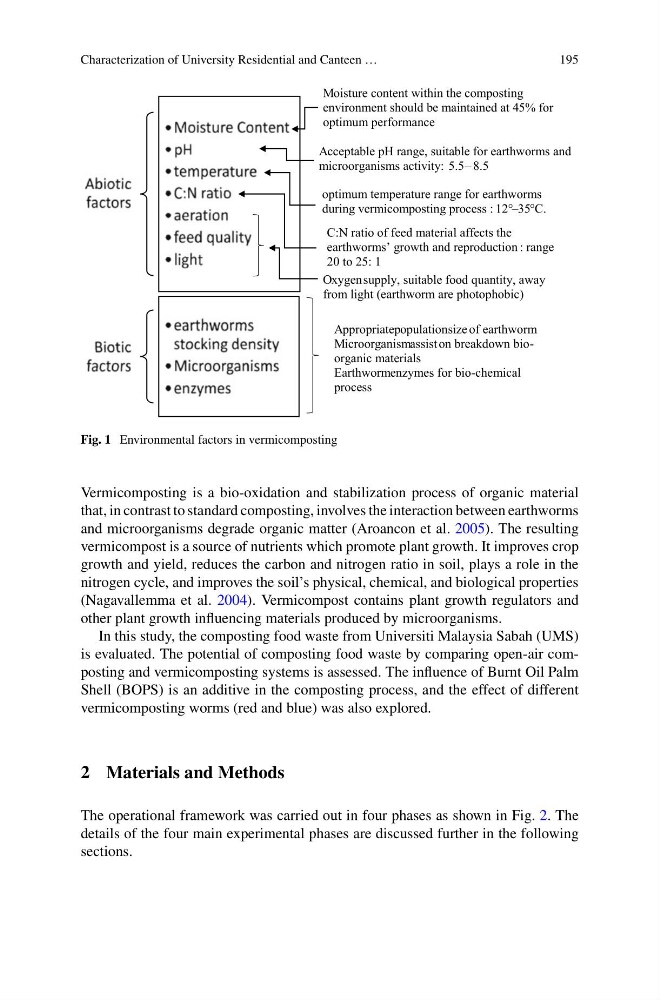
Moisture content within the composting
environment should be maintained at 45% for
optimum performance
Acceptable pH range, suitable for earthworms and
microorganisms activity: 5.5– 8.5
optimum temperature range for earthworms
during vermicomposting process : 12°–35°C.
Oxygen supply, suitable food quantity, away
from light (earthworm are photophobic)
C:N ratio of feed material affects the
earthworms’ growth and reproduction : range
20 to 25: 1
Appropriate population size of earthworm
Microorganism assist on breakdown bioorganic materials
Earthwormenzymes for bio-chemical
process
Fig. 1 Environmental factors in vermicomposting
Vermicomposting is a bio-oxidation and stabilization process of organic material
that, in contrast to standard composting, involves the interaction between earthworms
and microorganisms degrade organic matter (Aroancon et al. 2005). The resulting
vermicompost is a source of nutrients which promote plant growth. It improves crop
growth and yield, reduces the carbon and nitrogen ratio in soil, plays a role in the
nitrogen cycle, and improves the soil’s physical, chemical, and biological properties
(Nagavallemma et al. 2004). Vermicompost contains plant growth regulators and
other plant growth influencing materials produced by microorganisms.
In this study, the composting food waste from Universiti Malaysia Sabah (UMS)
is evaluated. The potential of composting food waste by comparing open-air composting and vermicomposting systems is assessed. The influence of Burnt Oil Palm
Shell (BOPS) is an additive in the composting process, and the effect of different
vermicomposting worms (red and blue) was also explored.
2 Materials and Methods
The operational framework was carried out in four phases as shown in Fig. 2. The
details of the four main experimental phases are discussed further in the following
sections.
195
Moisture content within the composting
environment should be maintained at 45% for
optimum performance
Acceptable pH range, suitable for earthworms and
microorganisms activity: 5.5– 8.5
optimum temperature range for earthworms
during vermicomposting process : 12°–35°C.
Oxygen supply, suitable food quantity, away
from light (earthworm are photophobic)
C:N ratio of feed material affects the
earthworms’ growth and reproduction : range
20 to 25: 1
Appropriate population size of earthworm
Microorganism assist on breakdown bioorganic materials
Earthwormenzymes for bio-chemical
process
Fig. 1 Environmental factors in vermicomposting
Vermicomposting is a bio-oxidation and stabilization process of organic material
that, in contrast to standard composting, involves the interaction between earthworms
and microorganisms degrade organic matter (Aroancon et al. 2005). The resulting
vermicompost is a source of nutrients which promote plant growth. It improves crop
growth and yield, reduces the carbon and nitrogen ratio in soil, plays a role in the
nitrogen cycle, and improves the soil’s physical, chemical, and biological properties
(Nagavallemma et al. 2004). Vermicompost contains plant growth regulators and
other plant growth influencing materials produced by microorganisms.
In this study, the composting food waste from Universiti Malaysia Sabah (UMS)
is evaluated. The potential of composting food waste by comparing open-air composting and vermicomposting systems is assessed. The influence of Burnt Oil Palm
Shell (BOPS) is an additive in the composting process, and the effect of different
vermicomposting worms (red and blue) was also explored.
2 Materials and Methods
The operational framework was carried out in four phases as shown in Fig. 2. The
details of the four main experimental phases are discussed further in the following
sections.