

166
J. Jayaprakash and H. Jagadeesan
2.3 Waste Management and Methods of Waste Disposal
Waste minimization is one of the major thrusts of waste management. Student activities could focus on reducing the waste generated. Another aspect is reuse. If student
groups can plan for supporting needy with the excess food or donating their clothing
and other reusable accessories to the needy or reusing papers, the much needed minimization of waste requiring treatment will be achieved. An ideal waste management
technique should be simple, cost-effective and easily scalable and comply with the
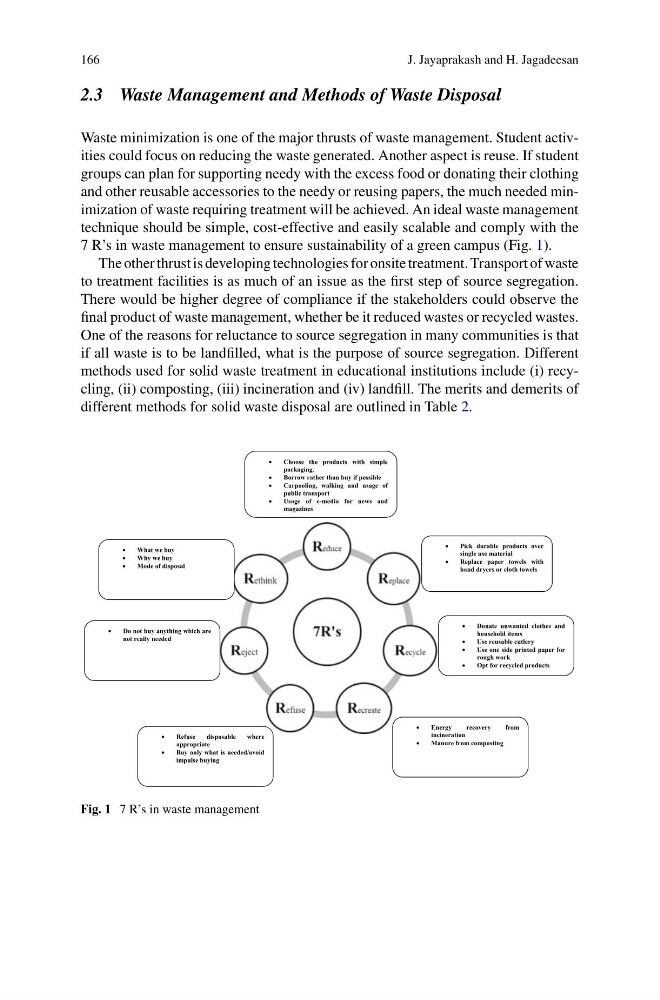
7 R’s in waste management to ensure sustainability of a green campus (Fig. 1).
The other thrust is developing technologies for onsite treatment. Transport of waste
to treatment facilities is as much of an issue as the first step of source segregation.
There would be higher degree of compliance if the stakeholders could observe the
final product of waste management, whether be it reduced wastes or recycled wastes.
One of the reasons for reluctance to source segregation in many communities is that
if all waste is to be landfilled, what is the purpose of source segregation. Different
methods used for solid waste treatment in educational institutions include (i) recycling, (ii) composting, (iii) incineration and (iv) landfill. The merits and demerits of
different methods for solid waste disposal are outlined in Table 2.
Pick durable products over
single use material
Replace paper towels with
hand dryers or cloth towels
Donate unwanted clothes and
household items
Use reusable cutlery
Use one side printed paper for
rough work
Opt for recycled products
Energy
recovery
from
incineration
Manure from composting
Refuse
disposable
where
appropriate
Buy only what is needed/avoid
impulse buying
Do not buy anything which are
not really needed
What we buy
Why we buy
Mode of disposal
Choose the products with simple
packaging.
Borrow rather than buy if possible
Carpooling, walking and usage of
public transport
Usage of e-media for news and
magazines
Fig. 1 7 R’s in waste management
J. Jayaprakash and H. Jagadeesan
2.3 Waste Management and Methods of Waste Disposal
Waste minimization is one of the major thrusts of waste management. Student activities could focus on reducing the waste generated. Another aspect is reuse. If student
groups can plan for supporting needy with the excess food or donating their clothing
and other reusable accessories to the needy or reusing papers, the much needed minimization of waste requiring treatment will be achieved. An ideal waste management
technique should be simple, cost-effective and easily scalable and comply with the
7 R’s in waste management to ensure sustainability of a green campus (Fig. 1).
The other thrust is developing technologies for onsite treatment. Transport of waste
to treatment facilities is as much of an issue as the first step of source segregation.
There would be higher degree of compliance if the stakeholders could observe the
final product of waste management, whether be it reduced wastes or recycled wastes.
One of the reasons for reluctance to source segregation in many communities is that
if all waste is to be landfilled, what is the purpose of source segregation. Different
methods used for solid waste treatment in educational institutions include (i) recycling, (ii) composting, (iii) incineration and (iv) landfill. The merits and demerits of
different methods for solid waste disposal are outlined in Table 2.
Pick durable products over
single use material
Replace paper towels with
hand dryers or cloth towels
Donate unwanted clothes and
household items
Use reusable cutlery
Use one side printed paper for
rough work
Opt for recycled products
Energy
recovery
from
incineration
Manure from composting
Refuse
disposable
where
appropriate
Buy only what is needed/avoid
impulse buying
Do not buy anything which are
not really needed
What we buy
Why we buy
Mode of disposal
Choose the products with simple
packaging.
Borrow rather than buy if possible
Carpooling, walking and usage of
public transport
Usage of e-media for news and
magazines
Fig. 1 7 R’s in waste management