

Sustainable Waste Management in Higher Education ...
165
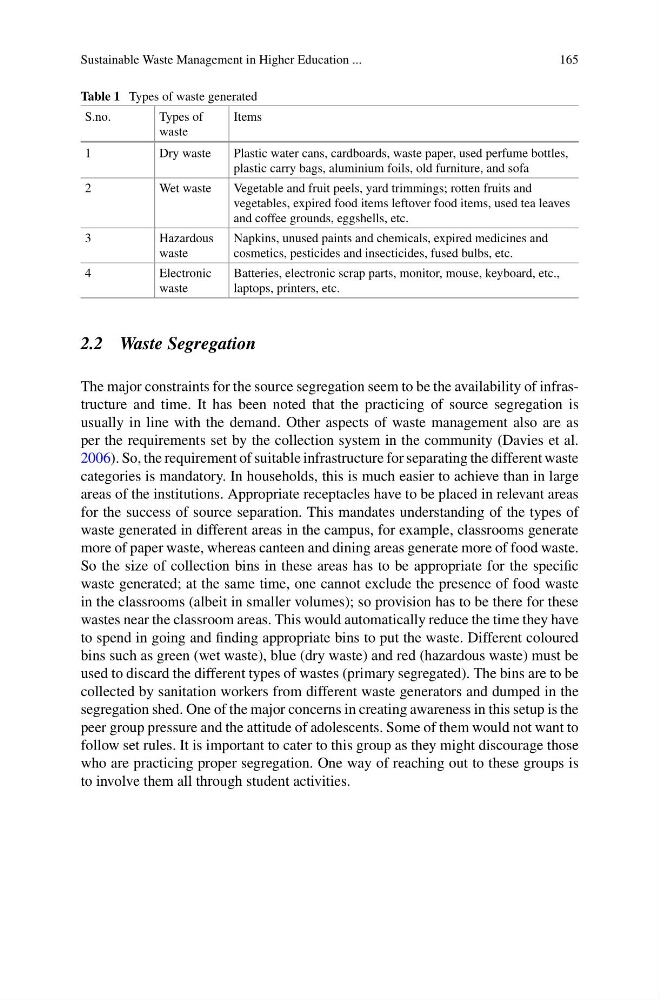
Table 1 Types of waste generated
S.no.
Types of
waste
Items
1
Dry waste
Plastic water cans, cardboards, waste paper, used perfume bottles,
plastic carry bags, aluminium foils, old furniture, and sofa
2
Wet waste
Vegetable and fruit peels, yard trimmings; rotten fruits and
vegetables, expired food items leftover food items, used tea leaves
and coffee grounds, eggshells, etc.
3
Hazardous
waste
Napkins, unused paints and chemicals, expired medicines and
cosmetics, pesticides and insecticides, fused bulbs, etc.
4
Electronic
waste
Batteries, electronic scrap parts, monitor, mouse, keyboard, etc.,
laptops, printers, etc.
2.2 Waste Segregation
The major constraints for the source segregation seem to be the availability of infrastructure and time. It has been noted that the practicing of source segregation is
usually in line with the demand. Other aspects of waste management also are as
per the requirements set by the collection system in the community (Davies et al.
2006). So, the requirement of suitable infrastructure for separating the different waste
categories is mandatory. In households, this is much easier to achieve than in large
areas of the institutions. Appropriate receptacles have to be placed in relevant areas
for the success of source separation. This mandates understanding of the types of
waste generated in different areas in the campus, for example, classrooms generate
more of paper waste, whereas canteen and dining areas generate more of food waste.
So the size of collection bins in these areas has to be appropriate for the specific
waste generated; at the same time, one cannot exclude the presence of food waste
in the classrooms (albeit in smaller volumes); so provision has to be there for these
wastes near the classroom areas. This would automatically reduce the time they have
to spend in going and finding appropriate bins to put the waste. Different coloured
bins such as green (wet waste), blue (dry waste) and red (hazardous waste) must be
used to discard the different types of wastes (primary segregated). The bins are to be
collected by sanitation workers from different waste generators and dumped in the
segregation shed. One of the major concerns in creating awareness in this setup is the
peer group pressure and the attitude of adolescents. Some of them would not want to
follow set rules. It is important to cater to this group as they might discourage those
who are practicing proper segregation. One way of reaching out to these groups is
to involve them all through student activities.
165
Table 1 Types of waste generated
S.no.
Types of
waste
Items
1
Dry waste
Plastic water cans, cardboards, waste paper, used perfume bottles,
plastic carry bags, aluminium foils, old furniture, and sofa
2
Wet waste
Vegetable and fruit peels, yard trimmings; rotten fruits and
vegetables, expired food items leftover food items, used tea leaves
and coffee grounds, eggshells, etc.
3
Hazardous
waste
Napkins, unused paints and chemicals, expired medicines and
cosmetics, pesticides and insecticides, fused bulbs, etc.
4
Electronic
waste
Batteries, electronic scrap parts, monitor, mouse, keyboard, etc.,
laptops, printers, etc.
2.2 Waste Segregation
The major constraints for the source segregation seem to be the availability of infrastructure and time. It has been noted that the practicing of source segregation is
usually in line with the demand. Other aspects of waste management also are as
per the requirements set by the collection system in the community (Davies et al.
2006). So, the requirement of suitable infrastructure for separating the different waste
categories is mandatory. In households, this is much easier to achieve than in large
areas of the institutions. Appropriate receptacles have to be placed in relevant areas
for the success of source separation. This mandates understanding of the types of
waste generated in different areas in the campus, for example, classrooms generate
more of paper waste, whereas canteen and dining areas generate more of food waste.
So the size of collection bins in these areas has to be appropriate for the specific
waste generated; at the same time, one cannot exclude the presence of food waste
in the classrooms (albeit in smaller volumes); so provision has to be there for these
wastes near the classroom areas. This would automatically reduce the time they have
to spend in going and finding appropriate bins to put the waste. Different coloured
bins such as green (wet waste), blue (dry waste) and red (hazardous waste) must be
used to discard the different types of wastes (primary segregated). The bins are to be
collected by sanitation workers from different waste generators and dumped in the
segregation shed. One of the major concerns in creating awareness in this setup is the
peer group pressure and the attitude of adolescents. Some of them would not want to
follow set rules. It is important to cater to this group as they might discourage those
who are practicing proper segregation. One way of reaching out to these groups is
to involve them all through student activities.