

116
S. Krishnan et al.
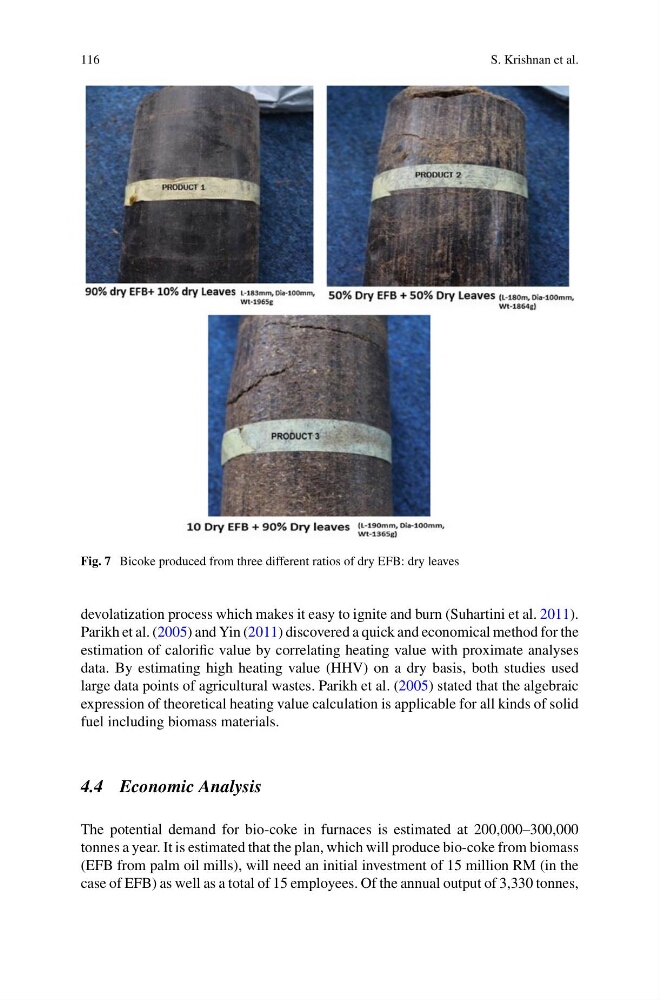
Fig. 7 Bicoke produced from three different ratios of dry EFB: dry leaves
devolatization process which makes it easy to ignite and burn (Suhartini et al. 2011).
Parikh et al. (2005) and Yin (2011) discovered a quick and economical method for the
estimation of calorific value by correlating heating value with proximate analyses
data. By estimating high heating value (HHV) on a dry basis, both studies used
large data points of agricultural wastes. Parikh et al. (2005) stated that the algebraic
expression of theoretical heating value calculation is applicable for all kinds of solid
fuel including biomass materials.
4.4 Economic Analysis
The potential demand for bio-coke in furnaces is estimated at 200,000–300,000
tonnes a year. It is estimated that the plan, which will produce bio-coke from biomass
(EFB from palm oil mills), will need an initial investment of 15 million RM (in the
case of EFB) as well as a total of 15 employees. Of the annual output of 3,330 tonnes,
S. Krishnan et al.
Fig. 7 Bicoke produced from three different ratios of dry EFB: dry leaves
devolatization process which makes it easy to ignite and burn (Suhartini et al. 2011).
Parikh et al. (2005) and Yin (2011) discovered a quick and economical method for the
estimation of calorific value by correlating heating value with proximate analyses
data. By estimating high heating value (HHV) on a dry basis, both studies used
large data points of agricultural wastes. Parikh et al. (2005) stated that the algebraic
expression of theoretical heating value calculation is applicable for all kinds of solid
fuel including biomass materials.
4.4 Economic Analysis
The potential demand for bio-coke in furnaces is estimated at 200,000–300,000
tonnes a year. It is estimated that the plan, which will produce bio-coke from biomass
(EFB from palm oil mills), will need an initial investment of 15 million RM (in the
case of EFB) as well as a total of 15 employees. Of the annual output of 3,330 tonnes,