

Conversion of Landscape Waste into Bio-coke Solid Fuel
117
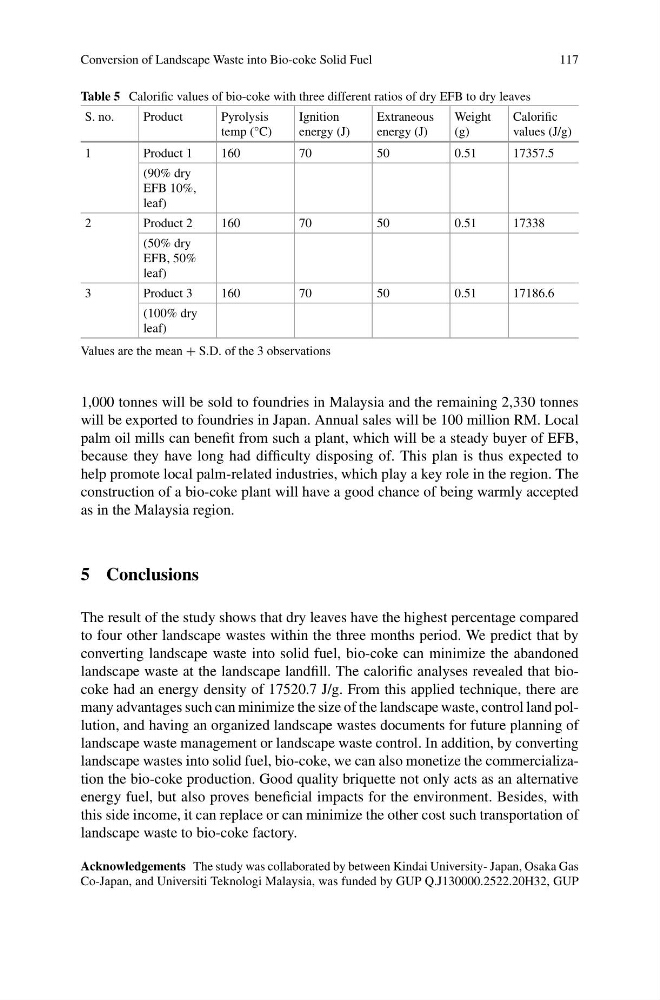
Table 5 Calorific values of bio-coke with three different ratios of dry EFB to dry leaves
S. no.
Product
Pyrolysis
temp (°C)
Ignition
energy (J)
Extraneous
energy (J)
Weight
(g)
Calorific
values (J/g)
1
Product 1
160
70
50
0.51
17357.5
(90% dry
EFB 10%,
leaf)
2
Product 2
160
70
50
0.51
17338
(50% dry
EFB, 50%
leaf)
3
Product 3
160
70
50
0.51
17186.6
(100% dry
leaf)
Values are the mean + S.D. of the 3 observations
1,000 tonnes will be sold to foundries in Malaysia and the remaining 2,330 tonnes
will be exported to foundries in Japan. Annual sales will be 100 million RM. Local
palm oil mills can benefit from such a plant, which will be a steady buyer of EFB,
because they have long had difficulty disposing of. This plan is thus expected to
help promote local palm-related industries, which play a key role in the region. The
construction of a bio-coke plant will have a good chance of being warmly accepted
as in the Malaysia region.
5 Conclusions
The result of the study shows that dry leaves have the highest percentage compared
to four other landscape wastes within the three months period. We predict that by
converting landscape waste into solid fuel, bio-coke can minimize the abandoned
landscape waste at the landscape landfill. The calorific analyses revealed that biocoke had an energy density of 17520.7 J/g. From this applied technique, there are
many advantages such can minimize the size of the landscape waste, control land pollution, and having an organized landscape wastes documents for future planning of
landscape waste management or landscape waste control. In addition, by converting
landscape wastes into solid fuel, bio-coke, we can also monetize the commercialization the bio-coke production. Good quality briquette not only acts as an alternative
energy fuel, but also proves beneficial impacts for the environment. Besides, with
this side income, it can replace or can minimize the other cost such transportation of
landscape waste to bio-coke factory.
Acknowledgements The study was collaborated by between Kindai University- Japan, Osaka Gas
Co-Japan, and Universiti Teknologi Malaysia, was funded by GUP Q.J130000.2522.20H32, GUP
117
Table 5 Calorific values of bio-coke with three different ratios of dry EFB to dry leaves
S. no.
Product
Pyrolysis
temp (°C)
Ignition
energy (J)
Extraneous
energy (J)
Weight
(g)
Calorific
values (J/g)
1
Product 1
160
70
50
0.51
17357.5
(90% dry
EFB 10%,
leaf)
2
Product 2
160
70
50
0.51
17338
(50% dry
EFB, 50%
leaf)
3
Product 3
160
70
50
0.51
17186.6
(100% dry
leaf)
Values are the mean + S.D. of the 3 observations
1,000 tonnes will be sold to foundries in Malaysia and the remaining 2,330 tonnes
will be exported to foundries in Japan. Annual sales will be 100 million RM. Local
palm oil mills can benefit from such a plant, which will be a steady buyer of EFB,
because they have long had difficulty disposing of. This plan is thus expected to
help promote local palm-related industries, which play a key role in the region. The
construction of a bio-coke plant will have a good chance of being warmly accepted
as in the Malaysia region.
5 Conclusions
The result of the study shows that dry leaves have the highest percentage compared
to four other landscape wastes within the three months period. We predict that by
converting landscape waste into solid fuel, bio-coke can minimize the abandoned
landscape waste at the landscape landfill. The calorific analyses revealed that biocoke had an energy density of 17520.7 J/g. From this applied technique, there are
many advantages such can minimize the size of the landscape waste, control land pollution, and having an organized landscape wastes documents for future planning of
landscape waste management or landscape waste control. In addition, by converting
landscape wastes into solid fuel, bio-coke, we can also monetize the commercialization the bio-coke production. Good quality briquette not only acts as an alternative
energy fuel, but also proves beneficial impacts for the environment. Besides, with
this side income, it can replace or can minimize the other cost such transportation of
landscape waste to bio-coke factory.
Acknowledgements The study was collaborated by between Kindai University- Japan, Osaka Gas
Co-Japan, and Universiti Teknologi Malaysia, was funded by GUP Q.J130000.2522.20H32, GUP