

5. SHELXL can use the original list of reflections and the atomic
coordinates outputted by SHELXD/T to generate a density
map for model building. Make a copy of the “.res” output from
SHELXD/T and rename it as an “.ins” file. Now rename the “.
hkl” file used for direct methods calculations so that it matches
the new “.ins” file. Run SHELXL, calling the new “.ins” and “.
hkl” files as inputs. This will produce a calculated density map
as an “.fcf” file (also readable in Coot).
6. Build a polypeptide model in Coot or PyMOL by sequentially
assigning specific residues according to the data (Fig. 6b).
7. Refine the structure using the newly built model in tandem
with the original list of reflections supplied by XDSCONV in
step 5 of Subheading 3.5. Several standard programs can execute refinement; Phenix and REFMAC natively support electron scattering factors (see Note 24).
4 Notes
1. Recommended instruments employ field-emission guns
(FEGs) as electron sources. These contain elemental tungsten
(W) tips roughly 15 nm in diameter coated with a thin layer of
zirconium oxide (ZrO). The apex of the emitter approaches
1800 K during excitation, augmenting ZrO conductivity and
facilitating thermionic emission by diminishing the work function of the cathode. Schottky-type FEGs generate a highly
coherent beam, with an energy spread ΔE of 0.3–0.7 eV. Alternative sources such as W hairpin filaments or lanthanum hexaboride crystals exhibit ΔE values of 1.5–3 eV and 1–2 eV,
respectively. Systems operating at a higher accelerating voltage
4000
3500
3000
2500
2000
Frequency
1500
CFOM
1000
500
0
45
50
55
60
65
70
75
80
85
90
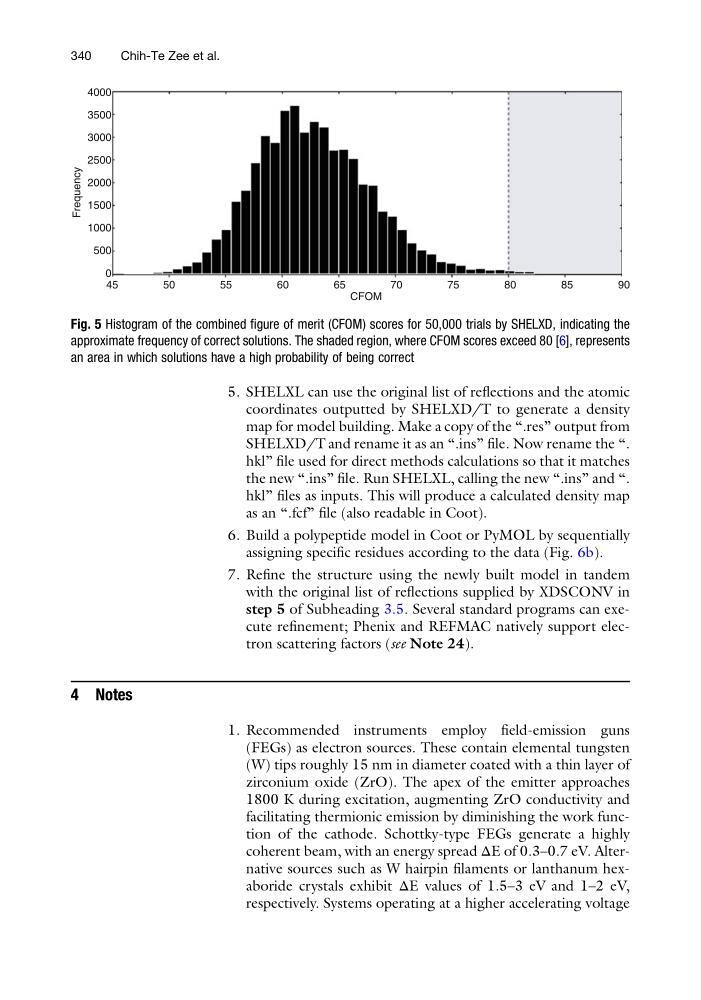
Fig. 5 Histogram of the combined figure of merit (CFOM) scores for 50,000 trials by SHELXD, indicating the
approximate frequency of correct solutions. The shaded region, where CFOM scores exceed 80 [6], represents
an area in which solutions have a high probability of being correct
340
Chih-Te Zee et al.
coordinates outputted by SHELXD/T to generate a density
map for model building. Make a copy of the “.res” output from
SHELXD/T and rename it as an “.ins” file. Now rename the “.
hkl” file used for direct methods calculations so that it matches
the new “.ins” file. Run SHELXL, calling the new “.ins” and “.
hkl” files as inputs. This will produce a calculated density map
as an “.fcf” file (also readable in Coot).
6. Build a polypeptide model in Coot or PyMOL by sequentially
assigning specific residues according to the data (Fig. 6b).
7. Refine the structure using the newly built model in tandem
with the original list of reflections supplied by XDSCONV in
step 5 of Subheading 3.5. Several standard programs can execute refinement; Phenix and REFMAC natively support electron scattering factors (see Note 24).
4 Notes
1. Recommended instruments employ field-emission guns
(FEGs) as electron sources. These contain elemental tungsten
(W) tips roughly 15 nm in diameter coated with a thin layer of
zirconium oxide (ZrO). The apex of the emitter approaches
1800 K during excitation, augmenting ZrO conductivity and
facilitating thermionic emission by diminishing the work function of the cathode. Schottky-type FEGs generate a highly
coherent beam, with an energy spread ΔE of 0.3–0.7 eV. Alternative sources such as W hairpin filaments or lanthanum hexaboride crystals exhibit ΔE values of 1.5–3 eV and 1–2 eV,
respectively. Systems operating at a higher accelerating voltage
4000
3500
3000
2500
2000
Frequency
1500
CFOM
1000
500
0
45
50
55
60
65
70
75
80
85
90
Fig. 5 Histogram of the combined figure of merit (CFOM) scores for 50,000 trials by SHELXD, indicating the
approximate frequency of correct solutions. The shaded region, where CFOM scores exceed 80 [6], represents
an area in which solutions have a high probability of being correct
340
Chih-Te Zee et al.