

3.6 Structure
Determination
1. Generate a SHELX instruction file (extension “.ins”) by using
SHELXPRO [26] (see Note 22).
2. Execute SHELXD/T with the newly made instruction file and
the list of reflections generated in step 5 in the previous section
(“.hkl”). During the SHELX trials, keep track of the best
CFOM values; these form a distribution whose high end may
be indicative of correct solutions (Fig. 5) (see Note 23).
3. Open the direct methods solution in Coot (“.pdb” or “.res”
files tolerated) or PyMOL (accepts “.pdb” files) to visualize the
atoms. Generally, a solution is considered valid when each atom
in the polypeptide backbone is placed in accordance with wellestablished restraints on bond geometries (Fig. 6a).
4. While structure determination programs do not routinely
assign the absolute configuration of individual stereocenters
from electron diffraction data, special routines can be implemented to exploit potential differences in Friedel mates
[33]. In the event that absolute structure is known but
SHELXD/T outputs its inverse, the PDBSET program [29]
can rectify the handedness of the coordinate file by inverting
the input coordinates.
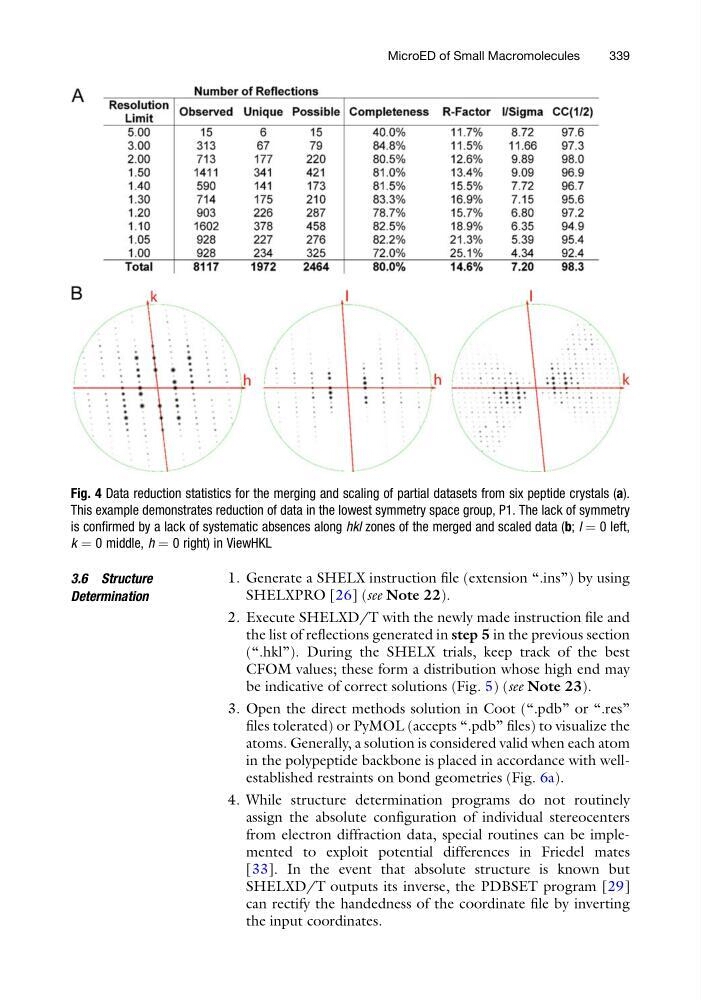
Fig. 4 Data reduction statistics for the merging and scaling of partial datasets from six peptide crystals (a).
This example demonstrates reduction of data in the lowest symmetry space group, P1. The lack of symmetry
is confirmed by a lack of systematic absences along hkl zones of the merged and scaled data (b; l ¼ 0 left,
k ¼ 0 middle, h ¼ 0 right) in ViewHKL
MicroED of Small Macromolecules
339
Determination
1. Generate a SHELX instruction file (extension “.ins”) by using
SHELXPRO [26] (see Note 22).
2. Execute SHELXD/T with the newly made instruction file and
the list of reflections generated in step 5 in the previous section
(“.hkl”). During the SHELX trials, keep track of the best
CFOM values; these form a distribution whose high end may
be indicative of correct solutions (Fig. 5) (see Note 23).
3. Open the direct methods solution in Coot (“.pdb” or “.res”
files tolerated) or PyMOL (accepts “.pdb” files) to visualize the
atoms. Generally, a solution is considered valid when each atom
in the polypeptide backbone is placed in accordance with wellestablished restraints on bond geometries (Fig. 6a).
4. While structure determination programs do not routinely
assign the absolute configuration of individual stereocenters
from electron diffraction data, special routines can be implemented to exploit potential differences in Friedel mates
[33]. In the event that absolute structure is known but
SHELXD/T outputs its inverse, the PDBSET program [29]
can rectify the handedness of the coordinate file by inverting
the input coordinates.
Fig. 4 Data reduction statistics for the merging and scaling of partial datasets from six peptide crystals (a).
This example demonstrates reduction of data in the lowest symmetry space group, P1. The lack of symmetry
is confirmed by a lack of systematic absences along hkl zones of the merged and scaled data (b; l ¼ 0 left,
k ¼ 0 middle, h ¼ 0 right) in ViewHKL
MicroED of Small Macromolecules
339