

are preferred since these can also accommodate lower accelerating voltages (i.e., a 300 keV instrument can be driven at
200 keV if necessary). Although cold FEGs (in instruments
such as the JEOL JEM-2100) can achieve even better spatial
coherence, Schottky-type FEGs may offer greater durability,
lower noise, and steadier beam current [34].
2. Other detectors include the CMOS-based CetaD 16 M
(Thermo Fisher Scientific, [35]), a previous generation
TVIPS TemCam-F416 (Tietz Video and Image Processing,
[13]), and two direct electron detectors, Falcon in integrating
mode [35] and K2 in counting mode (Gatan Inc., [36]).
Hybrid pixel detectors such as the Dectris EIGER detector
[37] and the Medipix2 [38] allow for fast and high dynamic
range data collection. In principle, collection of MicroED data
using a slow-scan CCD is possible, but inherent deficits in
readout speed may severely limit data quality.
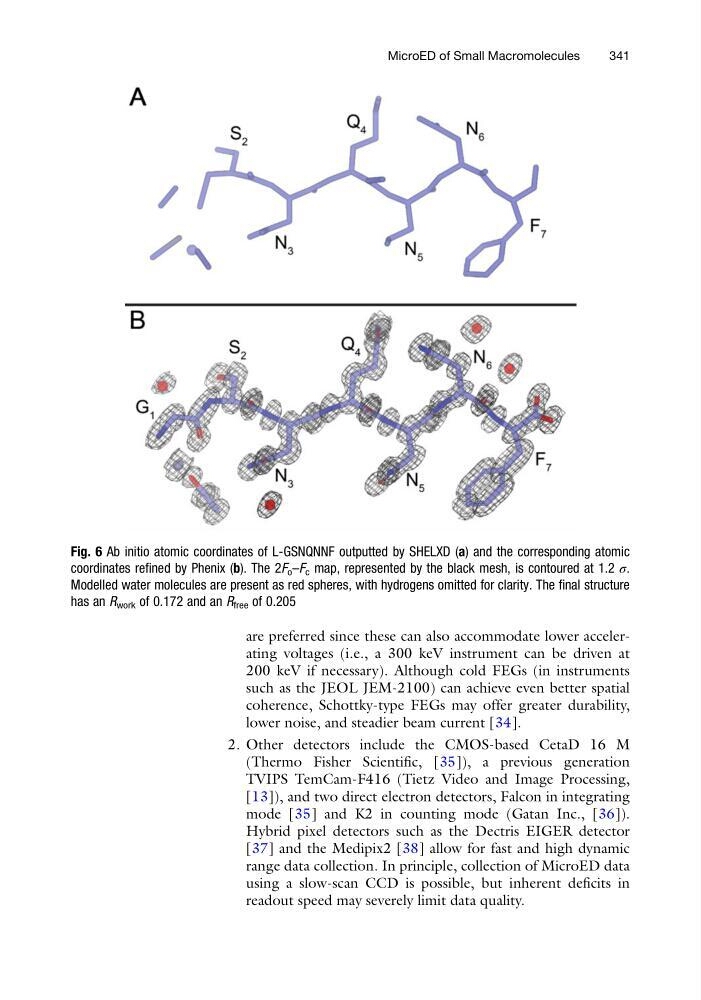
Fig. 6 Ab initio atomic coordinates of L-GSNQNNF outputted by SHELXD (a) and the corresponding atomic
coordinates refined by Phenix (b). The 2F o –F c map, represented by the black mesh, is contoured at 1.2 σ.
Modelled water molecules are present as red spheres, with hydrogens omitted for clarity. The final structure
has an R work of 0.172 and an R free of 0.205
MicroED of Small Macromolecules
341
200 keV if necessary). Although cold FEGs (in instruments
such as the JEOL JEM-2100) can achieve even better spatial
coherence, Schottky-type FEGs may offer greater durability,
lower noise, and steadier beam current [34].
2. Other detectors include the CMOS-based CetaD 16 M
(Thermo Fisher Scientific, [35]), a previous generation
TVIPS TemCam-F416 (Tietz Video and Image Processing,
[13]), and two direct electron detectors, Falcon in integrating
mode [35] and K2 in counting mode (Gatan Inc., [36]).
Hybrid pixel detectors such as the Dectris EIGER detector
[37] and the Medipix2 [38] allow for fast and high dynamic
range data collection. In principle, collection of MicroED data
using a slow-scan CCD is possible, but inherent deficits in
readout speed may severely limit data quality.
Fig. 6 Ab initio atomic coordinates of L-GSNQNNF outputted by SHELXD (a) and the corresponding atomic
coordinates refined by Phenix (b). The 2F o –F c map, represented by the black mesh, is contoured at 1.2 σ.
Modelled water molecules are present as red spheres, with hydrogens omitted for clarity. The final structure
has an R work of 0.172 and an R free of 0.205
MicroED of Small Macromolecules
341