

The Threshold to include particles parameter allows to define
how strict the picking should be:
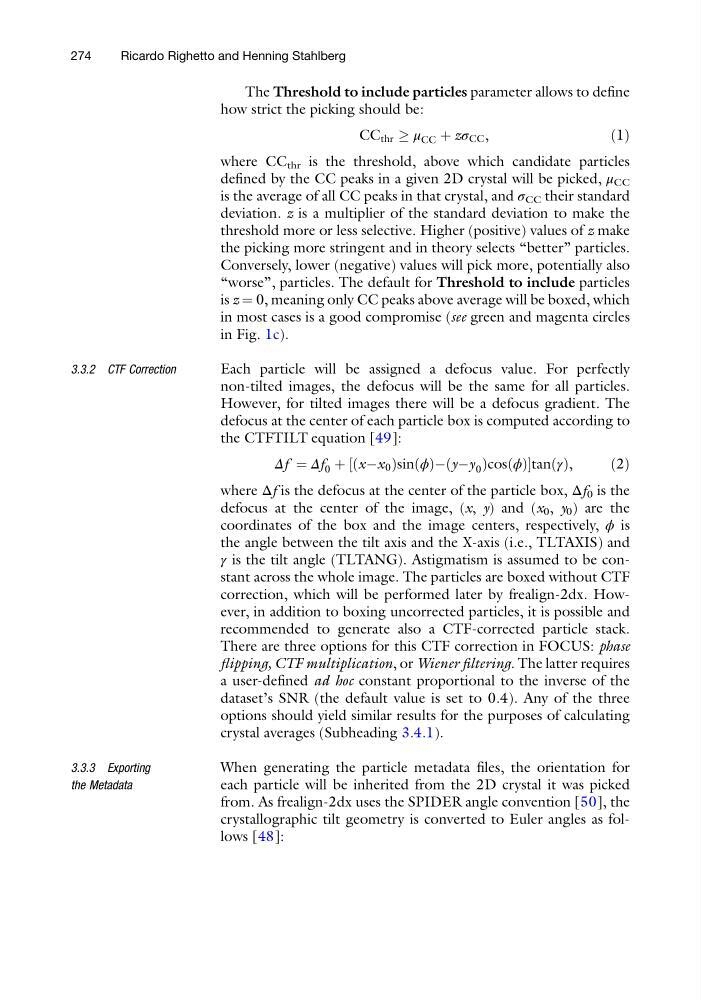
CC thr ! μ CC þ zσ CC ,
ð1Þ
where CC thr is the threshold, above which candidate particles
defined by the CC peaks in a given 2D crystal will be picked, μ CC
is the average of all CC peaks in that crystal, and σ CC their standard
deviation. z is a multiplier of the standard deviation to make the
threshold more or less selective. Higher (positive) values of z make
the picking more stringent and in theory selects “better” particles.
Conversely, lower (negative) values will pick more, potentially also
“worse”, particles. The default for Threshold to include particles
is z ¼ 0, meaning only CC peaks above average will be boxed, which
in most cases is a good compromise (see green and magenta circles
in Fig. 1c).
3.3.2 CTF Correction
Each particle will be assigned a defocus value. For perfectly
non-tilted images, the defocus will be the same for all particles.
However, for tilted images there will be a defocus gradient. The
defocus at the center of each particle box is computed according to
the CTFTILT equation [49]:
Δf ¼ Δf 0 þ ½ðxÀx 0 ÞsinðϕÞÀðyÀy 0 ÞcosðϕÞtanðγÞ,
ð2Þ
where Δf is the defocus at the center of the particle box, Δf 0 is the
defocus at the center of the image, (x, y) and (x 0 , y 0 ) are the
coordinates of the box and the image centers, respectively, ϕ is
the angle between the tilt axis and the X-axis (i.e., TLTAXIS) and
γ is the tilt angle (TLTANG). Astigmatism is assumed to be constant across the whole image. The particles are boxed without CTF
correction, which will be performed later by frealign-2dx. However, in addition to boxing uncorrected particles, it is possible and
recommended to generate also a CTF-corrected particle stack.
There are three options for this CTF correction in FOCUS: phase
flipping, CTF multiplication, or Wiener filtering. The latter requires
a user-defined ad hoc constant proportional to the inverse of the
dataset’s SNR (the default value is set to 0.4). Any of the three
options should yield similar results for the purposes of calculating
crystal averages (Subheading 3.4.1).
3.3.3 Exporting
the Metadata
When generating the particle metadata files, the orientation for
each particle will be inherited from the 2D crystal it was picked
from. As frealign-2dx uses the SPIDER angle convention [50], the
crystallographic tilt geometry is converted to Euler angles as follows [48]:
274
Ricardo Righetto and Henning Stahlberg
how strict the picking should be:
CC thr ! μ CC þ zσ CC ,
ð1Þ
where CC thr is the threshold, above which candidate particles
defined by the CC peaks in a given 2D crystal will be picked, μ CC
is the average of all CC peaks in that crystal, and σ CC their standard
deviation. z is a multiplier of the standard deviation to make the
threshold more or less selective. Higher (positive) values of z make
the picking more stringent and in theory selects “better” particles.
Conversely, lower (negative) values will pick more, potentially also
“worse”, particles. The default for Threshold to include particles
is z ¼ 0, meaning only CC peaks above average will be boxed, which
in most cases is a good compromise (see green and magenta circles
in Fig. 1c).
3.3.2 CTF Correction
Each particle will be assigned a defocus value. For perfectly
non-tilted images, the defocus will be the same for all particles.
However, for tilted images there will be a defocus gradient. The
defocus at the center of each particle box is computed according to
the CTFTILT equation [49]:
Δf ¼ Δf 0 þ ½ðxÀx 0 ÞsinðϕÞÀðyÀy 0 ÞcosðϕÞtanðγÞ,
ð2Þ
where Δf is the defocus at the center of the particle box, Δf 0 is the
defocus at the center of the image, (x, y) and (x 0 , y 0 ) are the
coordinates of the box and the image centers, respectively, ϕ is
the angle between the tilt axis and the X-axis (i.e., TLTAXIS) and
γ is the tilt angle (TLTANG). Astigmatism is assumed to be constant across the whole image. The particles are boxed without CTF
correction, which will be performed later by frealign-2dx. However, in addition to boxing uncorrected particles, it is possible and
recommended to generate also a CTF-corrected particle stack.
There are three options for this CTF correction in FOCUS: phase
flipping, CTF multiplication, or Wiener filtering. The latter requires
a user-defined ad hoc constant proportional to the inverse of the
dataset’s SNR (the default value is set to 0.4). Any of the three
options should yield similar results for the purposes of calculating
crystal averages (Subheading 3.4.1).
3.3.3 Exporting
the Metadata
When generating the particle metadata files, the orientation for
each particle will be inherited from the 2D crystal it was picked
from. As frealign-2dx uses the SPIDER angle convention [50], the
crystallographic tilt geometry is converted to Euler angles as follows [48]:
274
Ricardo Righetto and Henning Stahlberg