

atop two layers of Whatman #4 filter paper, without releasing it
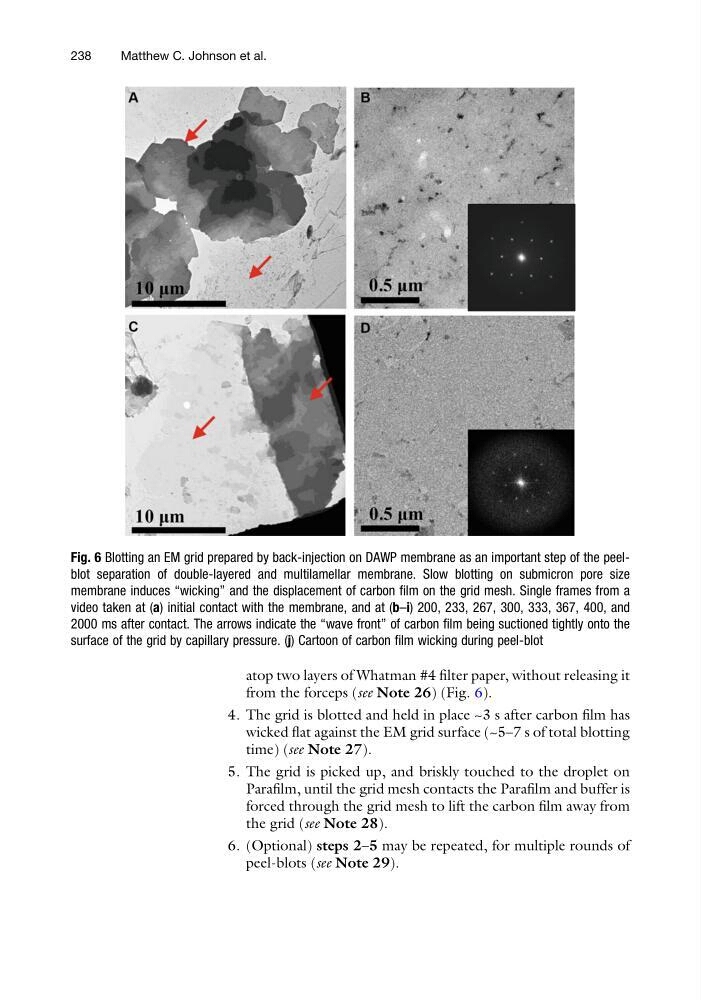
from the forceps (see Note 26) (Fig. 6).
4. The grid is blotted and held in place ~3 s after carbon film has
wicked flat against the EM grid surface (~5–7 s of total blotting
time) (see Note 27).
5. The grid is picked up, and briskly touched to the droplet on
Parafilm, until the grid mesh contacts the Parafilm and buffer is
forced through the grid mesh to lift the carbon film away from
the grid (see Note 28).
6. (Optional) steps 2–5 may be repeated, for multiple rounds of
peel-blots (see Note 29).
Fig. 6 Blotting an EM grid prepared by back-injection on DAWP membrane as an important step of the peelblot separation of double-layered and multilamellar membrane. Slow blotting on submicron pore size
membrane induces “wicking” and the displacement of carbon film on the grid mesh. Single frames from a
video taken at (a) initial contact with the membrane, and at (b–i) 200, 233, 267, 300, 333, 367, 400, and
2000 ms after contact. The arrows indicate the “wave front” of carbon film being suctioned tightly onto the
surface of the grid by capillary pressure. (j) Cartoon of carbon film wicking during peel-blot
238
Matthew C. Johnson et al.
from the forceps (see Note 26) (Fig. 6).
4. The grid is blotted and held in place ~3 s after carbon film has
wicked flat against the EM grid surface (~5–7 s of total blotting
time) (see Note 27).
5. The grid is picked up, and briskly touched to the droplet on
Parafilm, until the grid mesh contacts the Parafilm and buffer is
forced through the grid mesh to lift the carbon film away from
the grid (see Note 28).
6. (Optional) steps 2–5 may be repeated, for multiple rounds of
peel-blots (see Note 29).
Fig. 6 Blotting an EM grid prepared by back-injection on DAWP membrane as an important step of the peelblot separation of double-layered and multilamellar membrane. Slow blotting on submicron pore size
membrane induces “wicking” and the displacement of carbon film on the grid mesh. Single frames from a
video taken at (a) initial contact with the membrane, and at (b–i) 200, 233, 267, 300, 333, 367, 400, and
2000 ms after contact. The arrows indicate the “wave front” of carbon film being suctioned tightly onto the
surface of the grid by capillary pressure. (j) Cartoon of carbon film wicking during peel-blot
238
Matthew C. Johnson et al.