

protein, hundreds of candidate models were assessed (following
local optimization of the fit) and the top-scoring model was
selected. It was also used to describe conformational changes during pore formation by the perforin-related protein pleurotolysin
using cryo-EM maps at ~11 A ˚ resolution [39]. To describe a
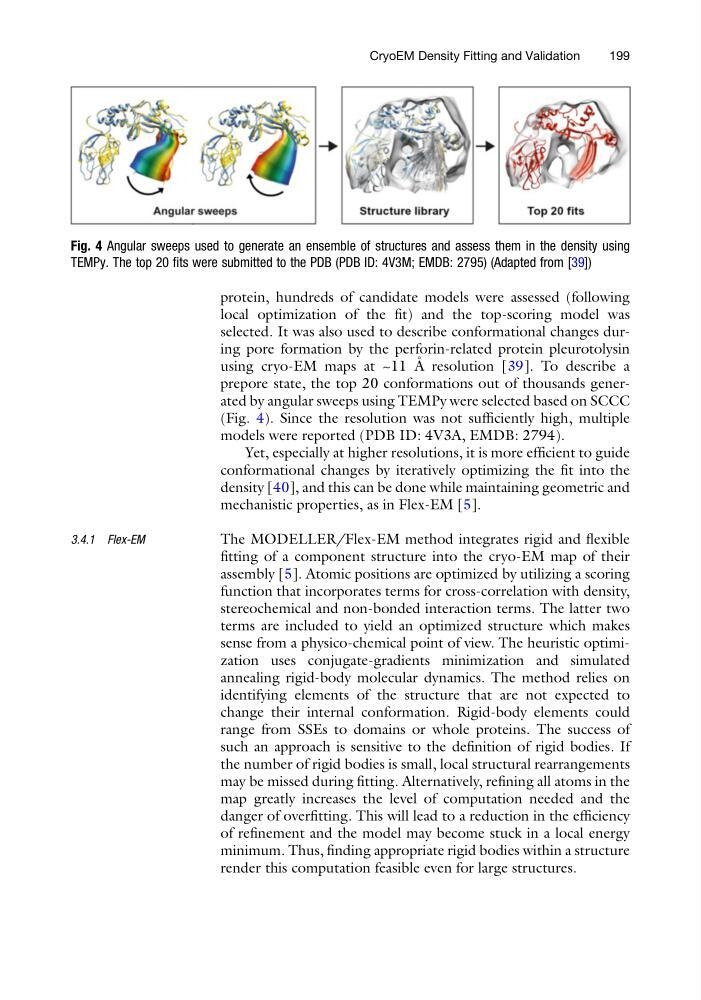
prepore state, the top 20 conformations out of thousands generated by angular sweeps using TEMPy were selected based on SCCC
(Fig. 4). Since the resolution was not sufficiently high, multiple
models were reported (PDB ID: 4V3A, EMDB: 2794).
Yet, especially at higher resolutions, it is more efficient to guide
conformational changes by iteratively optimizing the fit into the
density [40], and this can be done while maintaining geometric and
mechanistic properties, as in Flex-EM [5].
3.4.1 Flex-EM
The MODELLER/Flex-EM method integrates rigid and flexible
fitting of a component structure into the cryo-EM map of their
assembly [5]. Atomic positions are optimized by utilizing a scoring
function that incorporates terms for cross-correlation with density,
stereochemical and non-bonded interaction terms. The latter two
terms are included to yield an optimized structure which makes
sense from a physico-chemical point of view. The heuristic optimization uses conjugate-gradients minimization and simulated
annealing rigid-body molecular dynamics. The method relies on
identifying elements of the structure that are not expected to
change their internal conformation. Rigid-body elements could
range from SSEs to domains or whole proteins. The success of
such an approach is sensitive to the definition of rigid bodies. If
the number of rigid bodies is small, local structural rearrangements
may be missed during fitting. Alternatively, refining all atoms in the
map greatly increases the level of computation needed and the
danger of overfitting. This will lead to a reduction in the efficiency
of refinement and the model may become stuck in a local energy
minimum. Thus, finding appropriate rigid bodies within a structure
render this computation feasible even for large structures.
Fig. 4 Angular sweeps used to generate an ensemble of structures and assess them in the density using
TEMPy. The top 20 fits were submitted to the PDB (PDB ID: 4V3M; EMDB: 2795) (Adapted from [39])
CryoEM Density Fitting and Validation
199
local optimization of the fit) and the top-scoring model was
selected. It was also used to describe conformational changes during pore formation by the perforin-related protein pleurotolysin
using cryo-EM maps at ~11 A ˚ resolution [39]. To describe a
prepore state, the top 20 conformations out of thousands generated by angular sweeps using TEMPy were selected based on SCCC
(Fig. 4). Since the resolution was not sufficiently high, multiple
models were reported (PDB ID: 4V3A, EMDB: 2794).
Yet, especially at higher resolutions, it is more efficient to guide
conformational changes by iteratively optimizing the fit into the
density [40], and this can be done while maintaining geometric and
mechanistic properties, as in Flex-EM [5].
3.4.1 Flex-EM
The MODELLER/Flex-EM method integrates rigid and flexible
fitting of a component structure into the cryo-EM map of their
assembly [5]. Atomic positions are optimized by utilizing a scoring
function that incorporates terms for cross-correlation with density,
stereochemical and non-bonded interaction terms. The latter two
terms are included to yield an optimized structure which makes
sense from a physico-chemical point of view. The heuristic optimization uses conjugate-gradients minimization and simulated
annealing rigid-body molecular dynamics. The method relies on
identifying elements of the structure that are not expected to
change their internal conformation. Rigid-body elements could
range from SSEs to domains or whole proteins. The success of
such an approach is sensitive to the definition of rigid bodies. If
the number of rigid bodies is small, local structural rearrangements
may be missed during fitting. Alternatively, refining all atoms in the
map greatly increases the level of computation needed and the
danger of overfitting. This will lead to a reduction in the efficiency
of refinement and the model may become stuck in a local energy
minimum. Thus, finding appropriate rigid bodies within a structure
render this computation feasible even for large structures.
Fig. 4 Angular sweeps used to generate an ensemble of structures and assess them in the density using
TEMPy. The top 20 fits were submitted to the PDB (PDB ID: 4V3M; EMDB: 2795) (Adapted from [39])
CryoEM Density Fitting and Validation
199