

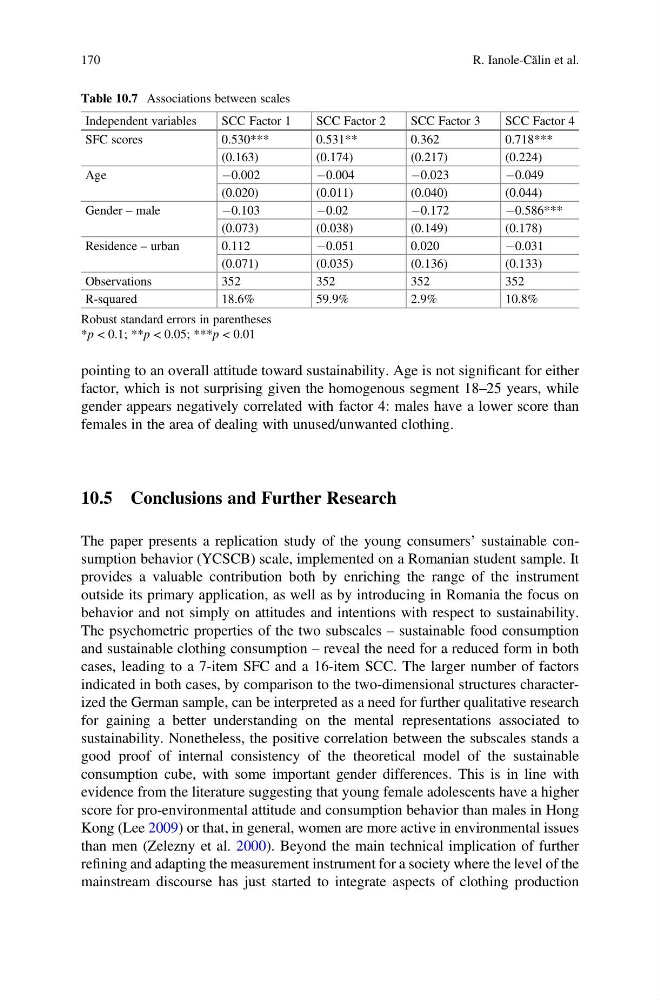
pointing to an overall attitude toward sustainability. Age is not significant for either
factor, which is not surprising given the homogenous segment 18–25 years, while
gender appears negatively correlated with factor 4: males have a lower score than
females in the area of dealing with unused/unwanted clothing.
10.5 Conclusions and Further Research
The paper presents a replication study of the young consumers’ sustainable consumption behavior (YCSCB) scale, implemented on a Romanian student sample. It
provides a valuable contribution both by enriching the range of the instrument
outside its primary application, as well as by introducing in Romania the focus on
behavior and not simply on attitudes and intentions with respect to sustainability.
The psychometric properties of the two subscales – sustainable food consumption
and sustainable clothing consumption – reveal the need for a reduced form in both
cases, leading to a 7-item SFC and a 16-item SCC. The larger number of factors
indicated in both cases, by comparison to the two-dimensional structures characterized the German sample, can be interpreted as a need for further qualitative research
for gaining a better understanding on the mental representations associated to
sustainability. Nonetheless, the positive correlation between the subscales stands a
good proof of internal consistency of the theoretical model of the sustainable
consumption cube, with some important gender differences. This is in line with
evidence from the literature suggesting that young female adolescents have a higher
score for pro-environmental attitude and consumption behavior than males in Hong
Kong (Lee 2009) or that, in general, women are more active in environmental issues
than men (Zelezny et al. 2000). Beyond the main technical implication of further
refining and adapting the measurement instrument for a society where the level of the
mainstream discourse has just started to integrate aspects of clothing production
Table 10.7 Associations between scales
Independent variables
SCC Factor 1
SCC Factor 2
SCC Factor 3
SCC Factor 4
SFC scores
0.530***
0.531**
0.362
0.718***
(0.163)
(0.174)
(0.217)
(0.224)
Age
À0.002
À0.004
À0.023
À0.049
(0.020)
(0.011)
(0.040)
(0.044)
Gender – male
À0.103
À0.02
À0.172
À0.586***
(0.073)
(0.038)
(0.149)
(0.178)
Residence – urban
0.112
À0.051
0.020
À0.031
(0.071)
(0.035)
(0.136)
(0.133)
Observations
352
352
352
352
R-squared
18.6%
59.9%
2.9%
10.8%
Robust standard errors in parentheses
*p < 0.1; **p < 0.05; ***p < 0.01
170
R. Ianole-Călin et al.
factor, which is not surprising given the homogenous segment 18–25 years, while
gender appears negatively correlated with factor 4: males have a lower score than
females in the area of dealing with unused/unwanted clothing.
10.5 Conclusions and Further Research
The paper presents a replication study of the young consumers’ sustainable consumption behavior (YCSCB) scale, implemented on a Romanian student sample. It
provides a valuable contribution both by enriching the range of the instrument
outside its primary application, as well as by introducing in Romania the focus on
behavior and not simply on attitudes and intentions with respect to sustainability.
The psychometric properties of the two subscales – sustainable food consumption
and sustainable clothing consumption – reveal the need for a reduced form in both
cases, leading to a 7-item SFC and a 16-item SCC. The larger number of factors
indicated in both cases, by comparison to the two-dimensional structures characterized the German sample, can be interpreted as a need for further qualitative research
for gaining a better understanding on the mental representations associated to
sustainability. Nonetheless, the positive correlation between the subscales stands a
good proof of internal consistency of the theoretical model of the sustainable
consumption cube, with some important gender differences. This is in line with
evidence from the literature suggesting that young female adolescents have a higher
score for pro-environmental attitude and consumption behavior than males in Hong
Kong (Lee 2009) or that, in general, women are more active in environmental issues
than men (Zelezny et al. 2000). Beyond the main technical implication of further
refining and adapting the measurement instrument for a society where the level of the
mainstream discourse has just started to integrate aspects of clothing production
Table 10.7 Associations between scales
Independent variables
SCC Factor 1
SCC Factor 2
SCC Factor 3
SCC Factor 4
SFC scores
0.530***
0.531**
0.362
0.718***
(0.163)
(0.174)
(0.217)
(0.224)
Age
À0.002
À0.004
À0.023
À0.049
(0.020)
(0.011)
(0.040)
(0.044)
Gender – male
À0.103
À0.02
À0.172
À0.586***
(0.073)
(0.038)
(0.149)
(0.178)
Residence – urban
0.112
À0.051
0.020
À0.031
(0.071)
(0.035)
(0.136)
(0.133)
Observations
352
352
352
352
R-squared
18.6%
59.9%
2.9%
10.8%
Robust standard errors in parentheses
*p < 0.1; **p < 0.05; ***p < 0.01
170
R. Ianole-Călin et al.