

707
unreliable, fleeting idea, somehow surprisingly upended atomist, yogis, Brahmans,
and logicians, staking a permanent claim for original essence within the lounge of
everyday rational existence, a shadow government of metaphysics exerting the most
lasting suasion in the history of Buddhism (Fig. 78.3).
Such emptiness, as defined by the 32-year-old Mipham writing his Ketaka Jewel,
or Wisdom Chapter (and considered by many to be the most prolific “polymath” in
Tibetan history),
9
endeavored to characterize for laypersons the idea of emptiness in
9 See Phuntsho, Karma, 2005, Mipham’s Dialectics and Debates on Emptiness: To Be, Not to Be or
Neither. Routledge Critical Studies in Buddhism. London: RoutledgeCurzon, p. 13.
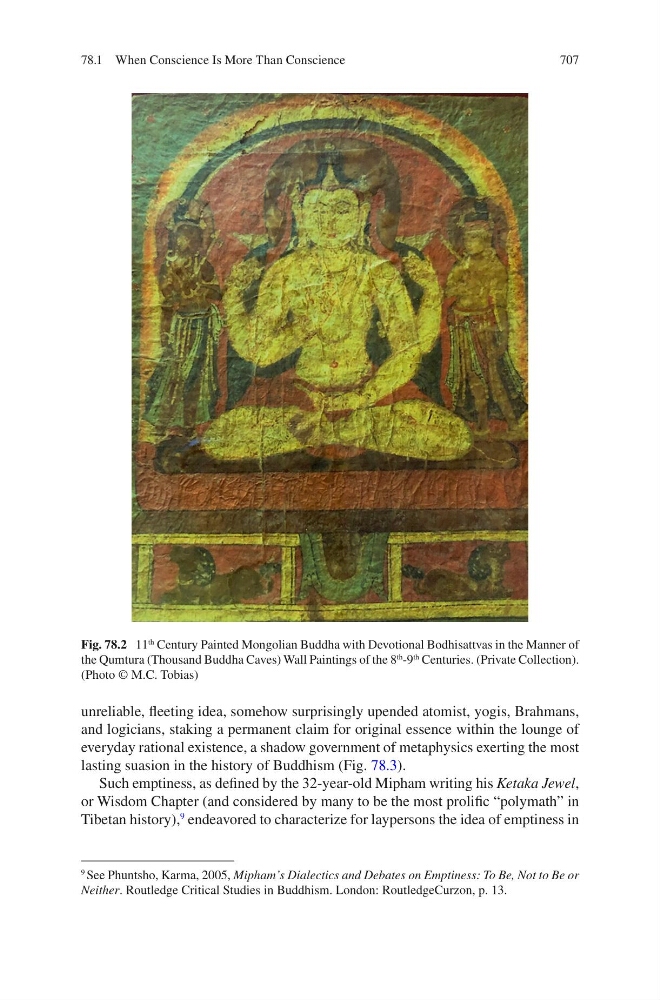
Fig. 78.2 11
th Century Painted Mongolian Buddha with Devotional Bodhisattvas in the Manner of
the Qumtura (Thousand Buddha Caves) Wall Paintings of the 8
th -9
th Centuries. (Private Collection).
(Photo © M.C. Tobias)
78.1 When Conscience Is More Than Conscience