

325
have been involved in placing the 15 stones in five groupings upon the raked, naked
sand, Kotaro and Hikojiro, whose signatures were carved into one of the tallest of
the rocks there.
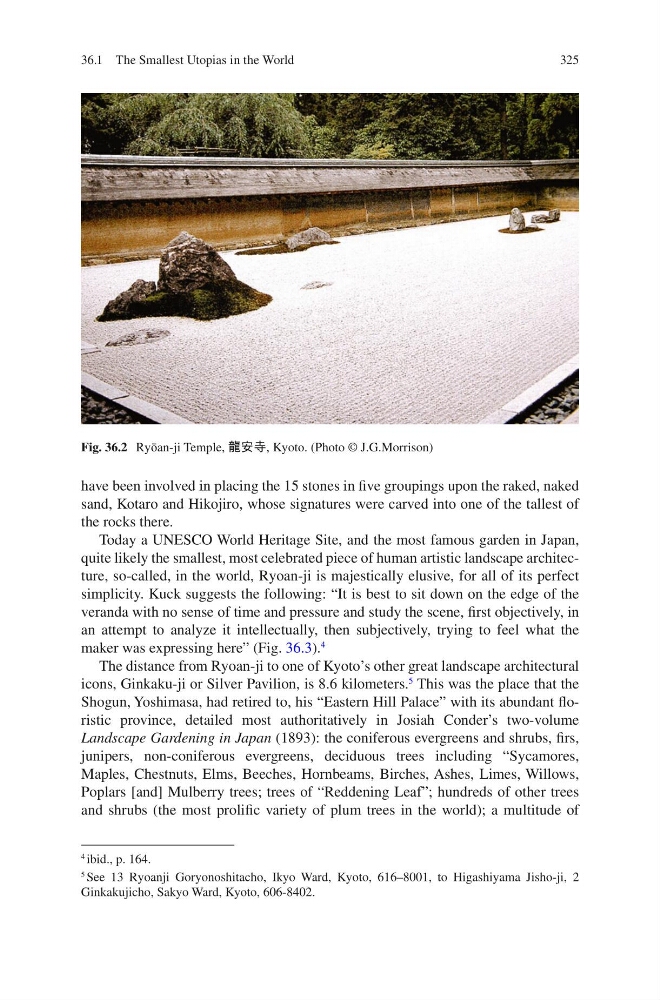
Today a UNESCO World Heritage Site, and the most famous garden in Japan,
quite likely the smallest, most celebrated piece of human artistic landscape architecture, so-called, in the world, Ryoan-ji is majestically elusive, for all of its perfect
simplicity. Kuck suggests the following: “It is best to sit down on the edge of the
veranda with no sense of time and pressure and study the scene, first objectively, in
an attempt to analyze it intellectually, then subjectively, trying to feel what the
maker was expressing here” (Fig. 36.3).
4
The distance from Ryoan-ji to one of Kyoto’s other great landscape architectural
icons, Ginkaku-ji or Silver Pavilion, is 8.6 kilometers.
5
This was the place that the
Shogun, Yoshimasa, had retired to, his “Eastern Hill Palace” with its abundant floristic province, detailed most authoritatively in Josiah Conder’s two-volume
Landscape Gardening in Japan (1893): the coniferous evergreens and shrubs, firs,
junipers, non-coniferous evergreens, deciduous trees including “Sycamores,
Maples, Chestnuts, Elms, Beeches, Hornbeams, Birches, Ashes, Limes, Willows,
Poplars [and] Mulberry trees; trees of “Reddening Leaf”; hundreds of other trees
and shrubs (the most prolific variety of plum trees in the world); a multitude of
4 ibid., p. 164.
5 See 13 Ryoanji Goryonoshitacho, Ikyo Ward, Kyoto, 616–8001, to Higashiyama Jisho-ji, 2
Ginkakujicho, Sakyo Ward, Kyoto, 606-8402.
Fig. 36.2 Ryōan-ji Temple, 龍安寺, Kyoto. (Photo © J.G.Morrison)
36.1 The Smallest Utopias in the World
have been involved in placing the 15 stones in five groupings upon the raked, naked
sand, Kotaro and Hikojiro, whose signatures were carved into one of the tallest of
the rocks there.
Today a UNESCO World Heritage Site, and the most famous garden in Japan,
quite likely the smallest, most celebrated piece of human artistic landscape architecture, so-called, in the world, Ryoan-ji is majestically elusive, for all of its perfect
simplicity. Kuck suggests the following: “It is best to sit down on the edge of the
veranda with no sense of time and pressure and study the scene, first objectively, in
an attempt to analyze it intellectually, then subjectively, trying to feel what the
maker was expressing here” (Fig. 36.3).
4
The distance from Ryoan-ji to one of Kyoto’s other great landscape architectural
icons, Ginkaku-ji or Silver Pavilion, is 8.6 kilometers.
5
This was the place that the
Shogun, Yoshimasa, had retired to, his “Eastern Hill Palace” with its abundant floristic province, detailed most authoritatively in Josiah Conder’s two-volume
Landscape Gardening in Japan (1893): the coniferous evergreens and shrubs, firs,
junipers, non-coniferous evergreens, deciduous trees including “Sycamores,
Maples, Chestnuts, Elms, Beeches, Hornbeams, Birches, Ashes, Limes, Willows,
Poplars [and] Mulberry trees; trees of “Reddening Leaf”; hundreds of other trees
and shrubs (the most prolific variety of plum trees in the world); a multitude of
4 ibid., p. 164.
5 See 13 Ryoanji Goryonoshitacho, Ikyo Ward, Kyoto, 616–8001, to Higashiyama Jisho-ji, 2
Ginkakujicho, Sakyo Ward, Kyoto, 606-8402.
Fig. 36.2 Ryōan-ji Temple, 龍安寺, Kyoto. (Photo © J.G.Morrison)
36.1 The Smallest Utopias in the World