

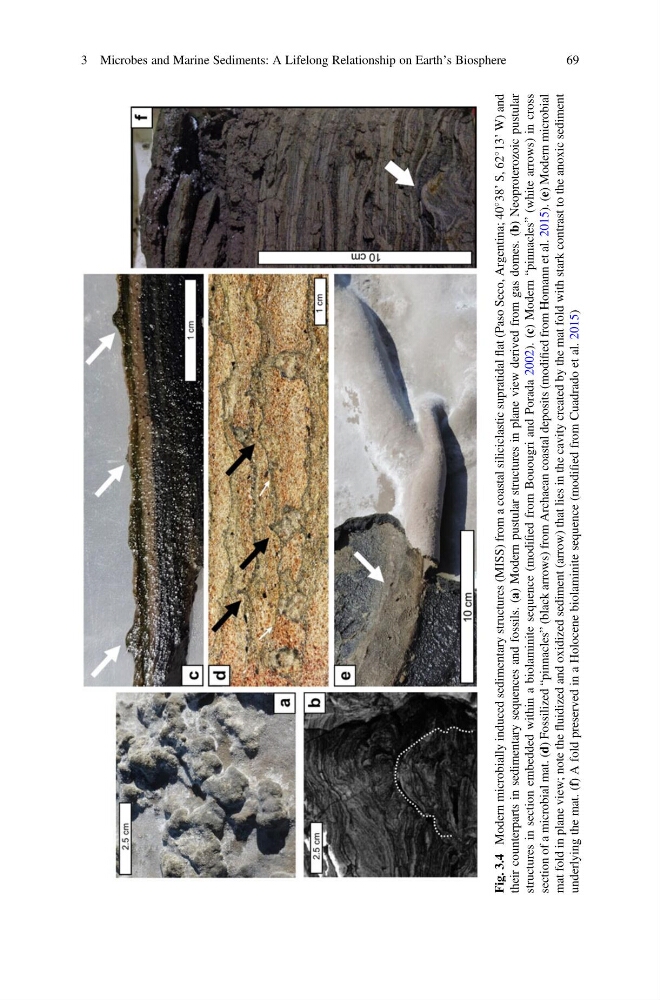
Fig. 3.4
Modern microbially induced sedimentary structures (MISS) from a coastal siliciclastic supratidal
flat (Paso Seco, Argentina; 40
38’ S, 62
13’ W) and
their counterparts in sedimentary sequences and fossils. (a) Modern pustular structures in plane view derived from gas domes. (b) Neoproterozoic pustular
structures in section embedded within a biolaminite sequence (modified from Bouougri and Porada 2002). (c) Modern
“pinnacles” (white arrows) in cross
section of a microbial mat. (d) Fossilized
“pinnacles” (black arrows) from Archaean coastal deposits (modified from Homann et al. 2015). (e) Modern microbial
mat fold in plane view; note the
fluidized and oxidized sediment (arrow) that lies in the cavity created by the mat fold with stark contrast to the anoxic sediment
underlying the mat. (f) A fold preserved in a Holocene biolaminite sequence (modified from Cuadrado et al. 2015)
3 Microbes and Marine Sediments: A Lifelong Relationship on Earth’s Biosphere
69
Modern microbially induced sedimentary structures (MISS) from a coastal siliciclastic supratidal
flat (Paso Seco, Argentina; 40
38’ S, 62
13’ W) and
their counterparts in sedimentary sequences and fossils. (a) Modern pustular structures in plane view derived from gas domes. (b) Neoproterozoic pustular
structures in section embedded within a biolaminite sequence (modified from Bouougri and Porada 2002). (c) Modern
“pinnacles” (white arrows) in cross
section of a microbial mat. (d) Fossilized
“pinnacles” (black arrows) from Archaean coastal deposits (modified from Homann et al. 2015). (e) Modern microbial
mat fold in plane view; note the
fluidized and oxidized sediment (arrow) that lies in the cavity created by the mat fold with stark contrast to the anoxic sediment
underlying the mat. (f) A fold preserved in a Holocene biolaminite sequence (modified from Cuadrado et al. 2015)
3 Microbes and Marine Sediments: A Lifelong Relationship on Earth’s Biosphere
69