

linked in terms of sharing a common mechanism of formation. My colleague Rob
Gunsalus (Gunsalus and Wolfe 1980) published dissertation work that provided a
possible mechanism involving the methyl coenzyme M reductase (MCR) purified
from Methanobacterium thermoautotrophicum (renamed as Methanothermobacter
thermautotrophicus; Wasserfallen et al. 2000). It turns out that when coenzyme M
reductase was provided in vitro with methylated CoM (methyl-S-CoM), methane
was formed as would be expected. However, when the ethylated analogue was
employed (ethyl-S-CoM), ethane was produced. However, this could not be
extended to higher alkanes, as propane formation did not occur when the enzyme
was fed propyl-S-CoM (Gunsalus et al. 1978). Nonetheless, a mechanism for
ethanogenesis in sediment systems was suggested and it could clearly involve
methanogens.
To pursue this question, I worked with dilute San Francisco Bay sediment
slurries, which lent themselves readily to experimental manipulations (Oremland
1981). Incubation of the slurries under H 2 (an electron donor for many methanogens)
stimulated methane production when compared against incubation under N 2 . The
observed methanogenesis was inhibited by 2-bromoethane sulfonic acid (BES).
Addition of ethyl-S-CoM (kindly provided by Prof. Ralph Wolfe) to the slurries
resulted in the formation of a small amount of ethane, which occurred simultaneously with methane production but at roughly 20,000-fold lower amounts than
methane. Significantly, endogenous ethane formation was also noted (~4 nmoles)
without the added ethyl-S-CoM but at lower levels than the slurries amended with
~2 mM ethyl-S-CoM (~24 nmoles). The BES inhibited ethane production by both
amended and un-amended ethane slurries (Fig. 30.3). A highly purified enrichment
culture of a coccoid methanogen, routinely cultivated in the presence of ethyl-SCoM, was obtained from these slurries. It proved capable of ethane formation when
provided with ethyl-S-CoM and after 4 days of growth yielded a final CH 4 /C 2 H 6
ratio of ~12,000. It was significant that neither tested sulfate-reducers (e.g.,
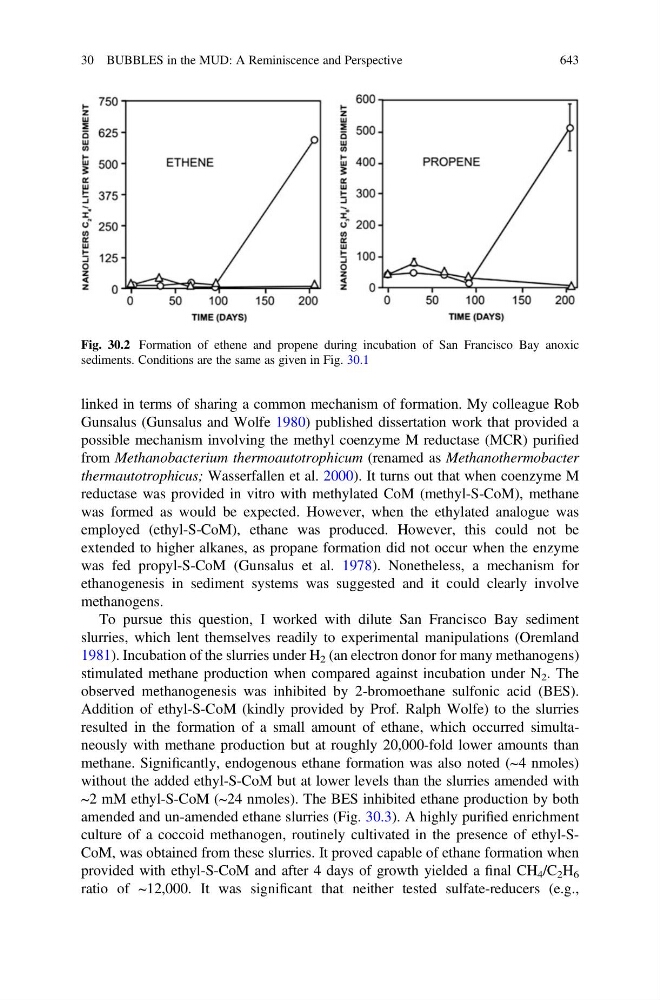
Fig. 30.2 Formation of ethene and propene during incubation of San Francisco Bay anoxic
sediments. Conditions are the same as given in Fig. 30.1
30 BUBBLES in the MUD: A Reminiscence and Perspective
643