

material per sample, the idea was that we could detect robust production not only of
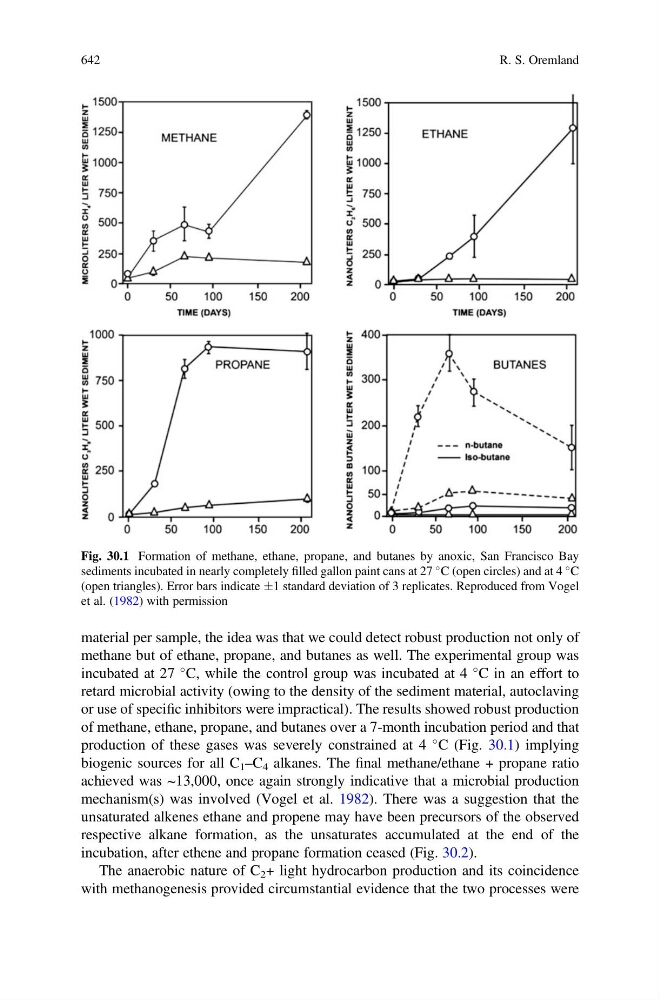
methane but of ethane, propane, and butanes as well. The experimental group was
incubated at 27
C, while the control group was incubated at 4
C in an effort to
retard microbial activity (owing to the density of the sediment material, autoclaving
or use of specific inhibitors were impractical). The results showed robust production
of methane, ethane, propane, and butanes over a 7-month incubation period and that
production of these gases was severely constrained at 4
C (Fig. 30.1) implying
biogenic sources for all C 1 –C 4 alkanes. The final methane/ethane + propane ratio
achieved was ~13,000, once again strongly indicative that a microbial production
mechanism(s) was involved (Vogel et al. 1982). There was a suggestion that the
unsaturated alkenes ethane and propene may have been precursors of the observed
respective alkane formation, as the unsaturates accumulated at the end of the
incubation, after ethene and propane formation ceased (Fig. 30.2).
The anaerobic nature of C 2 + light hydrocarbon production and its coincidence
with methanogenesis provided circumstantial evidence that the two processes were
Fig. 30.1 Formation of methane, ethane, propane, and butanes by anoxic, San Francisco Bay
sediments incubated in nearly completely filled gallon paint cans at 27
C (open circles) and at 4
C
(open triangles). Error bars indicate Æ1 standard deviation of 3 replicates. Reproduced from Vogel
et al. (1982) with permission
642
R. S. Oremland