

Desulfovibrio desulfuricans) nor the HS-CoM impermeable Methanobacterium
bryantii were able to produce ethane when provided with ethyl-S-CoM.
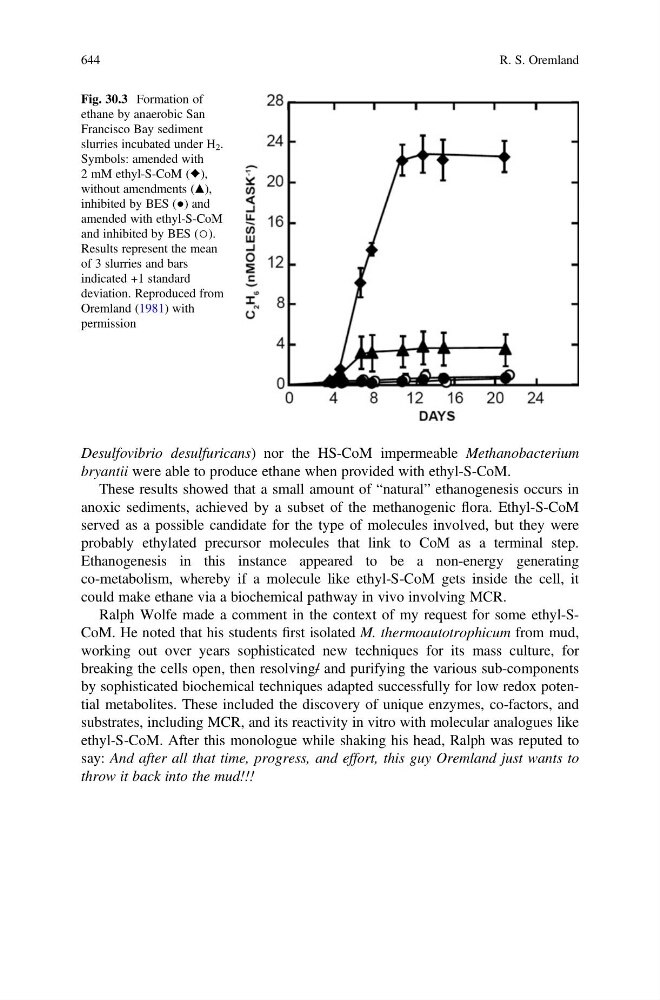
These results showed that a small amount of “natural” ethanogenesis occurs in
anoxic sediments, achieved by a subset of the methanogenic flora. Ethyl-S-CoM
served as a possible candidate for the type of molecules involved, but they were
probably ethylated precursor molecules that link to CoM as a terminal step.
Ethanogenesis in this instance appeared to be a non-energy generating
co-metabolism, whereby if a molecule like ethyl-S-CoM gets inside the cell, it
could make ethane via a biochemical pathway in vivo involving MCR.
Ralph Wolfe made a comment in the context of my request for some ethyl-SCoM. He noted that his students first isolated M. thermoautotrophicum from mud,
working out over years sophisticated new techniques for its mass culture, for
breaking the cells open, then resolving/ and purifying the various sub-components
by sophisticated biochemical techniques adapted successfully for low redox potential metabolites. These included the discovery of unique enzymes, co-factors, and
substrates, including MCR, and its reactivity in vitro with molecular analogues like
ethyl-S-CoM. After this monologue while shaking his head, Ralph was reputed to
say: And after all that time, progress, and effort, this guy Oremland just wants to
throw it back into the mud!!!
Fig. 30.3 Formation of
ethane by anaerobic San
Francisco Bay sediment
slurries incubated under H 2 .
Symbols: amended with
2 mM ethyl-S-CoM (♦),
without amendments (▲),
inhibited by BES (●) and
amended with ethyl-S-CoM
and inhibited by BES (○).
Results represent the mean
of 3 slurries and bars
indicated +1 standard
deviation. Reproduced from
Oremland (1981) with
permission
644
R. S. Oremland