

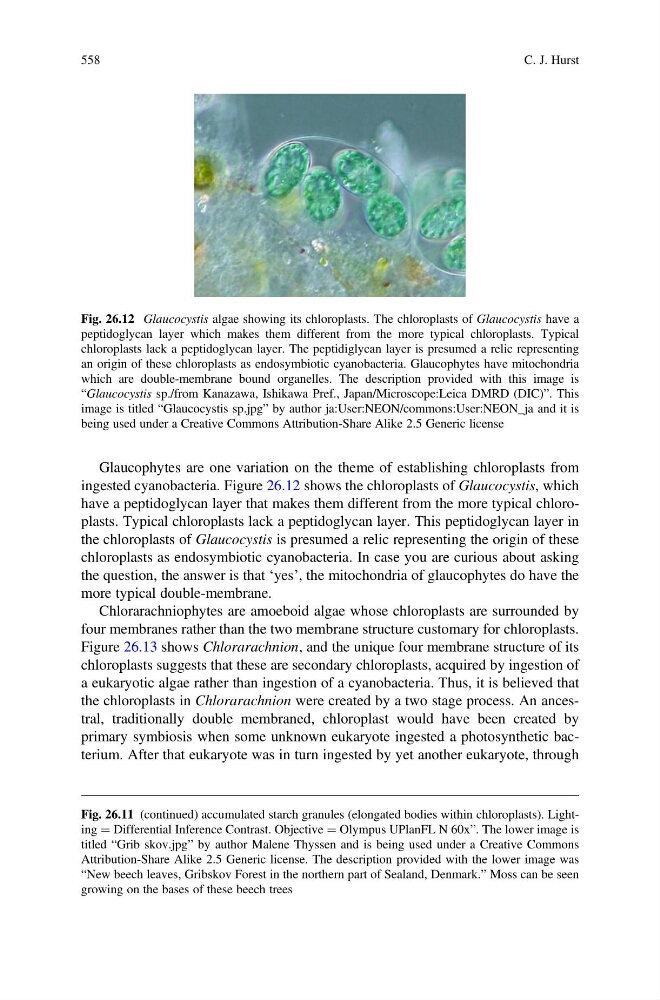
Glaucophytes are one variation on the theme of establishing chloroplasts from
ingested cyanobacteria. Figure 26.12 shows the chloroplasts of Glaucocystis, which
have a peptidoglycan layer that makes them different from the more typical chloroplasts. Typical chloroplasts lack a peptidoglycan layer. This peptidoglycan layer in
the chloroplasts of Glaucocystis is presumed a relic representing the origin of these
chloroplasts as endosymbiotic cyanobacteria. In case you are curious about asking
the question, the answer is that ‘yes’, the mitochondria of glaucophytes do have the
more typical double-membrane.
Chlorarachniophytes are amoeboid algae whose chloroplasts are surrounded by
four membranes rather than the two membrane structure customary for chloroplasts.
Figure 26.13 shows Chlorarachnion, and the unique four membrane structure of its
chloroplasts suggests that these are secondary chloroplasts, acquired by ingestion of
a eukaryotic algae rather than ingestion of a cyanobacteria. Thus, it is believed that
the chloroplasts in Chlorarachnion were created by a two stage process. An ancestral, traditionally double membraned, chloroplast would have been created by
primary symbiosis when some unknown eukaryote ingested a photosynthetic bacterium. After that eukaryote was in turn ingested by yet another eukaryote, through
Fig. 26.11 (continued) accumulated starch granules (elongated bodies within chloroplasts). Lighting ¼ Differential Inference Contrast. Objective ¼ Olympus UPlanFL N 60x”. The lower image is
titled “Grib skov.jpg” by author Malene Thyssen and is being used under a Creative Commons
Attribution-Share Alike 2.5 Generic license. The description provided with the lower image was
“New beech leaves, Gribskov Forest in the northern part of Sealand, Denmark.” Moss can be seen
growing on the bases of these beech trees
Fig. 26.12 Glaucocystis algae showing its chloroplasts. The chloroplasts of Glaucocystis have a
peptidoglycan layer which makes them different from the more typical chloroplasts. Typical
chloroplasts lack a peptidoglycan layer. The peptidiglycan layer is presumed a relic representing
an origin of these chloroplasts as endosymbiotic cyanobacteria. Glaucophytes have mitochondria
which are double-membrane bound organelles. The description provided with this image is
“Glaucocystis sp./from Kanazawa, Ishikawa Pref., Japan/Microscope:Leica DMRD (DIC)”. This
image is titled “Glaucocystis sp.jpg” by author ja:User:NEON/commons:User:NEON_ja and it is
being used under a Creative Commons Attribution-Share Alike 2.5 Generic license
558
C. J. Hurst
ingested cyanobacteria. Figure 26.12 shows the chloroplasts of Glaucocystis, which
have a peptidoglycan layer that makes them different from the more typical chloroplasts. Typical chloroplasts lack a peptidoglycan layer. This peptidoglycan layer in
the chloroplasts of Glaucocystis is presumed a relic representing the origin of these
chloroplasts as endosymbiotic cyanobacteria. In case you are curious about asking
the question, the answer is that ‘yes’, the mitochondria of glaucophytes do have the
more typical double-membrane.
Chlorarachniophytes are amoeboid algae whose chloroplasts are surrounded by
four membranes rather than the two membrane structure customary for chloroplasts.
Figure 26.13 shows Chlorarachnion, and the unique four membrane structure of its
chloroplasts suggests that these are secondary chloroplasts, acquired by ingestion of
a eukaryotic algae rather than ingestion of a cyanobacteria. Thus, it is believed that
the chloroplasts in Chlorarachnion were created by a two stage process. An ancestral, traditionally double membraned, chloroplast would have been created by
primary symbiosis when some unknown eukaryote ingested a photosynthetic bacterium. After that eukaryote was in turn ingested by yet another eukaryote, through
Fig. 26.11 (continued) accumulated starch granules (elongated bodies within chloroplasts). Lighting ¼ Differential Inference Contrast. Objective ¼ Olympus UPlanFL N 60x”. The lower image is
titled “Grib skov.jpg” by author Malene Thyssen and is being used under a Creative Commons
Attribution-Share Alike 2.5 Generic license. The description provided with the lower image was
“New beech leaves, Gribskov Forest in the northern part of Sealand, Denmark.” Moss can be seen
growing on the bases of these beech trees
Fig. 26.12 Glaucocystis algae showing its chloroplasts. The chloroplasts of Glaucocystis have a
peptidoglycan layer which makes them different from the more typical chloroplasts. Typical
chloroplasts lack a peptidoglycan layer. The peptidiglycan layer is presumed a relic representing
an origin of these chloroplasts as endosymbiotic cyanobacteria. Glaucophytes have mitochondria
which are double-membrane bound organelles. The description provided with this image is
“Glaucocystis sp./from Kanazawa, Ishikawa Pref., Japan/Microscope:Leica DMRD (DIC)”. This
image is titled “Glaucocystis sp.jpg” by author ja:User:NEON/commons:User:NEON_ja and it is
being used under a Creative Commons Attribution-Share Alike 2.5 Generic license
558
C. J. Hurst