

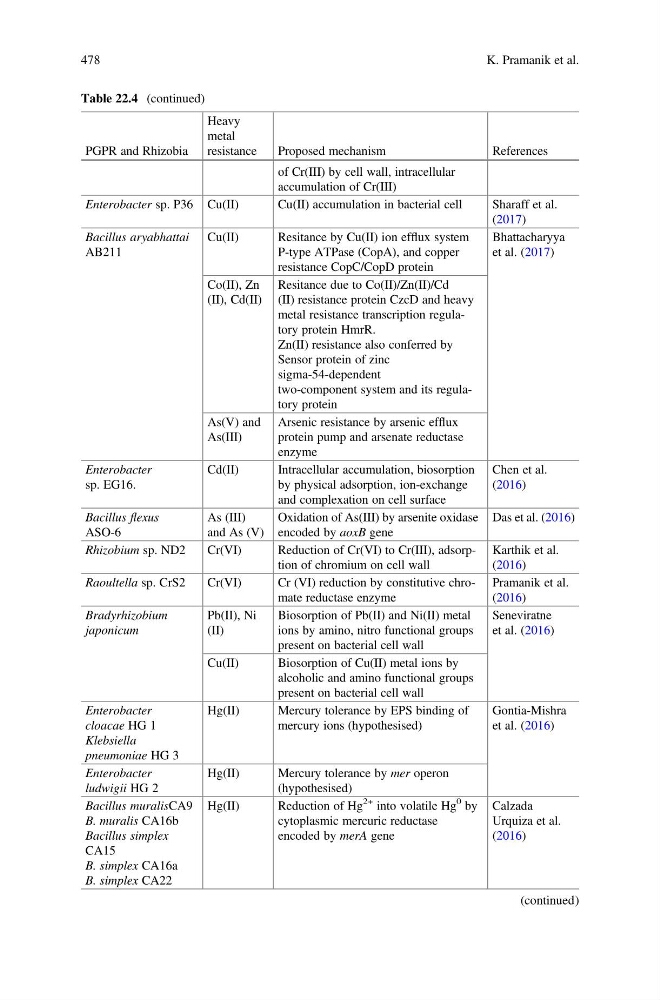
Table 22.4 (continued)
PGPR and Rhizobia
Heavy
metal
resistance
Proposed mechanism
References
of Cr(III) by cell wall, intracellular
accumulation of Cr(III)
Enterobacter sp. P36 Cu(II)
Cu(II) accumulation in bacterial cell
Sharaff et al.
(2017)
Bacillus aryabhattai
AB211
Cu(II)
Resitance by Cu(II) ion efflux system
P-type ATPase (CopA), and copper
resistance CopC/CopD protein
Bhattacharyya
et al. (2017)
Co(II), Zn
(II), Cd(II)
Resitance due to Co(II)/Zn(II)/Cd
(II) resistance protein CzcD and heavy
metal resistance transcription regulatory protein HmrR.
Zn(II) resistance also conferred by
Sensor protein of zinc
sigma-54-dependent
two-component system and its regulatory protein
As(V) and
As(III)
Arsenic resistance by arsenic efflux
protein pump and arsenate reductase
enzyme
Enterobacter
sp. EG16.
Cd(II)
Intracellular accumulation, biosorption
by physical adsorption, ion-exchange
and complexation on cell surface
Chen et al.
(2016)
Bacillus flexus
ASO-6
As (III)
and As (V)
Oxidation of As(III) by arsenite oxidase
encoded by aoxB gene
Das et al. (2016)
Rhizobium sp. ND2
Cr(VI)
Reduction of Cr(VI) to Cr(III), adsorption of chromium on cell wall
Karthik et al.
(2016)
Raoultella sp. CrS2
Cr(VI)
Cr (VI) reduction by constitutive chromate reductase enzyme
Pramanik et al.
(2016)
Bradyrhizobium
japonicum
Pb(II), Ni
(II)
Biosorption of Pb(II) and Ni(II) metal
ions by amino, nitro functional groups
present on bacterial cell wall
Seneviratne
et al. (2016)
Cu(II)
Biosorption of Cu(II) metal ions by
alcoholic and amino functional groups
present on bacterial cell wall
Enterobacter
cloacae HG 1
Klebsiella
pneumoniae HG 3
Hg(II)
Mercury tolerance by EPS binding of
mercury ions (hypothesised)
Gontia-Mishra
et al. (2016)
Enterobacter
ludwigii HG 2
Hg(II)
Mercury tolerance by mer operon
(hypothesised)
Bacillus muralisCA9
B. muralis CA16b
Bacillus simplex
CA15
B. simplex CA16a
B. simplex CA22
Hg(II)
Reduction of Hg
2+ into volatile Hg
0 by
cytoplasmic mercuric reductase
encoded by merA gene
Calzada
Urquiza et al.
(2016)
(continued)
478
K. Pramanik et al.
PGPR and Rhizobia
Heavy
metal
resistance
Proposed mechanism
References
of Cr(III) by cell wall, intracellular
accumulation of Cr(III)
Enterobacter sp. P36 Cu(II)
Cu(II) accumulation in bacterial cell
Sharaff et al.
(2017)
Bacillus aryabhattai
AB211
Cu(II)
Resitance by Cu(II) ion efflux system
P-type ATPase (CopA), and copper
resistance CopC/CopD protein
Bhattacharyya
et al. (2017)
Co(II), Zn
(II), Cd(II)
Resitance due to Co(II)/Zn(II)/Cd
(II) resistance protein CzcD and heavy
metal resistance transcription regulatory protein HmrR.
Zn(II) resistance also conferred by
Sensor protein of zinc
sigma-54-dependent
two-component system and its regulatory protein
As(V) and
As(III)
Arsenic resistance by arsenic efflux
protein pump and arsenate reductase
enzyme
Enterobacter
sp. EG16.
Cd(II)
Intracellular accumulation, biosorption
by physical adsorption, ion-exchange
and complexation on cell surface
Chen et al.
(2016)
Bacillus flexus
ASO-6
As (III)
and As (V)
Oxidation of As(III) by arsenite oxidase
encoded by aoxB gene
Das et al. (2016)
Rhizobium sp. ND2
Cr(VI)
Reduction of Cr(VI) to Cr(III), adsorption of chromium on cell wall
Karthik et al.
(2016)
Raoultella sp. CrS2
Cr(VI)
Cr (VI) reduction by constitutive chromate reductase enzyme
Pramanik et al.
(2016)
Bradyrhizobium
japonicum
Pb(II), Ni
(II)
Biosorption of Pb(II) and Ni(II) metal
ions by amino, nitro functional groups
present on bacterial cell wall
Seneviratne
et al. (2016)
Cu(II)
Biosorption of Cu(II) metal ions by
alcoholic and amino functional groups
present on bacterial cell wall
Enterobacter
cloacae HG 1
Klebsiella
pneumoniae HG 3
Hg(II)
Mercury tolerance by EPS binding of
mercury ions (hypothesised)
Gontia-Mishra
et al. (2016)
Enterobacter
ludwigii HG 2
Hg(II)
Mercury tolerance by mer operon
(hypothesised)
Bacillus muralisCA9
B. muralis CA16b
Bacillus simplex
CA15
B. simplex CA16a
B. simplex CA22
Hg(II)
Reduction of Hg
2+ into volatile Hg
0 by
cytoplasmic mercuric reductase
encoded by merA gene
Calzada
Urquiza et al.
(2016)
(continued)
478
K. Pramanik et al.