

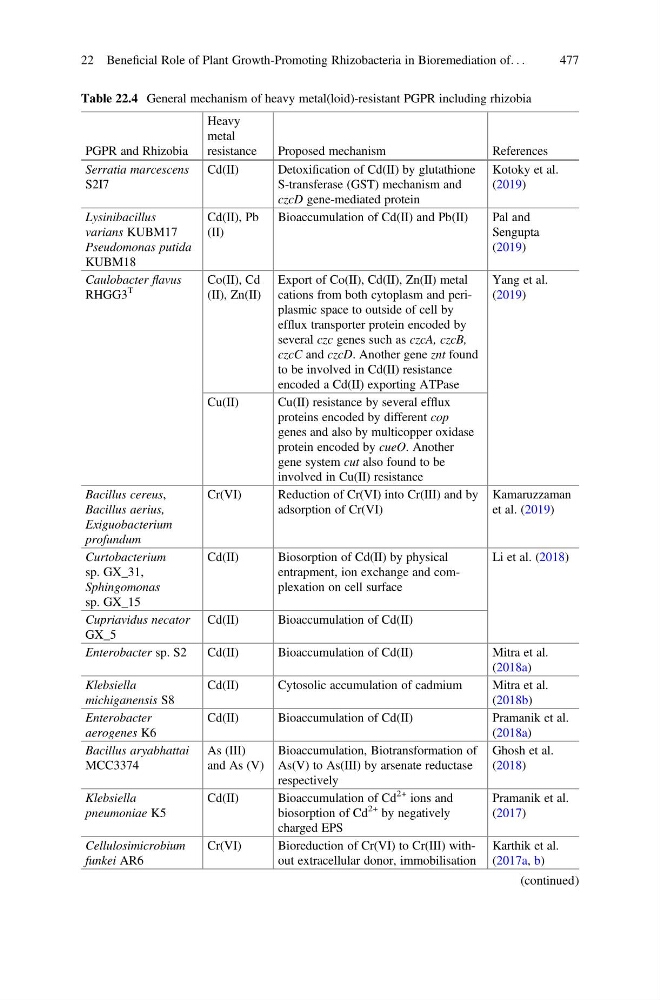
Table 22.4 General mechanism of heavy metal(loid)-resistant PGPR including rhizobia
PGPR and Rhizobia
Heavy
metal
resistance
Proposed mechanism
References
Serratia marcescens
S2I7
Cd(II)
Detoxification of Cd(II) by glutathione
S-transferase (GST) mechanism and
czcD gene-mediated protein
Kotoky et al.
(2019)
Lysinibacillus
varians KUBM17
Pseudomonas putida
KUBM18
Cd(II), Pb
(II)
Bioaccumulation of Cd(II) and Pb(II)
Pal and
Sengupta
(2019)
Caulobacter flavus
RHGG3
T
Co(II), Cd
(II), Zn(II)
Export of Co(II), Cd(II), Zn(II) metal
cations from both cytoplasm and periplasmic space to outside of cell by
efflux transporter protein encoded by
several czc genes such as czcA, czcB,
czcC and czcD. Another gene znt found
to be involved in Cd(II) resistance
encoded a Cd(II) exporting ATPase
Yang et al.
(2019)
Cu(II)
Cu(II) resistance by several efflux
proteins encoded by different cop
genes and also by multicopper oxidase
protein encoded by cueO. Another
gene system cut also found to be
involved in Cu(II) resistance
Bacillus cereus,
Bacillus aerius,
Exiguobacterium
profundum
Cr(VI)
Reduction of Cr(VI) into Cr(III) and by
adsorption of Cr(VI)
Kamaruzzaman
et al. (2019)
Curtobacterium
sp. GX_31,
Sphingomonas
sp. GX_15
Cd(II)
Biosorption of Cd(II) by physical
entrapment, ion exchange and complexation on cell surface
Li et al. (2018)
Cupriavidus necator
GX_5
Cd(II)
Bioaccumulation of Cd(II)
Enterobacter sp. S2
Cd(II)
Bioaccumulation of Cd(II)
Mitra et al.
(2018a)
Klebsiella
michiganensis S8
Cd(II)
Cytosolic accumulation of cadmium
Mitra et al.
(2018b)
Enterobacter
aerogenes K6
Cd(II)
Bioaccumulation of Cd(II)
Pramanik et al.
(2018a)
Bacillus aryabhattai
MCC3374
As (III)
and As (V)
Bioaccumulation, Biotransformation of
As(V) to As(III) by arsenate reductase
respectively
Ghosh et al.
(2018)
Klebsiella
pneumoniae K5
Cd(II)
Bioaccumulation of Cd
2+ ions and
biosorption of Cd
2+ by negatively
charged EPS
Pramanik et al.
(2017)
Cellulosimicrobium
funkei AR6
Cr(VI)
Bioreduction of Cr(VI) to Cr(III) without extracellular donor, immobilisation
Karthik et al.
(2017a, b)
(continued)
22 Beneficial Role of Plant Growth-Promoting Rhizobacteria in Bioremediation of. . .
477
PGPR and Rhizobia
Heavy
metal
resistance
Proposed mechanism
References
Serratia marcescens
S2I7
Cd(II)
Detoxification of Cd(II) by glutathione
S-transferase (GST) mechanism and
czcD gene-mediated protein
Kotoky et al.
(2019)
Lysinibacillus
varians KUBM17
Pseudomonas putida
KUBM18
Cd(II), Pb
(II)
Bioaccumulation of Cd(II) and Pb(II)
Pal and
Sengupta
(2019)
Caulobacter flavus
RHGG3
T
Co(II), Cd
(II), Zn(II)
Export of Co(II), Cd(II), Zn(II) metal
cations from both cytoplasm and periplasmic space to outside of cell by
efflux transporter protein encoded by
several czc genes such as czcA, czcB,
czcC and czcD. Another gene znt found
to be involved in Cd(II) resistance
encoded a Cd(II) exporting ATPase
Yang et al.
(2019)
Cu(II)
Cu(II) resistance by several efflux
proteins encoded by different cop
genes and also by multicopper oxidase
protein encoded by cueO. Another
gene system cut also found to be
involved in Cu(II) resistance
Bacillus cereus,
Bacillus aerius,
Exiguobacterium
profundum
Cr(VI)
Reduction of Cr(VI) into Cr(III) and by
adsorption of Cr(VI)
Kamaruzzaman
et al. (2019)
Curtobacterium
sp. GX_31,
Sphingomonas
sp. GX_15
Cd(II)
Biosorption of Cd(II) by physical
entrapment, ion exchange and complexation on cell surface
Li et al. (2018)
Cupriavidus necator
GX_5
Cd(II)
Bioaccumulation of Cd(II)
Enterobacter sp. S2
Cd(II)
Bioaccumulation of Cd(II)
Mitra et al.
(2018a)
Klebsiella
michiganensis S8
Cd(II)
Cytosolic accumulation of cadmium
Mitra et al.
(2018b)
Enterobacter
aerogenes K6
Cd(II)
Bioaccumulation of Cd(II)
Pramanik et al.
(2018a)
Bacillus aryabhattai
MCC3374
As (III)
and As (V)
Bioaccumulation, Biotransformation of
As(V) to As(III) by arsenate reductase
respectively
Ghosh et al.
(2018)
Klebsiella
pneumoniae K5
Cd(II)
Bioaccumulation of Cd
2+ ions and
biosorption of Cd
2+ by negatively
charged EPS
Pramanik et al.
(2017)
Cellulosimicrobium
funkei AR6
Cr(VI)
Bioreduction of Cr(VI) to Cr(III) without extracellular donor, immobilisation
Karthik et al.
(2017a, b)
(continued)
22 Beneficial Role of Plant Growth-Promoting Rhizobacteria in Bioremediation of. . .
477