

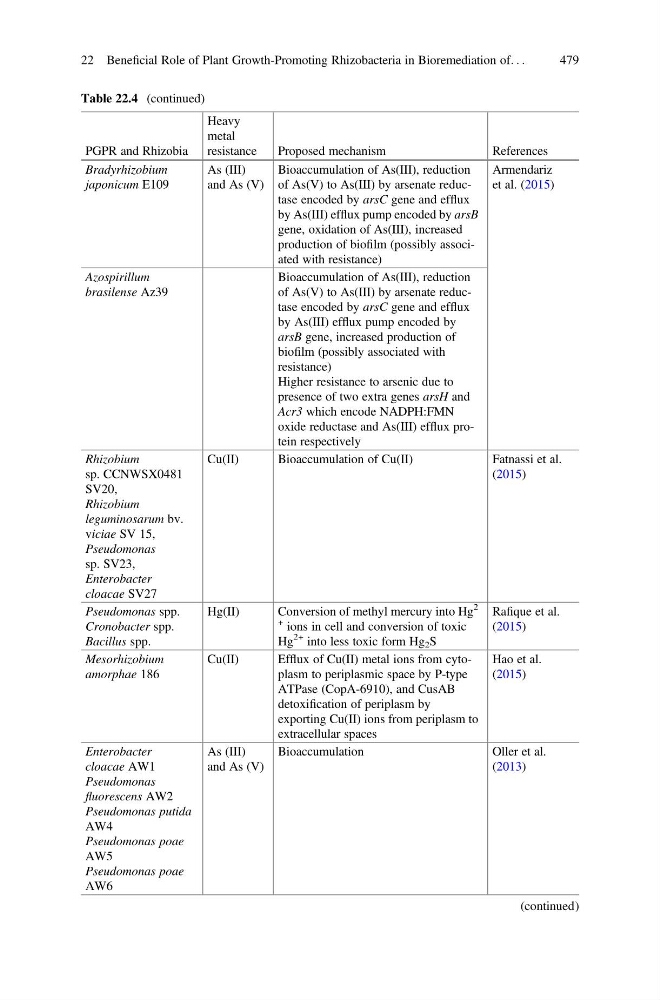
Table 22.4 (continued)
PGPR and Rhizobia
Heavy
metal
resistance
Proposed mechanism
References
Bradyrhizobium
japonicum E109
As (III)
and As (V)
Bioaccumulation of As(III), reduction
of As(V) to As(III) by arsenate reductase encoded by arsC gene and efflux
by As(III) efflux pump encoded by arsB
gene, oxidation of As(III), increased
production of biofilm (possibly associated with resistance)
Armendariz
et al. (2015)
Azospirillum
brasilense Az39
Bioaccumulation of As(III), reduction
of As(V) to As(III) by arsenate reductase encoded by arsC gene and efflux
by As(III) efflux pump encoded by
arsB gene, increased production of
biofilm (possibly associated with
resistance)
Higher resistance to arsenic due to
presence of two extra genes arsH and
Acr3 which encode NADPH:FMN
oxide reductase and As(III) efflux protein respectively
Rhizobium
sp. CCNWSX0481
SV20,
Rhizobium
leguminosarum bv.
viciae SV 15,
Pseudomonas
sp. SV23,
Enterobacter
cloacae SV27
Cu(II)
Bioaccumulation of Cu(II)
Fatnassi et al.
(2015)
Pseudomonas spp.
Cronobacter spp.
Bacillus spp.
Hg(II)
Conversion of methyl mercury into Hg
2
+ ions in cell and conversion of toxic
Hg
2+ into less toxic form Hg 2 S
Rafique et al.
(2015)
Mesorhizobium
amorphae 186
Cu(II)
Efflux of Cu(II) metal ions from cytoplasm to periplasmic space by P-type
ATPase (CopA-6910), and CusAB
detoxification of periplasm by
exporting Cu(II) ions from periplasm to
extracellular spaces
Hao et al.
(2015)
Enterobacter
cloacae AW1
Pseudomonas
fluorescens AW2
Pseudomonas putida
AW4
Pseudomonas poae
AW5
Pseudomonas poae
AW6
As (III)
and As (V)
Bioaccumulation
Oller et al.
(2013)
(continued)
22 Beneficial Role of Plant Growth-Promoting Rhizobacteria in Bioremediation of. . .
479
PGPR and Rhizobia
Heavy
metal
resistance
Proposed mechanism
References
Bradyrhizobium
japonicum E109
As (III)
and As (V)
Bioaccumulation of As(III), reduction
of As(V) to As(III) by arsenate reductase encoded by arsC gene and efflux
by As(III) efflux pump encoded by arsB
gene, oxidation of As(III), increased
production of biofilm (possibly associated with resistance)
Armendariz
et al. (2015)
Azospirillum
brasilense Az39
Bioaccumulation of As(III), reduction
of As(V) to As(III) by arsenate reductase encoded by arsC gene and efflux
by As(III) efflux pump encoded by
arsB gene, increased production of
biofilm (possibly associated with
resistance)
Higher resistance to arsenic due to
presence of two extra genes arsH and
Acr3 which encode NADPH:FMN
oxide reductase and As(III) efflux protein respectively
Rhizobium
sp. CCNWSX0481
SV20,
Rhizobium
leguminosarum bv.
viciae SV 15,
Pseudomonas
sp. SV23,
Enterobacter
cloacae SV27
Cu(II)
Bioaccumulation of Cu(II)
Fatnassi et al.
(2015)
Pseudomonas spp.
Cronobacter spp.
Bacillus spp.
Hg(II)
Conversion of methyl mercury into Hg
2
+ ions in cell and conversion of toxic
Hg
2+ into less toxic form Hg 2 S
Rafique et al.
(2015)
Mesorhizobium
amorphae 186
Cu(II)
Efflux of Cu(II) metal ions from cytoplasm to periplasmic space by P-type
ATPase (CopA-6910), and CusAB
detoxification of periplasm by
exporting Cu(II) ions from periplasm to
extracellular spaces
Hao et al.
(2015)
Enterobacter
cloacae AW1
Pseudomonas
fluorescens AW2
Pseudomonas putida
AW4
Pseudomonas poae
AW5
Pseudomonas poae
AW6
As (III)
and As (V)
Bioaccumulation
Oller et al.
(2013)
(continued)
22 Beneficial Role of Plant Growth-Promoting Rhizobacteria in Bioremediation of. . .
479