

of normal cellular function have also been identified (Requejo and Tena 2006;
Armendariz et al. 2016).
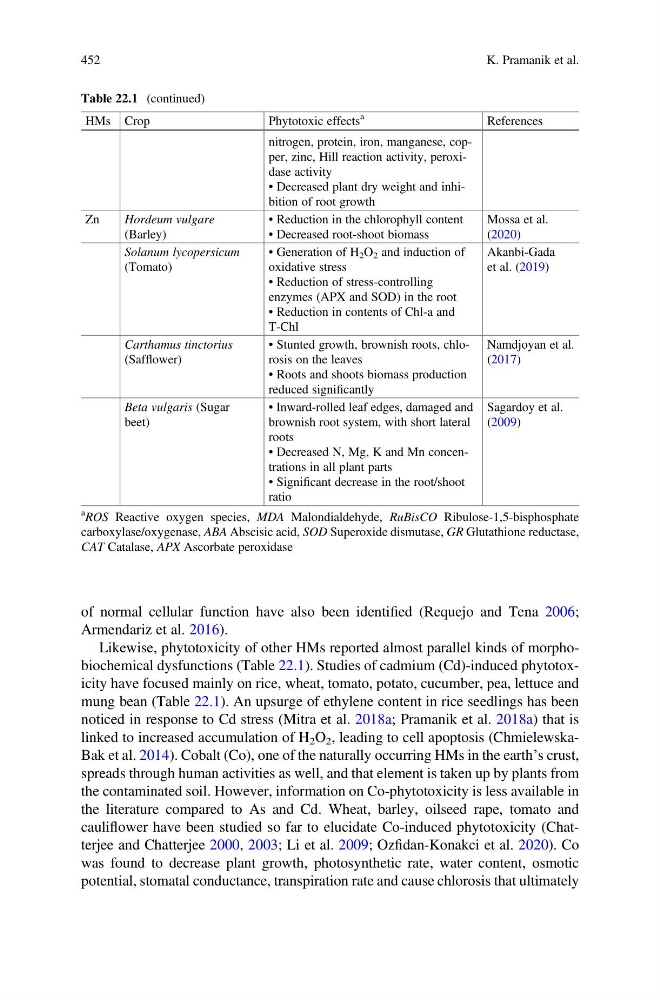
Likewise, phytotoxicity of other HMs reported almost parallel kinds of morphobiochemical dysfunctions (Table 22.1). Studies of cadmium (Cd)-induced phytotoxicity have focused mainly on rice, wheat, tomato, potato, cucumber, pea, lettuce and
mung bean (Table 22.1). An upsurge of ethylene content in rice seedlings has been
noticed in response to Cd stress (Mitra et al. 2018a; Pramanik et al. 2018a) that is
linked to increased accumulation of H 2 O 2 , leading to cell apoptosis (ChmielewskaBak et al. 2014). Cobalt (Co), one of the naturally occurring HMs in the earth’s crust,
spreads through human activities as well, and that element is taken up by plants from
the contaminated soil. However, information on Co-phytotoxicity is less available in
the literature compared to As and Cd. Wheat, barley, oilseed rape, tomato and
cauliflower have been studied so far to elucidate Co-induced phytotoxicity (Chatterjee and Chatterjee 2000, 2003; Li et al. 2009; Ozfidan-Konakci et al. 2020). Co
was found to decrease plant growth, photosynthetic rate, water content, osmotic
potential, stomatal conductance, transpiration rate and cause chlorosis that ultimately
Table 22.1 (continued)
HMs Crop
Phytotoxic effects
a
References
nitrogen, protein, iron, manganese, copper, zinc, Hill reaction activity, peroxidase activity
• Decreased plant dry weight and inhibition of root growth
Zn
Hordeum vulgare
(Barley)
• Reduction in the chlorophyll content
• Decreased root-shoot biomass
Mossa et al.
(2020)
Solanum lycopersicum
(Tomato)
• Generation of H 2 O 2 and induction of
oxidative stress
• Reduction of stress-controlling
enzymes (APX and SOD) in the root
• Reduction in contents of Chl-a and
T-Chl
Akanbi-Gada
et al. (2019)
Carthamus tinctorius
(Safflower)
• Stunted growth, brownish roots, chlorosis on the leaves
• Roots and shoots biomass production
reduced significantly
Namdjoyan et al.
(2017)
Beta vulgaris (Sugar
beet)
• Inward-rolled leaf edges, damaged and
brownish root system, with short lateral
roots
• Decreased N, Mg, K and Mn concentrations in all plant parts
• Significant decrease in the root/shoot
ratio
Sagardoy et al.
(2009)
a ROS Reactive oxygen species, MDA Malondialdehyde, RuBisCO Ribulose-1,5-bisphosphate
carboxylase/oxygenase, ABA Abscisic acid, SOD Superoxide dismutase, GR Glutathione reductase,
CAT Catalase, APX Ascorbate peroxidase
452
K. Pramanik et al.
Armendariz et al. 2016).
Likewise, phytotoxicity of other HMs reported almost parallel kinds of morphobiochemical dysfunctions (Table 22.1). Studies of cadmium (Cd)-induced phytotoxicity have focused mainly on rice, wheat, tomato, potato, cucumber, pea, lettuce and
mung bean (Table 22.1). An upsurge of ethylene content in rice seedlings has been
noticed in response to Cd stress (Mitra et al. 2018a; Pramanik et al. 2018a) that is
linked to increased accumulation of H 2 O 2 , leading to cell apoptosis (ChmielewskaBak et al. 2014). Cobalt (Co), one of the naturally occurring HMs in the earth’s crust,
spreads through human activities as well, and that element is taken up by plants from
the contaminated soil. However, information on Co-phytotoxicity is less available in
the literature compared to As and Cd. Wheat, barley, oilseed rape, tomato and
cauliflower have been studied so far to elucidate Co-induced phytotoxicity (Chatterjee and Chatterjee 2000, 2003; Li et al. 2009; Ozfidan-Konakci et al. 2020). Co
was found to decrease plant growth, photosynthetic rate, water content, osmotic
potential, stomatal conductance, transpiration rate and cause chlorosis that ultimately
Table 22.1 (continued)
HMs Crop
Phytotoxic effects
a
References
nitrogen, protein, iron, manganese, copper, zinc, Hill reaction activity, peroxidase activity
• Decreased plant dry weight and inhibition of root growth
Zn
Hordeum vulgare
(Barley)
• Reduction in the chlorophyll content
• Decreased root-shoot biomass
Mossa et al.
(2020)
Solanum lycopersicum
(Tomato)
• Generation of H 2 O 2 and induction of
oxidative stress
• Reduction of stress-controlling
enzymes (APX and SOD) in the root
• Reduction in contents of Chl-a and
T-Chl
Akanbi-Gada
et al. (2019)
Carthamus tinctorius
(Safflower)
• Stunted growth, brownish roots, chlorosis on the leaves
• Roots and shoots biomass production
reduced significantly
Namdjoyan et al.
(2017)
Beta vulgaris (Sugar
beet)
• Inward-rolled leaf edges, damaged and
brownish root system, with short lateral
roots
• Decreased N, Mg, K and Mn concentrations in all plant parts
• Significant decrease in the root/shoot
ratio
Sagardoy et al.
(2009)
a ROS Reactive oxygen species, MDA Malondialdehyde, RuBisCO Ribulose-1,5-bisphosphate
carboxylase/oxygenase, ABA Abscisic acid, SOD Superoxide dismutase, GR Glutathione reductase,
CAT Catalase, APX Ascorbate peroxidase
452
K. Pramanik et al.