

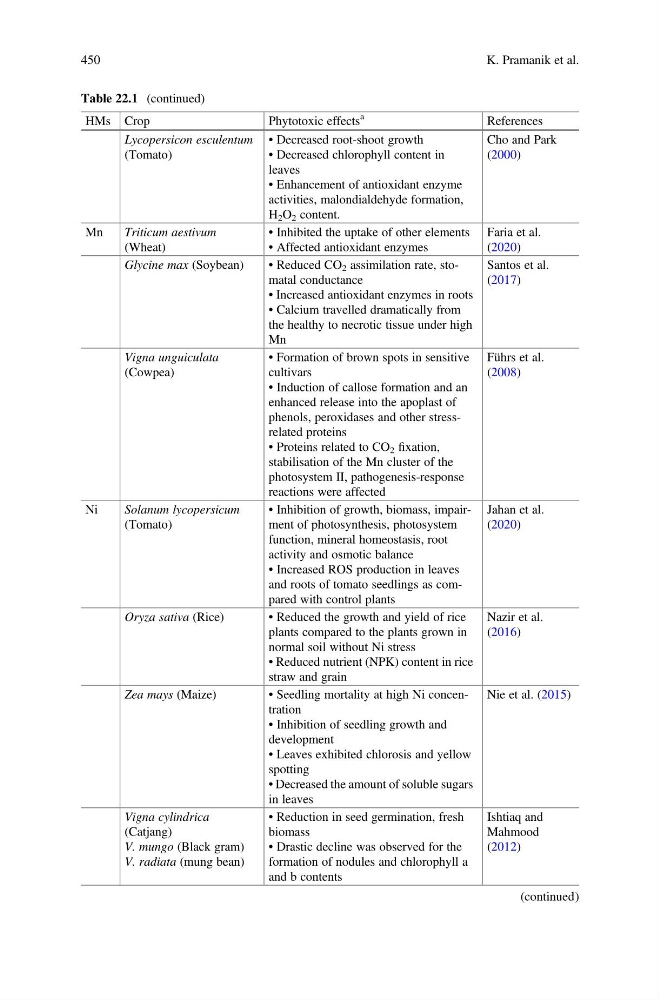
Table 22.1 (continued)
HMs Crop
Phytotoxic effects
a
References
Lycopersicon esculentum
(Tomato)
• Decreased root-shoot growth
• Decreased chlorophyll content in
leaves
• Enhancement of antioxidant enzyme
activities, malondialdehyde formation,
H 2 O 2 content.
Cho and Park
(2000)
Mn
Triticum aestivum
(Wheat)
• Inhibited the uptake of other elements
• Affected antioxidant enzymes
Faria et al.
(2020)
Glycine max (Soybean)
• Reduced CO 2 assimilation rate, stomatal conductance
• Increased antioxidant enzymes in roots
• Calcium travelled dramatically from
the healthy to necrotic tissue under high
Mn
Santos et al.
(2017)
Vigna unguiculata
(Cowpea)
• Formation of brown spots in sensitive
cultivars
• Induction of callose formation and an
enhanced release into the apoplast of
phenols, peroxidases and other stressrelated proteins
• Proteins related to CO 2 fixation,
stabilisation of the Mn cluster of the
photosystem II, pathogenesis-response
reactions were affected
Führs et al.
(2008)
Ni
Solanum lycopersicum
(Tomato)
• Inhibition of growth, biomass, impairment of photosynthesis, photosystem
function, mineral homeostasis, root
activity and osmotic balance
• Increased ROS production in leaves
and roots of tomato seedlings as compared with control plants
Jahan et al.
(2020)
Oryza sativa (Rice)
• Reduced the growth and yield of rice
plants compared to the plants grown in
normal soil without Ni stress
• Reduced nutrient (NPK) content in rice
straw and grain
Nazir et al.
(2016)
Zea mays (Maize)
• Seedling mortality at high Ni concentration
• Inhibition of seedling growth and
development
• Leaves exhibited chlorosis and yellow
spotting
• Decreased the amount of soluble sugars
in leaves
Nie et al. (2015)
Vigna cylindrica
(Catjang)
V. mungo (Black gram)
V. radiata (mung bean)
• Reduction in seed germination, fresh
biomass
• Drastic decline was observed for the
formation of nodules and chlorophyll a
and b contents
Ishtiaq and
Mahmood
(2012)
(continued)
450
K. Pramanik et al.
HMs Crop
Phytotoxic effects
a
References
Lycopersicon esculentum
(Tomato)
• Decreased root-shoot growth
• Decreased chlorophyll content in
leaves
• Enhancement of antioxidant enzyme
activities, malondialdehyde formation,
H 2 O 2 content.
Cho and Park
(2000)
Mn
Triticum aestivum
(Wheat)
• Inhibited the uptake of other elements
• Affected antioxidant enzymes
Faria et al.
(2020)
Glycine max (Soybean)
• Reduced CO 2 assimilation rate, stomatal conductance
• Increased antioxidant enzymes in roots
• Calcium travelled dramatically from
the healthy to necrotic tissue under high
Mn
Santos et al.
(2017)
Vigna unguiculata
(Cowpea)
• Formation of brown spots in sensitive
cultivars
• Induction of callose formation and an
enhanced release into the apoplast of
phenols, peroxidases and other stressrelated proteins
• Proteins related to CO 2 fixation,
stabilisation of the Mn cluster of the
photosystem II, pathogenesis-response
reactions were affected
Führs et al.
(2008)
Ni
Solanum lycopersicum
(Tomato)
• Inhibition of growth, biomass, impairment of photosynthesis, photosystem
function, mineral homeostasis, root
activity and osmotic balance
• Increased ROS production in leaves
and roots of tomato seedlings as compared with control plants
Jahan et al.
(2020)
Oryza sativa (Rice)
• Reduced the growth and yield of rice
plants compared to the plants grown in
normal soil without Ni stress
• Reduced nutrient (NPK) content in rice
straw and grain
Nazir et al.
(2016)
Zea mays (Maize)
• Seedling mortality at high Ni concentration
• Inhibition of seedling growth and
development
• Leaves exhibited chlorosis and yellow
spotting
• Decreased the amount of soluble sugars
in leaves
Nie et al. (2015)
Vigna cylindrica
(Catjang)
V. mungo (Black gram)
V. radiata (mung bean)
• Reduction in seed germination, fresh
biomass
• Drastic decline was observed for the
formation of nodules and chlorophyll a
and b contents
Ishtiaq and
Mahmood
(2012)
(continued)
450
K. Pramanik et al.