

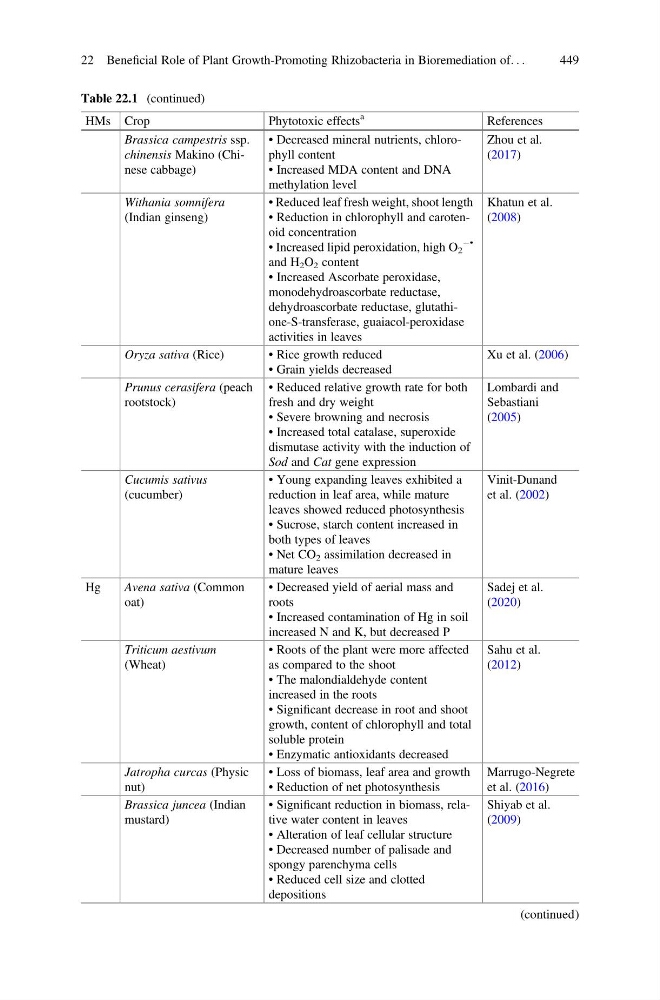
Table 22.1 (continued)
HMs Crop
Phytotoxic effects
a
References
Brassica campestris ssp.
chinensis Makino (Chinese cabbage)
• Decreased mineral nutrients, chlorophyll content
• Increased MDA content and DNA
methylation level
Zhou et al.
(2017)
Withania somnifera
(Indian ginseng)
• Reduced leaf fresh weight, shoot length
• Reduction in chlorophyll and carotenoid concentration
• Increased lipid peroxidation, high O 2
À•
and H 2 O 2 content
• Increased Ascorbate peroxidase,
monodehydroascorbate reductase,
dehydroascorbate reductase, glutathione-S-transferase, guaiacol-peroxidase
activities in leaves
Khatun et al.
(2008)
Oryza sativa (Rice)
• Rice growth reduced
• Grain yields decreased
Xu et al. (2006)
Prunus cerasifera (peach
rootstock)
• Reduced relative growth rate for both
fresh and dry weight
• Severe browning and necrosis
• Increased total catalase, superoxide
dismutase activity with the induction of
Sod and Cat gene expression
Lombardi and
Sebastiani
(2005)
Cucumis sativus
(cucumber)
• Young expanding leaves exhibited a
reduction in leaf area, while mature
leaves showed reduced photosynthesis
• Sucrose, starch content increased in
both types of leaves
• Net CO 2 assimilation decreased in
mature leaves
Vinit-Dunand
et al. (2002)
Hg
Avena sativa (Common
oat)
• Decreased yield of aerial mass and
roots
• Increased contamination of Hg in soil
increased N and K, but decreased P
Sadej et al.
(2020)
Triticum aestivum
(Wheat)
• Roots of the plant were more affected
as compared to the shoot
• The malondialdehyde content
increased in the roots
• Significant decrease in root and shoot
growth, content of chlorophyll and total
soluble protein
• Enzymatic antioxidants decreased
Sahu et al.
(2012)
Jatropha curcas (Physic
nut)
• Loss of biomass, leaf area and growth
• Reduction of net photosynthesis
Marrugo-Negrete
et al. (2016)
Brassica juncea (Indian
mustard)
• Significant reduction in biomass, relative water content in leaves
• Alteration of leaf cellular structure
• Decreased number of palisade and
spongy parenchyma cells
• Reduced cell size and clotted
depositions
Shiyab et al.
(2009)
(continued)
22 Beneficial Role of Plant Growth-Promoting Rhizobacteria in Bioremediation of. . .
449
HMs Crop
Phytotoxic effects
a
References
Brassica campestris ssp.
chinensis Makino (Chinese cabbage)
• Decreased mineral nutrients, chlorophyll content
• Increased MDA content and DNA
methylation level
Zhou et al.
(2017)
Withania somnifera
(Indian ginseng)
• Reduced leaf fresh weight, shoot length
• Reduction in chlorophyll and carotenoid concentration
• Increased lipid peroxidation, high O 2
À•
and H 2 O 2 content
• Increased Ascorbate peroxidase,
monodehydroascorbate reductase,
dehydroascorbate reductase, glutathione-S-transferase, guaiacol-peroxidase
activities in leaves
Khatun et al.
(2008)
Oryza sativa (Rice)
• Rice growth reduced
• Grain yields decreased
Xu et al. (2006)
Prunus cerasifera (peach
rootstock)
• Reduced relative growth rate for both
fresh and dry weight
• Severe browning and necrosis
• Increased total catalase, superoxide
dismutase activity with the induction of
Sod and Cat gene expression
Lombardi and
Sebastiani
(2005)
Cucumis sativus
(cucumber)
• Young expanding leaves exhibited a
reduction in leaf area, while mature
leaves showed reduced photosynthesis
• Sucrose, starch content increased in
both types of leaves
• Net CO 2 assimilation decreased in
mature leaves
Vinit-Dunand
et al. (2002)
Hg
Avena sativa (Common
oat)
• Decreased yield of aerial mass and
roots
• Increased contamination of Hg in soil
increased N and K, but decreased P
Sadej et al.
(2020)
Triticum aestivum
(Wheat)
• Roots of the plant were more affected
as compared to the shoot
• The malondialdehyde content
increased in the roots
• Significant decrease in root and shoot
growth, content of chlorophyll and total
soluble protein
• Enzymatic antioxidants decreased
Sahu et al.
(2012)
Jatropha curcas (Physic
nut)
• Loss of biomass, leaf area and growth
• Reduction of net photosynthesis
Marrugo-Negrete
et al. (2016)
Brassica juncea (Indian
mustard)
• Significant reduction in biomass, relative water content in leaves
• Alteration of leaf cellular structure
• Decreased number of palisade and
spongy parenchyma cells
• Reduced cell size and clotted
depositions
Shiyab et al.
(2009)
(continued)
22 Beneficial Role of Plant Growth-Promoting Rhizobacteria in Bioremediation of. . .
449