

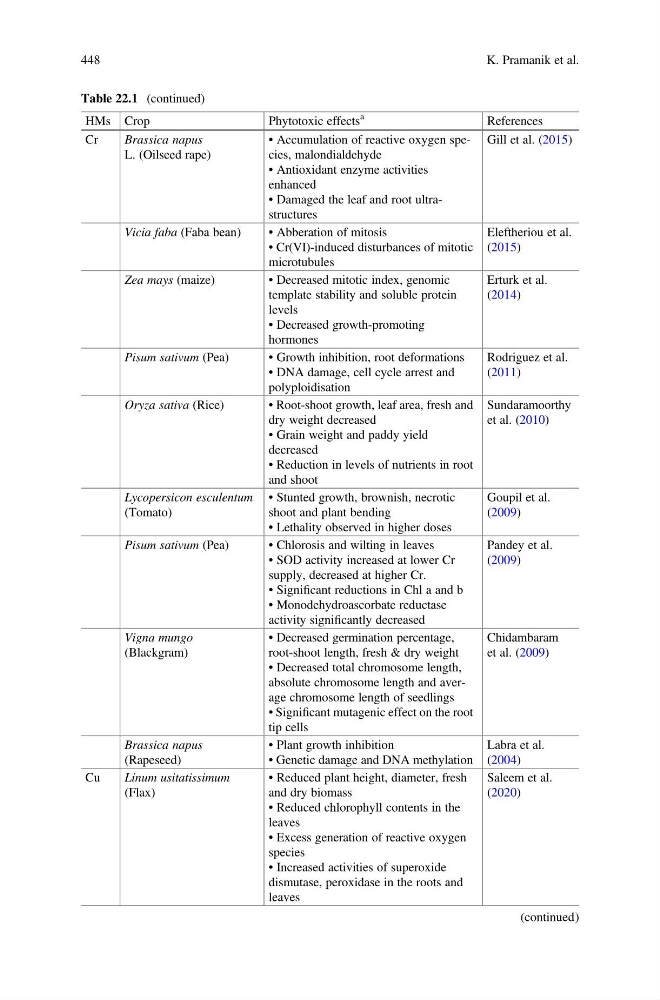
Table 22.1 (continued)
HMs Crop
Phytotoxic effects
a
References
Cr
Brassica napus
L. (Oilseed rape)
• Accumulation of reactive oxygen species, malondialdehyde
• Antioxidant enzyme activities
enhanced
• Damaged the leaf and root ultrastructures
Gill et al. (2015)
Vicia faba (Faba bean)
• Abberation of mitosis
• Cr(VI)-induced disturbances of mitotic
microtubules
Eleftheriou et al.
(2015)
Zea mays (maize)
• Decreased mitotic index, genomic
template stability and soluble protein
levels
• Decreased growth-promoting
hormones
Erturk et al.
(2014)
Pisum sativum (Pea)
• Growth inhibition, root deformations
• DNA damage, cell cycle arrest and
polyploidisation
Rodriguez et al.
(2011)
Oryza sativa (Rice)
• Root-shoot growth, leaf area, fresh and
dry weight decreased
• Grain weight and paddy yield
decreased
• Reduction in levels of nutrients in root
and shoot
Sundaramoorthy
et al. (2010)
Lycopersicon esculentum
(Tomato)
• Stunted growth, brownish, necrotic
shoot and plant bending
• Lethality observed in higher doses
Goupil et al.
(2009)
Pisum sativum (Pea)
• Chlorosis and wilting in leaves
• SOD activity increased at lower Cr
supply, decreased at higher Cr.
• Significant reductions in Chl a and b
• Monodehydroascorbate reductase
activity significantly decreased
Pandey et al.
(2009)
Vigna mungo
(Blackgram)
• Decreased germination percentage,
root-shoot length, fresh & dry weight
• Decreased total chromosome length,
absolute chromosome length and average chromosome length of seedlings
• Significant mutagenic effect on the root
tip cells
Chidambaram
et al. (2009)
Brassica napus
(Rapeseed)
• Plant growth inhibition
• Genetic damage and DNA methylation
Labra et al.
(2004)
Cu
Linum usitatissimum
(Flax)
• Reduced plant height, diameter, fresh
and dry biomass
• Reduced chlorophyll contents in the
leaves
• Excess generation of reactive oxygen
species
• Increased activities of superoxide
dismutase, peroxidase in the roots and
leaves
Saleem et al.
(2020)
(continued)
448
K. Pramanik et al.
HMs Crop
Phytotoxic effects
a
References
Cr
Brassica napus
L. (Oilseed rape)
• Accumulation of reactive oxygen species, malondialdehyde
• Antioxidant enzyme activities
enhanced
• Damaged the leaf and root ultrastructures
Gill et al. (2015)
Vicia faba (Faba bean)
• Abberation of mitosis
• Cr(VI)-induced disturbances of mitotic
microtubules
Eleftheriou et al.
(2015)
Zea mays (maize)
• Decreased mitotic index, genomic
template stability and soluble protein
levels
• Decreased growth-promoting
hormones
Erturk et al.
(2014)
Pisum sativum (Pea)
• Growth inhibition, root deformations
• DNA damage, cell cycle arrest and
polyploidisation
Rodriguez et al.
(2011)
Oryza sativa (Rice)
• Root-shoot growth, leaf area, fresh and
dry weight decreased
• Grain weight and paddy yield
decreased
• Reduction in levels of nutrients in root
and shoot
Sundaramoorthy
et al. (2010)
Lycopersicon esculentum
(Tomato)
• Stunted growth, brownish, necrotic
shoot and plant bending
• Lethality observed in higher doses
Goupil et al.
(2009)
Pisum sativum (Pea)
• Chlorosis and wilting in leaves
• SOD activity increased at lower Cr
supply, decreased at higher Cr.
• Significant reductions in Chl a and b
• Monodehydroascorbate reductase
activity significantly decreased
Pandey et al.
(2009)
Vigna mungo
(Blackgram)
• Decreased germination percentage,
root-shoot length, fresh & dry weight
• Decreased total chromosome length,
absolute chromosome length and average chromosome length of seedlings
• Significant mutagenic effect on the root
tip cells
Chidambaram
et al. (2009)
Brassica napus
(Rapeseed)
• Plant growth inhibition
• Genetic damage and DNA methylation
Labra et al.
(2004)
Cu
Linum usitatissimum
(Flax)
• Reduced plant height, diameter, fresh
and dry biomass
• Reduced chlorophyll contents in the
leaves
• Excess generation of reactive oxygen
species
• Increased activities of superoxide
dismutase, peroxidase in the roots and
leaves
Saleem et al.
(2020)
(continued)
448
K. Pramanik et al.