

physical characteristics of horses evolutionarily have changed, as shown on Fig. 1.5,
we actually are visualizing the way in which the niche of horses has changed. Thus
far, the equids have been able to evolve in ways that allowed them to adapt to
changes in their available niche space. Failure to successfully adapt as a groups
potential niche or operational niche changes, or failure to successfully adapt when
confronted with a complete loss of operational niche, would result in extinction.
1.3 Can we Utilize our Knowledge of Microbes to Gain
Ecological Benefits?
Perhaps we can!
One conceptual example of beneficially using symbiotic interactions between
microbes and hosts is the idea that commercially applying plant growth promoting
bacteria may help us to reduce the demand for synthetic fertilizers (Khan et al. 2020).
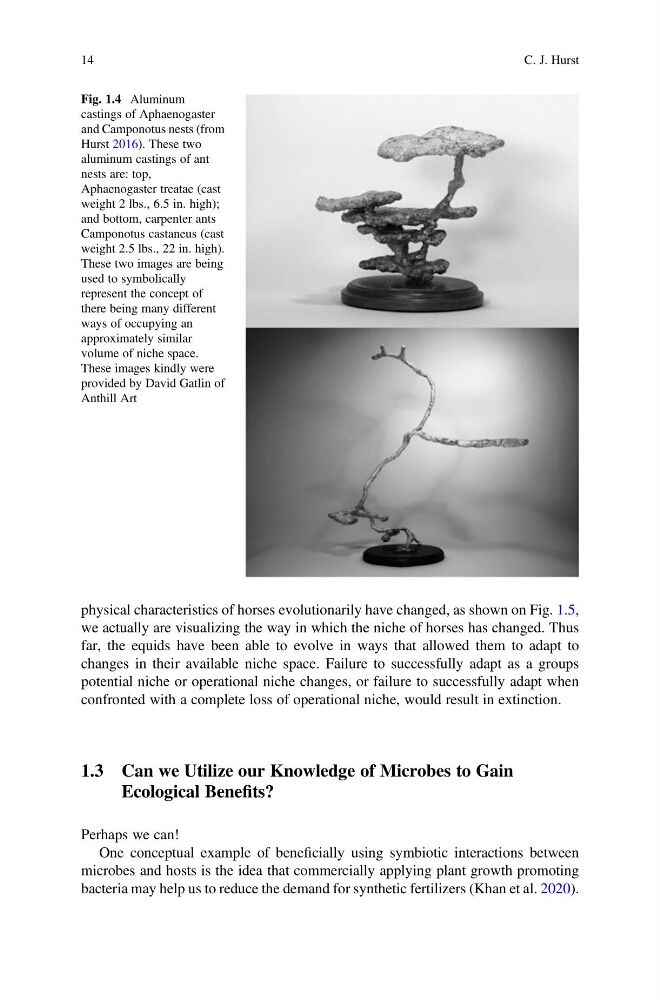
Fig. 1.4 Aluminum
castings of Aphaenogaster
and Camponotus nests (from
Hurst 2016). These two
aluminum castings of ant
nests are: top,
Aphaenogaster treatae (cast
weight 2 lbs., 6.5 in. high);
and bottom, carpenter ants
Camponotus castaneus (cast
weight 2.5 lbs., 22 in. high).
These two images are being
used to symbolically
represent the concept of
there being many different
ways of occupying an
approximately similar
volume of niche space.
These images kindly were
provided by David Gatlin of
Anthill Art
14
C. J. Hurst
we actually are visualizing the way in which the niche of horses has changed. Thus
far, the equids have been able to evolve in ways that allowed them to adapt to
changes in their available niche space. Failure to successfully adapt as a groups
potential niche or operational niche changes, or failure to successfully adapt when
confronted with a complete loss of operational niche, would result in extinction.
1.3 Can we Utilize our Knowledge of Microbes to Gain
Ecological Benefits?
Perhaps we can!
One conceptual example of beneficially using symbiotic interactions between
microbes and hosts is the idea that commercially applying plant growth promoting
bacteria may help us to reduce the demand for synthetic fertilizers (Khan et al. 2020).
Fig. 1.4 Aluminum
castings of Aphaenogaster
and Camponotus nests (from
Hurst 2016). These two
aluminum castings of ant
nests are: top,
Aphaenogaster treatae (cast
weight 2 lbs., 6.5 in. high);
and bottom, carpenter ants
Camponotus castaneus (cast
weight 2.5 lbs., 22 in. high).
These two images are being
used to symbolically
represent the concept of
there being many different
ways of occupying an
approximately similar
volume of niche space.
These images kindly were
provided by David Gatlin of
Anthill Art
14
C. J. Hurst