

Butyrate
À
þ 2 H 2 O ! 2 Acetate
À
þ H
þ
þ 2 H 2 ; ΔG o
0
¼ þ48:1 kJ
Benzoate
À
þ 7 H 2 O ! 3 Acetate
À
þ HCO 3
À
þ 3 H
þ
þ 3 H 2 ; ΔG o
0
¼ þ58:9 kJ
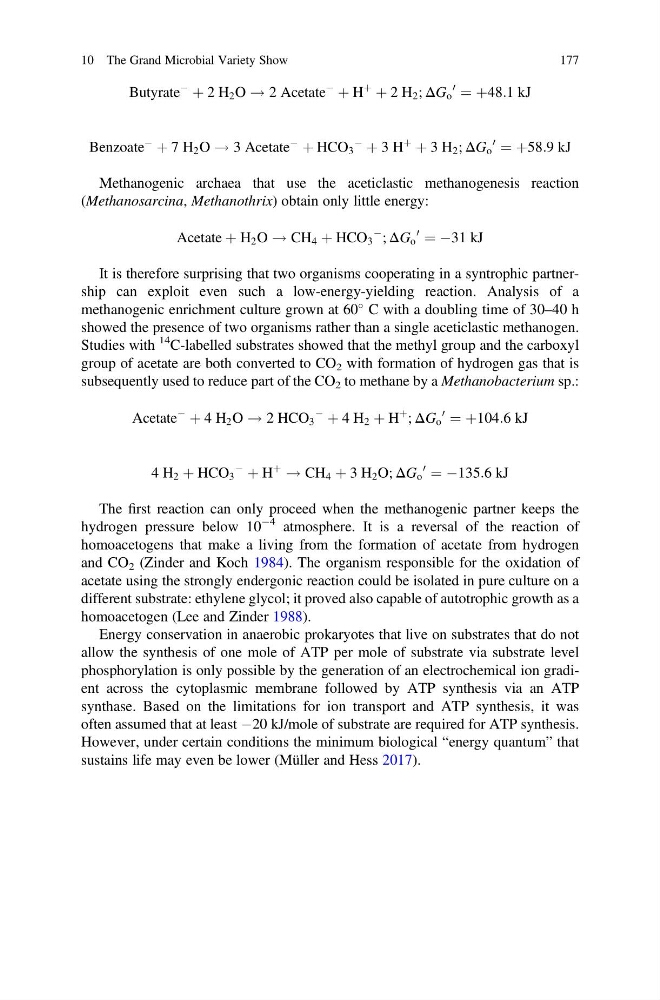
Methanogenic archaea that use the aceticlastic methanogenesis reaction
(Methanosarcina, Methanothrix) obtain only little energy:
Acetate þ H 2 O ! CH 4 þ HCO 3
À ; ΔG o
0
¼ À31 kJ
It is therefore surprising that two organisms cooperating in a syntrophic partnership can exploit even such a low-energy-yielding reaction. Analysis of a
methanogenic enrichment culture grown at 60
C with a doubling time of 30–40 h
showed the presence of two organisms rather than a single aceticlastic methanogen.
Studies with
14 C-labelled substrates showed that the methyl group and the carboxyl
group of acetate are both converted to CO 2 with formation of hydrogen gas that is
subsequently used to reduce part of the CO 2 to methane by a Methanobacterium sp.:
Acetate
À
þ 4 H 2 O ! 2 HCO 3
À
þ 4 H 2 þ H
þ ; ΔG o
0
¼ þ104:6 kJ
4 H 2 þ HCO 3
À
þ H
þ
! CH 4 þ 3 H 2 O; ΔG o
0
¼ À135:6 kJ
The first reaction can only proceed when the methanogenic partner keeps the
hydrogen pressure below 10
À4 atmosphere. It is a reversal of the reaction of
homoacetogens that make a living from the formation of acetate from hydrogen
and CO 2 (Zinder and Koch 1984). The organism responsible for the oxidation of
acetate using the strongly endergonic reaction could be isolated in pure culture on a
different substrate: ethylene glycol; it proved also capable of autotrophic growth as a
homoacetogen (Lee and Zinder 1988).
Energy conservation in anaerobic prokaryotes that live on substrates that do not
allow the synthesis of one mole of ATP per mole of substrate via substrate level
phosphorylation is only possible by the generation of an electrochemical ion gradient across the cytoplasmic membrane followed by ATP synthesis via an ATP
synthase. Based on the limitations for ion transport and ATP synthesis, it was
often assumed that at least À20 kJ/mole of substrate are required for ATP synthesis.
However, under certain conditions the minimum biological “energy quantum” that
sustains life may even be lower (Müller and Hess 2017).
10 The Grand Microbial Variety Show
177
À
þ 2 H 2 O ! 2 Acetate
À
þ H
þ
þ 2 H 2 ; ΔG o
0
¼ þ48:1 kJ
Benzoate
À
þ 7 H 2 O ! 3 Acetate
À
þ HCO 3
À
þ 3 H
þ
þ 3 H 2 ; ΔG o
0
¼ þ58:9 kJ
Methanogenic archaea that use the aceticlastic methanogenesis reaction
(Methanosarcina, Methanothrix) obtain only little energy:
Acetate þ H 2 O ! CH 4 þ HCO 3
À ; ΔG o
0
¼ À31 kJ
It is therefore surprising that two organisms cooperating in a syntrophic partnership can exploit even such a low-energy-yielding reaction. Analysis of a
methanogenic enrichment culture grown at 60
C with a doubling time of 30–40 h
showed the presence of two organisms rather than a single aceticlastic methanogen.
Studies with
14 C-labelled substrates showed that the methyl group and the carboxyl
group of acetate are both converted to CO 2 with formation of hydrogen gas that is
subsequently used to reduce part of the CO 2 to methane by a Methanobacterium sp.:
Acetate
À
þ 4 H 2 O ! 2 HCO 3
À
þ 4 H 2 þ H
þ ; ΔG o
0
¼ þ104:6 kJ
4 H 2 þ HCO 3
À
þ H
þ
! CH 4 þ 3 H 2 O; ΔG o
0
¼ À135:6 kJ
The first reaction can only proceed when the methanogenic partner keeps the
hydrogen pressure below 10
À4 atmosphere. It is a reversal of the reaction of
homoacetogens that make a living from the formation of acetate from hydrogen
and CO 2 (Zinder and Koch 1984). The organism responsible for the oxidation of
acetate using the strongly endergonic reaction could be isolated in pure culture on a
different substrate: ethylene glycol; it proved also capable of autotrophic growth as a
homoacetogen (Lee and Zinder 1988).
Energy conservation in anaerobic prokaryotes that live on substrates that do not
allow the synthesis of one mole of ATP per mole of substrate via substrate level
phosphorylation is only possible by the generation of an electrochemical ion gradient across the cytoplasmic membrane followed by ATP synthesis via an ATP
synthase. Based on the limitations for ion transport and ATP synthesis, it was
often assumed that at least À20 kJ/mole of substrate are required for ATP synthesis.
However, under certain conditions the minimum biological “energy quantum” that
sustains life may even be lower (Müller and Hess 2017).
10 The Grand Microbial Variety Show
177