

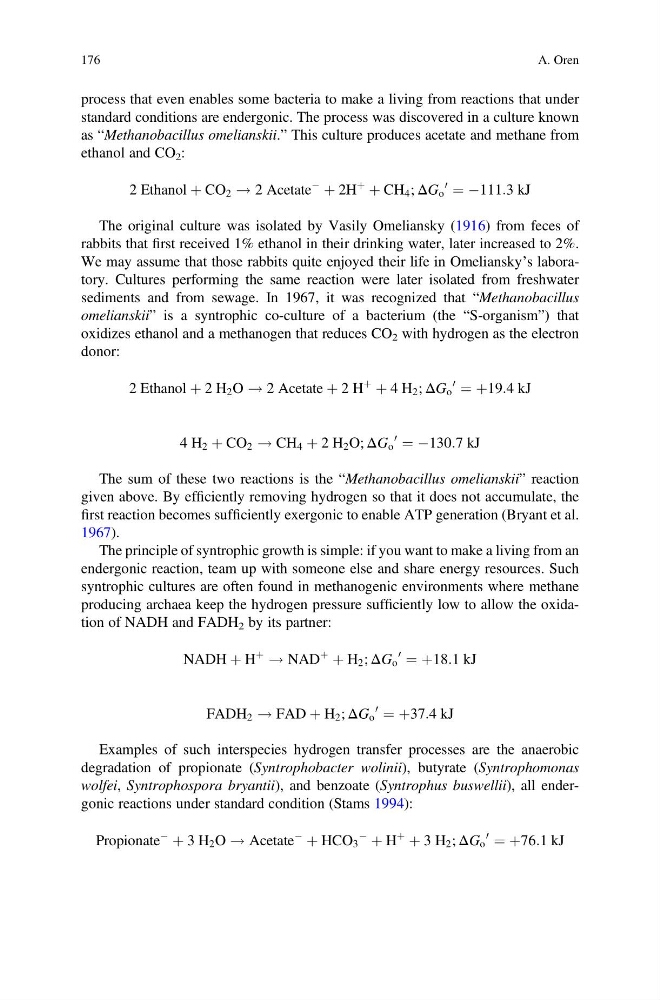
process that even enables some bacteria to make a living from reactions that under
standard conditions are endergonic. The process was discovered in a culture known
as “Methanobacillus omelianskii.” This culture produces acetate and methane from
ethanol and CO 2 :
2 Ethanol þ CO 2 ! 2 Acetate
À
þ 2H
þ
þ CH 4 ; ΔG o
0
¼ À111:3 kJ
The original culture was isolated by Vasily Omeliansky (1916) from feces of
rabbits that first received 1% ethanol in their drinking water, later increased to 2%.
We may assume that those rabbits quite enjoyed their life in Omeliansky’s laboratory. Cultures performing the same reaction were later isolated from freshwater
sediments and from sewage. In 1967, it was recognized that “Methanobacillus
omelianskii” is a syntrophic co-culture of a bacterium (the “S-organism”) that
oxidizes ethanol and a methanogen that reduces CO 2 with hydrogen as the electron
donor:
2 Ethanol þ 2 H 2 O ! 2 Acetate þ 2 H
þ
þ 4 H 2 ; ΔG o
0
¼ þ19:4 kJ
4 H 2 þ CO 2 ! CH 4 þ 2 H 2 O; ΔG o
0
¼ À130:7 kJ
The sum of these two reactions is the “Methanobacillus omelianskii” reaction
given above. By efficiently removing hydrogen so that it does not accumulate, the
first reaction becomes sufficiently exergonic to enable ATP generation (Bryant et al.
1967).
The principle of syntrophic growth is simple: if you want to make a living from an
endergonic reaction, team up with someone else and share energy resources. Such
syntrophic cultures are often found in methanogenic environments where methane
producing archaea keep the hydrogen pressure sufficiently low to allow the oxidation of NADH and FADH 2 by its partner:
NADH þ H
þ
! NAD
þ
þ H 2 ; ΔG o
0
¼ þ18:1 kJ
FADH 2 ! FAD þ H 2 ; ΔG o
0
¼ þ37:4 kJ
Examples of such interspecies hydrogen transfer processes are the anaerobic
degradation of propionate (Syntrophobacter wolinii), butyrate (Syntrophomonas
wolfei, Syntrophospora bryantii), and benzoate (Syntrophus buswellii), all endergonic reactions under standard condition (Stams 1994):
Propionate
À
þ 3 H 2 O ! Acetate
À
þ HCO 3
À
þ H
þ
þ 3 H 2 ; ΔG o
0
¼ þ76:1 kJ
176
A. Oren
standard conditions are endergonic. The process was discovered in a culture known
as “Methanobacillus omelianskii.” This culture produces acetate and methane from
ethanol and CO 2 :
2 Ethanol þ CO 2 ! 2 Acetate
À
þ 2H
þ
þ CH 4 ; ΔG o
0
¼ À111:3 kJ
The original culture was isolated by Vasily Omeliansky (1916) from feces of
rabbits that first received 1% ethanol in their drinking water, later increased to 2%.
We may assume that those rabbits quite enjoyed their life in Omeliansky’s laboratory. Cultures performing the same reaction were later isolated from freshwater
sediments and from sewage. In 1967, it was recognized that “Methanobacillus
omelianskii” is a syntrophic co-culture of a bacterium (the “S-organism”) that
oxidizes ethanol and a methanogen that reduces CO 2 with hydrogen as the electron
donor:
2 Ethanol þ 2 H 2 O ! 2 Acetate þ 2 H
þ
þ 4 H 2 ; ΔG o
0
¼ þ19:4 kJ
4 H 2 þ CO 2 ! CH 4 þ 2 H 2 O; ΔG o
0
¼ À130:7 kJ
The sum of these two reactions is the “Methanobacillus omelianskii” reaction
given above. By efficiently removing hydrogen so that it does not accumulate, the
first reaction becomes sufficiently exergonic to enable ATP generation (Bryant et al.
1967).
The principle of syntrophic growth is simple: if you want to make a living from an
endergonic reaction, team up with someone else and share energy resources. Such
syntrophic cultures are often found in methanogenic environments where methane
producing archaea keep the hydrogen pressure sufficiently low to allow the oxidation of NADH and FADH 2 by its partner:
NADH þ H
þ
! NAD
þ
þ H 2 ; ΔG o
0
¼ þ18:1 kJ
FADH 2 ! FAD þ H 2 ; ΔG o
0
¼ þ37:4 kJ
Examples of such interspecies hydrogen transfer processes are the anaerobic
degradation of propionate (Syntrophobacter wolinii), butyrate (Syntrophomonas
wolfei, Syntrophospora bryantii), and benzoate (Syntrophus buswellii), all endergonic reactions under standard condition (Stams 1994):
Propionate
À
þ 3 H 2 O ! Acetate
À
þ HCO 3
À
þ H
þ
þ 3 H 2 ; ΔG o
0
¼ þ76:1 kJ
176
A. Oren