

10.12 Can Indeed All Reactions with a Negative Gibbs Free
Energy Change Be Exploited to Drive Microbial
Growth?
The examples analyzed above create the impression that every possible exergonic
reaction that uses compounds readily available in nature is used at least by some type
of microorganism to make a living. This is indeed nearly always true.
Still, there are exceptions. The most notable is the simple equation:
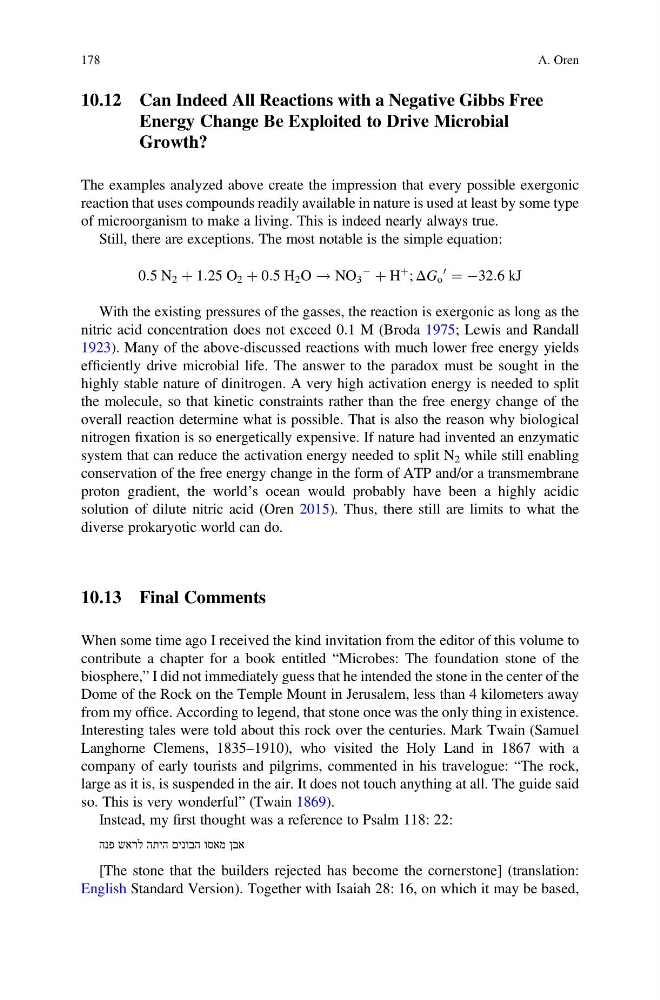
0:5 N 2 þ 1:25 O 2 þ 0:5 H 2 O ! NO 3
À
þ H
þ ; ΔG o
0
¼ À32:6 kJ
With the existing pressures of the gasses, the reaction is exergonic as long as the
nitric acid concentration does not exceed 0.1 M (Broda 1975; Lewis and Randall
1923). Many of the above-discussed reactions with much lower free energy yields
efficiently drive microbial life. The answer to the paradox must be sought in the
highly stable nature of dinitrogen. A very high activation energy is needed to split
the molecule, so that kinetic constraints rather than the free energy change of the
overall reaction determine what is possible. That is also the reason why biological
nitrogen fixation is so energetically expensive. If nature had invented an enzymatic
system that can reduce the activation energy needed to split N 2 while still enabling
conservation of the free energy change in the form of ATP and/or a transmembrane
proton gradient, the world’s ocean would probably have been a highly acidic
solution of dilute nitric acid (Oren 2015). Thus, there still are limits to what the
diverse prokaryotic world can do.
10.13 Final Comments
When some time ago I received the kind invitation from the editor of this volume to
contribute a chapter for a book entitled “Microbes: The foundation stone of the
biosphere,” I did not immediately guess that he intended the stone in the center of the
Dome of the Rock on the Temple Mount in Jerusalem, less than 4 kilometers away
from my office. According to legend, that stone once was the only thing in existence.
Interesting tales were told about this rock over the centuries. Mark Twain (Samuel
Langhorne Clemens, 1835–1910), who visited the Holy Land in 1867 with a
company of early tourists and pilgrims, commented in his travelogue: “The rock,
large as it is, is suspended in the air. It does not touch anything at all. The guide said
so. This is very wonderful” (Twain 1869).
Instead, my first thought was a reference to Psalm 118: 22:
א
ב
ן
מ
א
ס
ו
ה
ב
ו
נ
י
ם
ה
י
ת
ה
ל
ר
א
ש
פ
נ
ה
[The stone that the builders rejected has become the cornerstone] (translation:
English Standard Version). Together with Isaiah 28: 16, on which it may be based,
178
A. Oren
Energy Change Be Exploited to Drive Microbial
Growth?
The examples analyzed above create the impression that every possible exergonic
reaction that uses compounds readily available in nature is used at least by some type
of microorganism to make a living. This is indeed nearly always true.
Still, there are exceptions. The most notable is the simple equation:
0:5 N 2 þ 1:25 O 2 þ 0:5 H 2 O ! NO 3
À
þ H
þ ; ΔG o
0
¼ À32:6 kJ
With the existing pressures of the gasses, the reaction is exergonic as long as the
nitric acid concentration does not exceed 0.1 M (Broda 1975; Lewis and Randall
1923). Many of the above-discussed reactions with much lower free energy yields
efficiently drive microbial life. The answer to the paradox must be sought in the
highly stable nature of dinitrogen. A very high activation energy is needed to split
the molecule, so that kinetic constraints rather than the free energy change of the
overall reaction determine what is possible. That is also the reason why biological
nitrogen fixation is so energetically expensive. If nature had invented an enzymatic
system that can reduce the activation energy needed to split N 2 while still enabling
conservation of the free energy change in the form of ATP and/or a transmembrane
proton gradient, the world’s ocean would probably have been a highly acidic
solution of dilute nitric acid (Oren 2015). Thus, there still are limits to what the
diverse prokaryotic world can do.
10.13 Final Comments
When some time ago I received the kind invitation from the editor of this volume to
contribute a chapter for a book entitled “Microbes: The foundation stone of the
biosphere,” I did not immediately guess that he intended the stone in the center of the
Dome of the Rock on the Temple Mount in Jerusalem, less than 4 kilometers away
from my office. According to legend, that stone once was the only thing in existence.
Interesting tales were told about this rock over the centuries. Mark Twain (Samuel
Langhorne Clemens, 1835–1910), who visited the Holy Land in 1867 with a
company of early tourists and pilgrims, commented in his travelogue: “The rock,
large as it is, is suspended in the air. It does not touch anything at all. The guide said
so. This is very wonderful” (Twain 1869).
Instead, my first thought was a reference to Psalm 118: 22:
א
ב
ן
מ
א
ס
ו
ה
ב
ו
נ
י
ם
ה
י
ת
ה
ל
ר
א
ש
פ
נ
ה
[The stone that the builders rejected has become the cornerstone] (translation:
English Standard Version). Together with Isaiah 28: 16, on which it may be based,
178
A. Oren