

converges to the inverse of the number of residues in the protein,
which for the 36-residue villin headpiece subdomain is about
0.028.
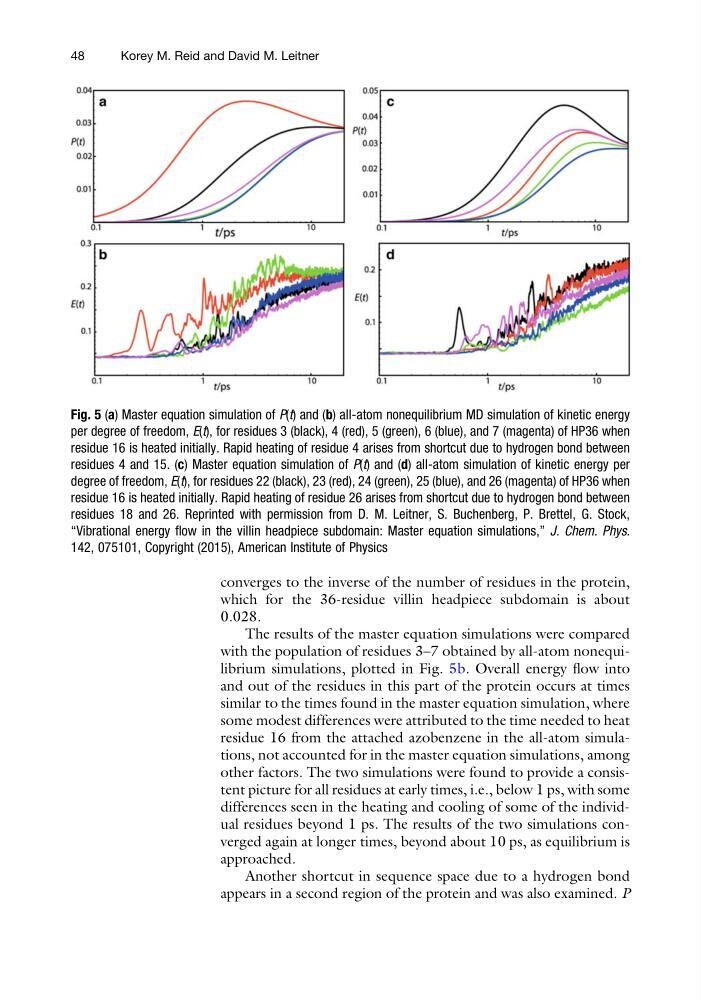
The results of the master equation simulations were compared
with the population of residues 3–7 obtained by all-atom nonequilibrium simulations, plotted in Fig. 5b. Overall energy flow into
and out of the residues in this part of the protein occurs at times
similar to the times found in the master equation simulation, where
some modest differences were attributed to the time needed to heat
residue 16 from the attached azobenzene in the all-atom simulations, not accounted for in the master equation simulations, among
other factors. The two simulations were found to provide a consistent picture for all residues at early times, i.e., below 1 ps, with some
differences seen in the heating and cooling of some of the individual residues beyond 1 ps. The results of the two simulations converged again at longer times, beyond about 10 ps, as equilibrium is
approached.
Another shortcut in sequence space due to a hydrogen bond
appears in a second region of the protein and was also examined. P
Fig. 5 (a) Master equation simulation of P(t) and (b) all-atom nonequilibrium MD simulation of kinetic energy
per degree of freedom, E(t), for residues 3 (black), 4 (red), 5 (green), 6 (blue), and 7 (magenta) of HP36 when
residue 16 is heated initially. Rapid heating of residue 4 arises from shortcut due to hydrogen bond between
residues 4 and 15. (c) Master equation simulation of P(t) and (d) all-atom simulation of kinetic energy per
degree of freedom, E(t), for residues 22 (black), 23 (red), 24 (green), 25 (blue), and 26 (magenta) of HP36 when
residue 16 is heated initially. Rapid heating of residue 26 arises from shortcut due to hydrogen bond between
residues 18 and 26. Reprinted with permission from D. M. Leitner, S. Buchenberg, P. Brettel, G. Stock,
“Vibrational energy flow in the villin headpiece subdomain: Master equation simulations,” J. Chem. Phys.
142, 075101, Copyright (2015), American Institute of Physics
48
Korey M. Reid and David M. Leitner
which for the 36-residue villin headpiece subdomain is about
0.028.
The results of the master equation simulations were compared
with the population of residues 3–7 obtained by all-atom nonequilibrium simulations, plotted in Fig. 5b. Overall energy flow into
and out of the residues in this part of the protein occurs at times
similar to the times found in the master equation simulation, where
some modest differences were attributed to the time needed to heat
residue 16 from the attached azobenzene in the all-atom simulations, not accounted for in the master equation simulations, among
other factors. The two simulations were found to provide a consistent picture for all residues at early times, i.e., below 1 ps, with some
differences seen in the heating and cooling of some of the individual residues beyond 1 ps. The results of the two simulations converged again at longer times, beyond about 10 ps, as equilibrium is
approached.
Another shortcut in sequence space due to a hydrogen bond
appears in a second region of the protein and was also examined. P
Fig. 5 (a) Master equation simulation of P(t) and (b) all-atom nonequilibrium MD simulation of kinetic energy
per degree of freedom, E(t), for residues 3 (black), 4 (red), 5 (green), 6 (blue), and 7 (magenta) of HP36 when
residue 16 is heated initially. Rapid heating of residue 4 arises from shortcut due to hydrogen bond between
residues 4 and 15. (c) Master equation simulation of P(t) and (d) all-atom simulation of kinetic energy per
degree of freedom, E(t), for residues 22 (black), 23 (red), 24 (green), 25 (blue), and 26 (magenta) of HP36 when
residue 16 is heated initially. Rapid heating of residue 26 arises from shortcut due to hydrogen bond between
residues 18 and 26. Reprinted with permission from D. M. Leitner, S. Buchenberg, P. Brettel, G. Stock,
“Vibrational energy flow in the villin headpiece subdomain: Master equation simulations,” J. Chem. Phys.
142, 075101, Copyright (2015), American Institute of Physics
48
Korey M. Reid and David M. Leitner