

dP t
ð Þ
dt
¼ kP t
ð Þ,
ð7Þ
where P is a vector with elements corresponding to the population of each residue and k is the matrix of transition probabilities
between residues. The elements of the matrix, {k ij }, are the rate
constants for energy transfer between a pair of residues, i and j. The
solutions of the master equation describing the time evolution of
the population of the residues are given by
P t
ð Þ ¼ exp kt
ð ÞP 0
ð Þ,
ð8Þ
The elements of the rate matrix were obtained using Eq. 5.
Damping due to coupling to the solvent was also included in some
of the simulations reported in Ref. [17], which matched closely
results of all-atom nonequilibrium simulations of hydrated villin,
but we summarize here only the results without damping.
The detailed analysis of energy flow in HP36 revealed some
shortcuts in sequence space. Initial excitation of the protein was
taken to be near the middle of the sequence, at residue 16. Because
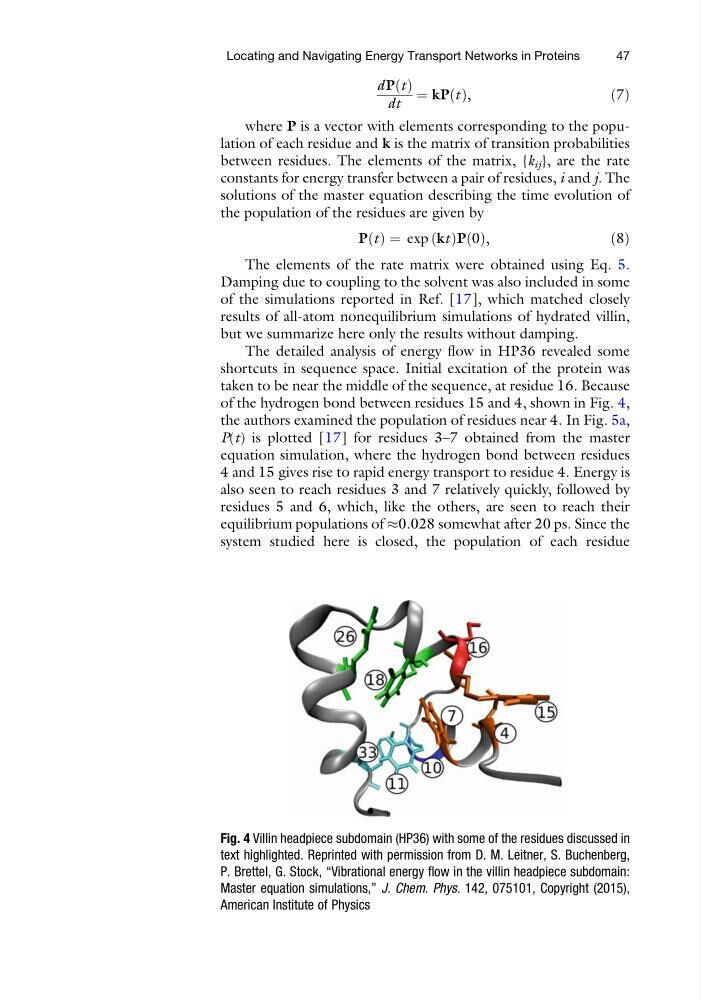
of the hydrogen bond between residues 15 and 4, shown in Fig. 4,
the authors examined the population of residues near 4. In Fig. 5a,
P(t) is plotted [17] for residues 3–7 obtained from the master
equation simulation, where the hydrogen bond between residues
4 and 15 gives rise to rapid energy transport to residue 4. Energy is
also seen to reach residues 3 and 7 relatively quickly, followed by
residues 5 and 6, which, like the others, are seen to reach their
equilibrium populations of %0.028 somewhat after 20 ps. Since the
system studied here is closed, the population of each residue
Fig. 4 Villin headpiece subdomain (HP36) with some of the residues discussed in
text highlighted. Reprinted with permission from D. M. Leitner, S. Buchenberg,
P. Brettel, G. Stock, “Vibrational energy flow in the villin headpiece subdomain:
Master equation simulations,” J. Chem. Phys. 142, 075101, Copyright (2015),
American Institute of Physics
Locating and Navigating Energy Transport Networks in Proteins
47
ð Þ
dt
¼ kP t
ð Þ,
ð7Þ
where P is a vector with elements corresponding to the population of each residue and k is the matrix of transition probabilities
between residues. The elements of the matrix, {k ij }, are the rate
constants for energy transfer between a pair of residues, i and j. The
solutions of the master equation describing the time evolution of
the population of the residues are given by
P t
ð Þ ¼ exp kt
ð ÞP 0
ð Þ,
ð8Þ
The elements of the rate matrix were obtained using Eq. 5.
Damping due to coupling to the solvent was also included in some
of the simulations reported in Ref. [17], which matched closely
results of all-atom nonequilibrium simulations of hydrated villin,
but we summarize here only the results without damping.
The detailed analysis of energy flow in HP36 revealed some
shortcuts in sequence space. Initial excitation of the protein was
taken to be near the middle of the sequence, at residue 16. Because
of the hydrogen bond between residues 15 and 4, shown in Fig. 4,
the authors examined the population of residues near 4. In Fig. 5a,
P(t) is plotted [17] for residues 3–7 obtained from the master
equation simulation, where the hydrogen bond between residues
4 and 15 gives rise to rapid energy transport to residue 4. Energy is
also seen to reach residues 3 and 7 relatively quickly, followed by
residues 5 and 6, which, like the others, are seen to reach their
equilibrium populations of %0.028 somewhat after 20 ps. Since the
system studied here is closed, the population of each residue
Fig. 4 Villin headpiece subdomain (HP36) with some of the residues discussed in
text highlighted. Reprinted with permission from D. M. Leitner, S. Buchenberg,
P. Brettel, G. Stock, “Vibrational energy flow in the villin headpiece subdomain:
Master equation simulations,” J. Chem. Phys. 142, 075101, Copyright (2015),
American Institute of Physics
Locating and Navigating Energy Transport Networks in Proteins
47