

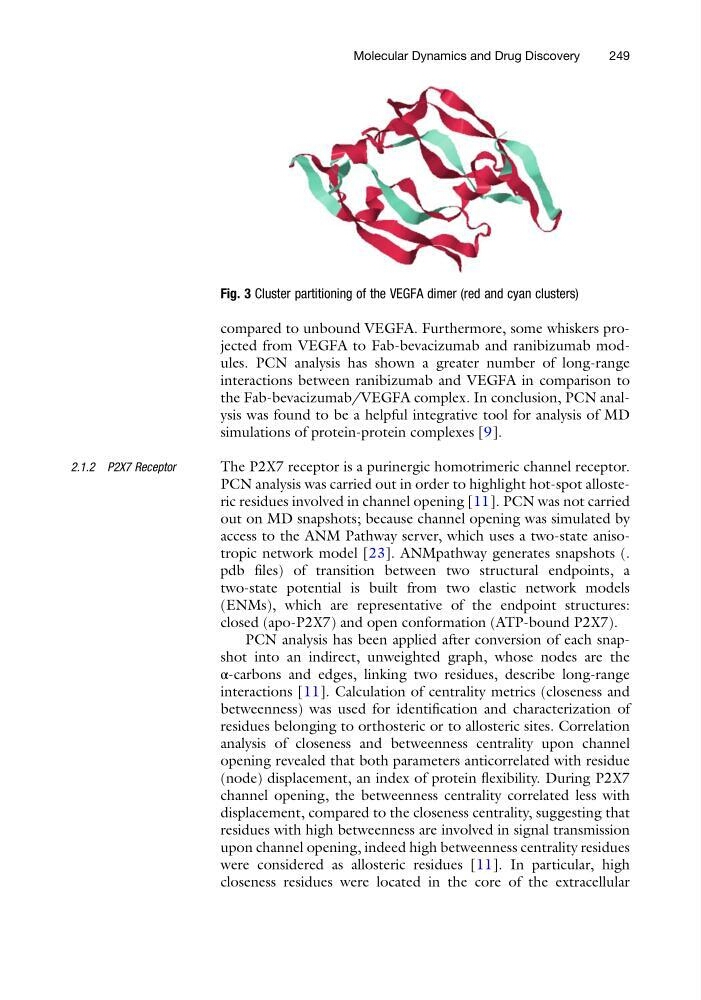
compared to unbound VEGFA. Furthermore, some whiskers projected from VEGFA to Fab-bevacizumab and ranibizumab modules. PCN analysis has shown a greater number of long-range
interactions between ranibizumab and VEGFA in comparison to
the Fab-bevacizumab/VEGFA complex. In conclusion, PCN analysis was found to be a helpful integrative tool for analysis of MD
simulations of protein-protein complexes [9].
2.1.2 P2X7 Receptor
The P2X7 receptor is a purinergic homotrimeric channel receptor.
PCN analysis was carried out in order to highlight hot-spot allosteric residues involved in channel opening [11]. PCN was not carried
out on MD snapshots; because channel opening was simulated by
access to the ANM Pathway server, which uses a two-state anisotropic network model [23]. ANMpathway generates snapshots (.
pdb files) of transition between two structural endpoints, a
two-state potential is built from two elastic network models
(ENMs), which are representative of the endpoint structures:
closed (apo-P2X7) and open conformation (ATP-bound P2X7).
PCN analysis has been applied after conversion of each snapshot into an indirect, unweighted graph, whose nodes are the
α-carbons and edges, linking two residues, describe long-range
interactions [11]. Calculation of centrality metrics (closeness and
betweenness) was used for identification and characterization of
residues belonging to orthosteric or to allosteric sites. Correlation
analysis of closeness and betweenness centrality upon channel
opening revealed that both parameters anticorrelated with residue
(node) displacement, an index of protein flexibility. During P2X7
channel opening, the betweenness centrality correlated less with
displacement, compared to the closeness centrality, suggesting that
residues with high betweenness are involved in signal transmission
upon channel opening, indeed high betweenness centrality residues
were considered as allosteric residues [11]. In particular, high
closeness residues were located in the core of the extracellular
Fig. 3 Cluster partitioning of the VEGFA dimer (red and cyan clusters)
Molecular Dynamics and Drug Discovery
249
interactions between ranibizumab and VEGFA in comparison to
the Fab-bevacizumab/VEGFA complex. In conclusion, PCN analysis was found to be a helpful integrative tool for analysis of MD
simulations of protein-protein complexes [9].
2.1.2 P2X7 Receptor
The P2X7 receptor is a purinergic homotrimeric channel receptor.
PCN analysis was carried out in order to highlight hot-spot allosteric residues involved in channel opening [11]. PCN was not carried
out on MD snapshots; because channel opening was simulated by
access to the ANM Pathway server, which uses a two-state anisotropic network model [23]. ANMpathway generates snapshots (.
pdb files) of transition between two structural endpoints, a
two-state potential is built from two elastic network models
(ENMs), which are representative of the endpoint structures:
closed (apo-P2X7) and open conformation (ATP-bound P2X7).
PCN analysis has been applied after conversion of each snapshot into an indirect, unweighted graph, whose nodes are the
α-carbons and edges, linking two residues, describe long-range
interactions [11]. Calculation of centrality metrics (closeness and
betweenness) was used for identification and characterization of
residues belonging to orthosteric or to allosteric sites. Correlation
analysis of closeness and betweenness centrality upon channel
opening revealed that both parameters anticorrelated with residue
(node) displacement, an index of protein flexibility. During P2X7
channel opening, the betweenness centrality correlated less with
displacement, compared to the closeness centrality, suggesting that
residues with high betweenness are involved in signal transmission
upon channel opening, indeed high betweenness centrality residues
were considered as allosteric residues [11]. In particular, high
closeness residues were located in the core of the extracellular
Fig. 3 Cluster partitioning of the VEGFA dimer (red and cyan clusters)
Molecular Dynamics and Drug Discovery
249