

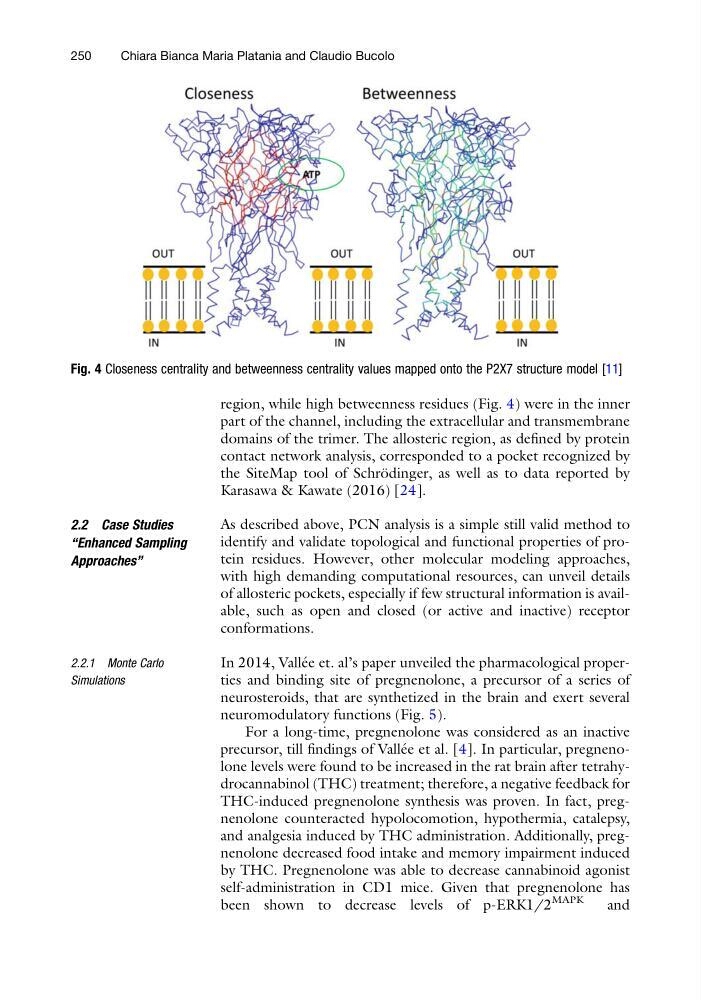
region, while high betweenness residues (Fig. 4) were in the inner
part of the channel, including the extracellular and transmembrane
domains of the trimer. The allosteric region, as defined by protein
contact network analysis, corresponded to a pocket recognized by
the SiteMap tool of Schro ¨dinger, as well as to data reported by
Karasawa & Kawate (2016) [24].
2.2 Case Studies
“Enhanced Sampling
Approaches”
As described above, PCN analysis is a simple still valid method to
identify and validate topological and functional properties of protein residues. However, other molecular modeling approaches,
with high demanding computational resources, can unveil details
of allosteric pockets, especially if few structural information is available, such as open and closed (or active and inactive) receptor
conformations.
2.2.1 Monte Carlo
Simulations
In 2014, Valle ´e et. al’s paper unveiled the pharmacological properties and binding site of pregnenolone, a precursor of a series of
neurosteroids, that are synthetized in the brain and exert several
neuromodulatory functions (Fig. 5).
For a long-time, pregnenolone was considered as an inactive
precursor, till findings of Valle ´e et al. [4]. In particular, pregnenolone levels were found to be increased in the rat brain after tetrahydrocannabinol (THC) treatment; therefore, a negative feedback for
THC-induced pregnenolone synthesis was proven. In fact, pregnenolone counteracted hypolocomotion, hypothermia, catalepsy,
and analgesia induced by THC administration. Additionally, pregnenolone decreased food intake and memory impairment induced
by THC. Pregnenolone was able to decrease cannabinoid agonist
self-administration in CD1 mice. Given that pregnenolone has
been shown to decrease levels of p-ERK1/2
MAPK
and
Fig. 4 Closeness centrality and betweenness centrality values mapped onto the P2X7 structure model [11]
250
Chiara Bianca Maria Platania and Claudio Bucolo
part of the channel, including the extracellular and transmembrane
domains of the trimer. The allosteric region, as defined by protein
contact network analysis, corresponded to a pocket recognized by
the SiteMap tool of Schro ¨dinger, as well as to data reported by
Karasawa & Kawate (2016) [24].
2.2 Case Studies
“Enhanced Sampling
Approaches”
As described above, PCN analysis is a simple still valid method to
identify and validate topological and functional properties of protein residues. However, other molecular modeling approaches,
with high demanding computational resources, can unveil details
of allosteric pockets, especially if few structural information is available, such as open and closed (or active and inactive) receptor
conformations.
2.2.1 Monte Carlo
Simulations
In 2014, Valle ´e et. al’s paper unveiled the pharmacological properties and binding site of pregnenolone, a precursor of a series of
neurosteroids, that are synthetized in the brain and exert several
neuromodulatory functions (Fig. 5).
For a long-time, pregnenolone was considered as an inactive
precursor, till findings of Valle ´e et al. [4]. In particular, pregnenolone levels were found to be increased in the rat brain after tetrahydrocannabinol (THC) treatment; therefore, a negative feedback for
THC-induced pregnenolone synthesis was proven. In fact, pregnenolone counteracted hypolocomotion, hypothermia, catalepsy,
and analgesia induced by THC administration. Additionally, pregnenolone decreased food intake and memory impairment induced
by THC. Pregnenolone was able to decrease cannabinoid agonist
self-administration in CD1 mice. Given that pregnenolone has
been shown to decrease levels of p-ERK1/2
MAPK
and
Fig. 4 Closeness centrality and betweenness centrality values mapped onto the P2X7 structure model [11]
250
Chiara Bianca Maria Platania and Claudio Bucolo