

5.6.1 M42-G121 Double
Mutants
Several different M42-G121 mutants have been constructed and
analyzed to determine whether these residues are coupled through
global protein dynamics and to determine why and how distal
mutations affect the hydride transfer step of the DHFR catalytic
cycle [84]. These mutants include M42-G121A, M42F-G121S,
M42W-G121A, M42W-G121S, and M42W-G121V (Table 3)
[85]. These double mutants generally showed little changes in
substrate and cofactor binding bit synergistic decreases in the rate
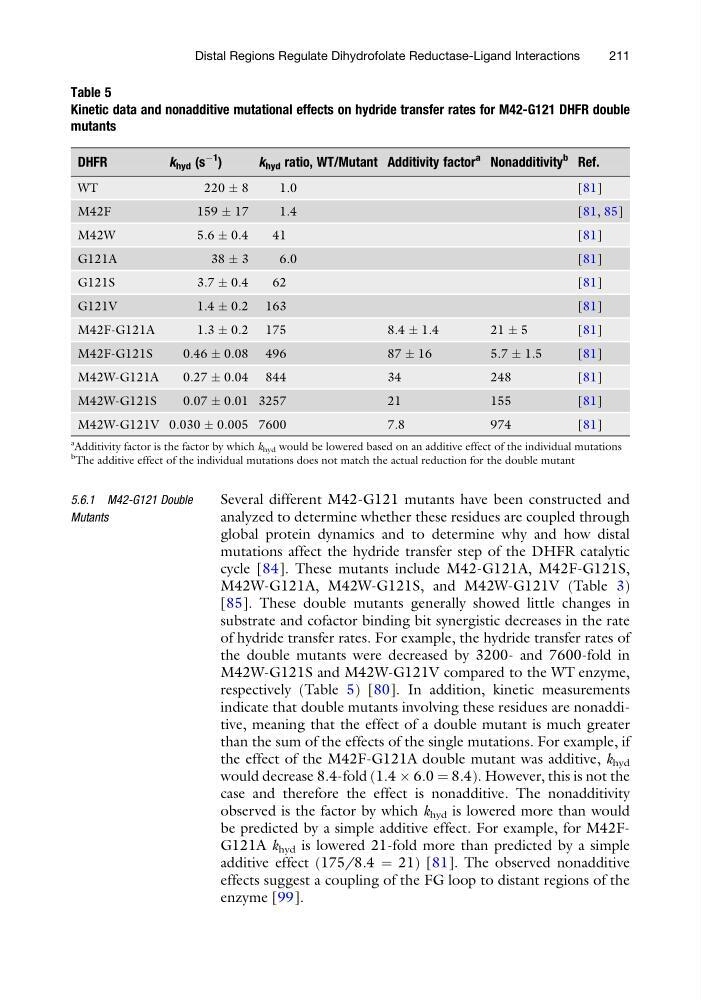
of hydride transfer rates. For example, the hydride transfer rates of
the double mutants were decreased by 3200- and 7600-fold in
M42W-G121S and M42W-G121V compared to the WT enzyme,
respectively (Table 5) [80]. In addition, kinetic measurements
indicate that double mutants involving these residues are nonadditive, meaning that the effect of a double mutant is much greater
than the sum of the effects of the single mutations. For example, if
the effect of the M42F-G121A double mutant was additive, k hyd
would decrease 8.4-fold (1.4 Â 6.0 ¼ 8.4). However, this is not the
case and therefore the effect is nonadditive. The nonadditivity
observed is the factor by which k hyd is lowered more than would
be predicted by a simple additive effect. For example, for M42FG121A k hyd is lowered 21-fold more than predicted by a simple
additive effect (175/8.4 ¼ 21) [81]. The observed nonadditive
effects suggest a coupling of the FG loop to distant regions of the
enzyme [99].
Table 5
Kinetic data and nonadditive mutational effects on hydride transfer rates for M42-G121 DHFR double
mutants
DHFR
k hyd (s
À1
)
k hyd ratio, WT/Mutant Additivity factor
a Nonadditivity
b Ref.
WT
220 Æ 8
1.0
[81]
M42F
159 Æ 17
1.4
[81, 85]
M42W
5.6 Æ 0.4
41
[81]
G121A
38 Æ 3
6.0
[81]
G121S
3.7 Æ 0.4
62
[81]
G121V
1.4 Æ 0.2 163
[81]
M42F-G121A
1.3 Æ 0.2 175
8.4 Æ 1.4
21 Æ 5
[ 81]
M42F-G121S
0.46 Æ 0.08 496
87 Æ 16
5.7 Æ 1.5
[81]
M42W-G121A
0.27 Æ 0.04 844
34
248
[81]
M42W-G121S
0.07 Æ 0.01 3257
21
155
[81]
M42W-G121V 0.030 Æ 0.005 7600
7.8
974
[81]
a
Additivity factor is the factor by which k hyd would be lowered based on an additive effect of the individual mutations
b
The additive effect of the individual mutations does not match the actual reduction for the double mutant
Distal Regions Regulate Dihydrofolate Reductase-Ligand Interactions
211
Mutants
Several different M42-G121 mutants have been constructed and
analyzed to determine whether these residues are coupled through
global protein dynamics and to determine why and how distal
mutations affect the hydride transfer step of the DHFR catalytic
cycle [84]. These mutants include M42-G121A, M42F-G121S,
M42W-G121A, M42W-G121S, and M42W-G121V (Table 3)
[85]. These double mutants generally showed little changes in
substrate and cofactor binding bit synergistic decreases in the rate
of hydride transfer rates. For example, the hydride transfer rates of
the double mutants were decreased by 3200- and 7600-fold in
M42W-G121S and M42W-G121V compared to the WT enzyme,
respectively (Table 5) [80]. In addition, kinetic measurements
indicate that double mutants involving these residues are nonadditive, meaning that the effect of a double mutant is much greater
than the sum of the effects of the single mutations. For example, if
the effect of the M42F-G121A double mutant was additive, k hyd
would decrease 8.4-fold (1.4 Â 6.0 ¼ 8.4). However, this is not the
case and therefore the effect is nonadditive. The nonadditivity
observed is the factor by which k hyd is lowered more than would
be predicted by a simple additive effect. For example, for M42FG121A k hyd is lowered 21-fold more than predicted by a simple
additive effect (175/8.4 ¼ 21) [81]. The observed nonadditive
effects suggest a coupling of the FG loop to distant regions of the
enzyme [99].
Table 5
Kinetic data and nonadditive mutational effects on hydride transfer rates for M42-G121 DHFR double
mutants
DHFR
k hyd (s
À1
)
k hyd ratio, WT/Mutant Additivity factor
a Nonadditivity
b Ref.
WT
220 Æ 8
1.0
[81]
M42F
159 Æ 17
1.4
[81, 85]
M42W
5.6 Æ 0.4
41
[81]
G121A
38 Æ 3
6.0
[81]
G121S
3.7 Æ 0.4
62
[81]
G121V
1.4 Æ 0.2 163
[81]
M42F-G121A
1.3 Æ 0.2 175
8.4 Æ 1.4
21 Æ 5
[ 81]
M42F-G121S
0.46 Æ 0.08 496
87 Æ 16
5.7 Æ 1.5
[81]
M42W-G121A
0.27 Æ 0.04 844
34
248
[81]
M42W-G121S
0.07 Æ 0.01 3257
21
155
[81]
M42W-G121V 0.030 Æ 0.005 7600
7.8
974
[81]
a
Additivity factor is the factor by which k hyd would be lowered based on an additive effect of the individual mutations
b
The additive effect of the individual mutations does not match the actual reduction for the double mutant
Distal Regions Regulate Dihydrofolate Reductase-Ligand Interactions
211