

enzyme is still able to maintain a sufficient rate of production
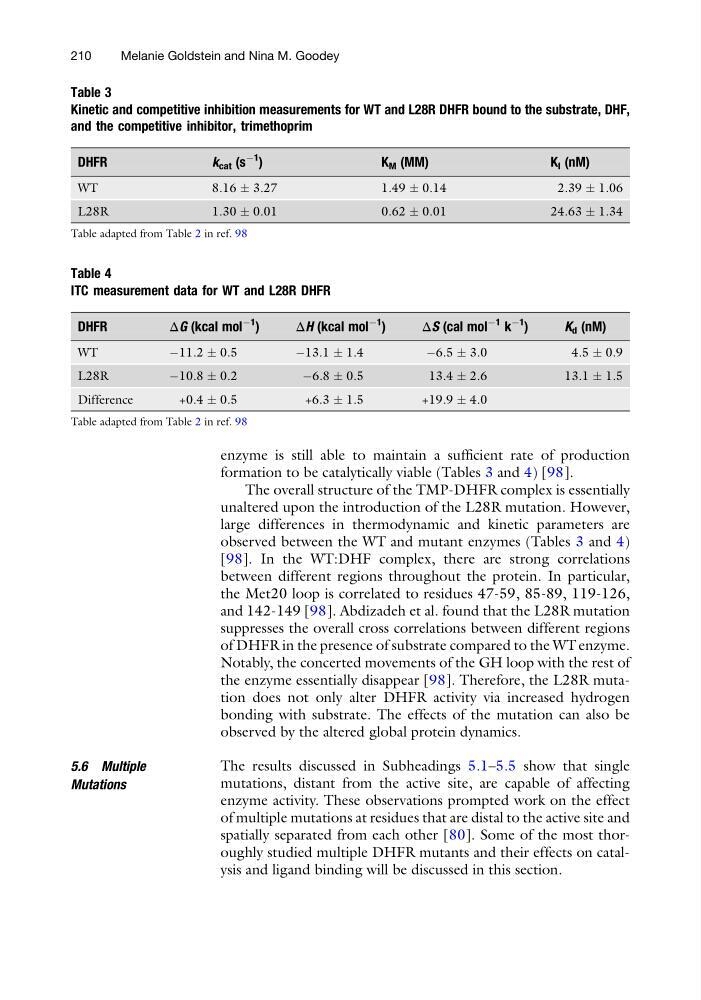
formation to be catalytically viable (Tables 3 and 4) [98].
The overall structure of the TMP-DHFR complex is essentially
unaltered upon the introduction of the L28R mutation. However,
large differences in thermodynamic and kinetic parameters are
observed between the WT and mutant enzymes (Tables 3 and 4)
[98]. In the WT:DHF complex, there are strong correlations
between different regions throughout the protein. In particular,
the Met20 loop is correlated to residues 47-59, 85-89, 119-126,
and 142-149 [98]. Abdizadeh et al. found that the L28R mutation
suppresses the overall cross correlations between different regions
of DHFR in the presence of substrate compared to the WT enzyme.
Notably, the concerted movements of the GH loop with the rest of
the enzyme essentially disappear [98]. Therefore, the L28R mutation does not only alter DHFR activity via increased hydrogen
bonding with substrate. The effects of the mutation can also be
observed by the altered global protein dynamics.
5.6 Multiple
Mutations
The results discussed in Subheadings 5.1–5.5 show that single
mutations, distant from the active site, are capable of affecting
enzyme activity. These observations prompted work on the effect
of multiple mutations at residues that are distal to the active site and
spatially separated from each other [80]. Some of the most thoroughly studied multiple DHFR mutants and their effects on catalysis and ligand binding will be discussed in this section.
Table 4
ITC measurement data for WT and L28R DHFR
DHFR
ΔG (kcal mol
À1
)
ΔH (kcal mol
À1 )
ΔS (cal mol
À1 k
À1
)
K d (nM)
WT
À11.2 Æ 0.5
À13.1 Æ 1.4
À6.5 Æ 3.0
4.5 Æ 0.9
L28R
À10.8 Æ 0.2
À6.8 Æ 0.5
13.4 Æ 2.6
13.1 Æ 1.5
Difference
+0.4 Æ 0.5
+6.3 Æ 1.5
+19.9 Æ 4.0
Table adapted from Table 2 in ref. 98
Table 3
Kinetic and competitive inhibition measurements for WT and L28R DHFR bound to the substrate, DHF,
and the competitive inhibitor, trimethoprim
DHFR
k cat (s
À1
)
K M (MM)
K I (nM)
WT
8.16 Æ 3.27
1.49 Æ 0.14
2.39 Æ 1.06
L28R
1.30 Æ 0.01
0.62 Æ 0.01
24.63 Æ 1.34
Table adapted from Table 2 in ref. 98
210
Melanie Goldstein and Nina M. Goodey
formation to be catalytically viable (Tables 3 and 4) [98].
The overall structure of the TMP-DHFR complex is essentially
unaltered upon the introduction of the L28R mutation. However,
large differences in thermodynamic and kinetic parameters are
observed between the WT and mutant enzymes (Tables 3 and 4)
[98]. In the WT:DHF complex, there are strong correlations
between different regions throughout the protein. In particular,
the Met20 loop is correlated to residues 47-59, 85-89, 119-126,
and 142-149 [98]. Abdizadeh et al. found that the L28R mutation
suppresses the overall cross correlations between different regions
of DHFR in the presence of substrate compared to the WT enzyme.
Notably, the concerted movements of the GH loop with the rest of
the enzyme essentially disappear [98]. Therefore, the L28R mutation does not only alter DHFR activity via increased hydrogen
bonding with substrate. The effects of the mutation can also be
observed by the altered global protein dynamics.
5.6 Multiple
Mutations
The results discussed in Subheadings 5.1–5.5 show that single
mutations, distant from the active site, are capable of affecting
enzyme activity. These observations prompted work on the effect
of multiple mutations at residues that are distal to the active site and
spatially separated from each other [80]. Some of the most thoroughly studied multiple DHFR mutants and their effects on catalysis and ligand binding will be discussed in this section.
Table 4
ITC measurement data for WT and L28R DHFR
DHFR
ΔG (kcal mol
À1
)
ΔH (kcal mol
À1 )
ΔS (cal mol
À1 k
À1
)
K d (nM)
WT
À11.2 Æ 0.5
À13.1 Æ 1.4
À6.5 Æ 3.0
4.5 Æ 0.9
L28R
À10.8 Æ 0.2
À6.8 Æ 0.5
13.4 Æ 2.6
13.1 Æ 1.5
Difference
+0.4 Æ 0.5
+6.3 Æ 1.5
+19.9 Æ 4.0
Table adapted from Table 2 in ref. 98
Table 3
Kinetic and competitive inhibition measurements for WT and L28R DHFR bound to the substrate, DHF,
and the competitive inhibitor, trimethoprim
DHFR
k cat (s
À1
)
K M (MM)
K I (nM)
WT
8.16 Æ 3.27
1.49 Æ 0.14
2.39 Æ 1.06
L28R
1.30 Æ 0.01
0.62 Æ 0.01
24.63 Æ 1.34
Table adapted from Table 2 in ref. 98
210
Melanie Goldstein and Nina M. Goodey