

5.6.2 M42F-G121SS148A Triple Mutant
and Associated Mutants
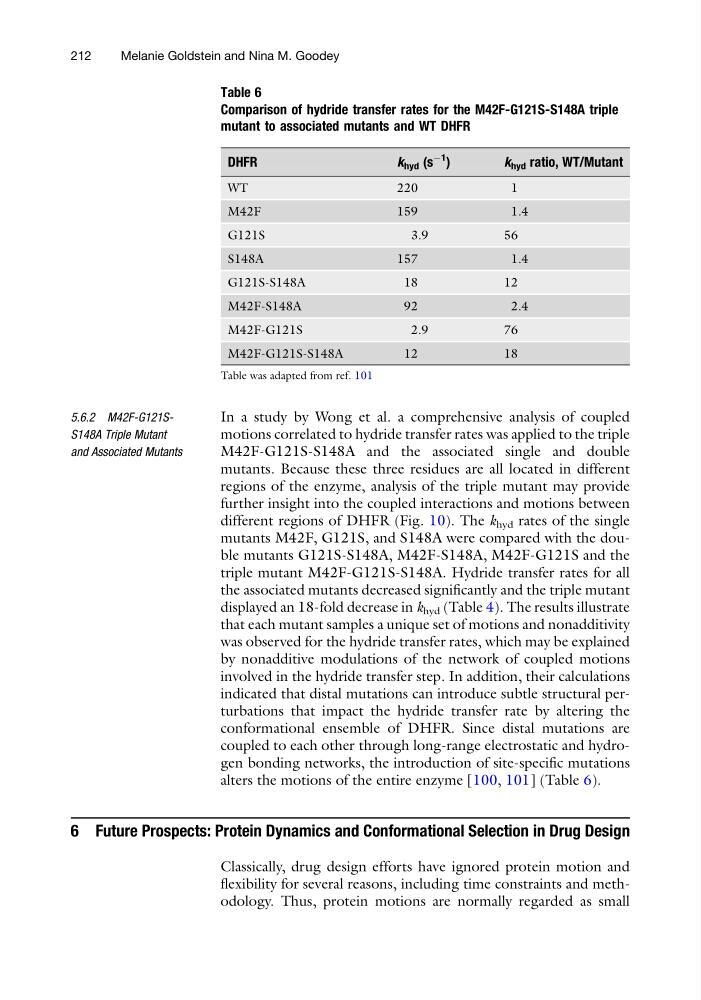
In a study by Wong et al. a comprehensive analysis of coupled
motions correlated to hydride transfer rates was applied to the triple
M42F-G121S-S148A and the associated single and double
mutants. Because these three residues are all located in different
regions of the enzyme, analysis of the triple mutant may provide
further insight into the coupled interactions and motions between
different regions of DHFR (Fig. 10). The k hyd rates of the single
mutants M42F, G121S, and S148A were compared with the double mutants G121S-S148A, M42F-S148A, M42F-G121S and the
triple mutant M42F-G121S-S148A. Hydride transfer rates for all
the associated mutants decreased significantly and the triple mutant
displayed an 18-fold decrease in k hyd (Table 4). The results illustrate
that each mutant samples a unique set of motions and nonadditivity
was observed for the hydride transfer rates, which may be explained
by nonadditive modulations of the network of coupled motions
involved in the hydride transfer step. In addition, their calculations
indicated that distal mutations can introduce subtle structural perturbations that impact the hydride transfer rate by altering the
conformational ensemble of DHFR. Since distal mutations are
coupled to each other through long-range electrostatic and hydrogen bonding networks, the introduction of site-specific mutations
alters the motions of the entire enzyme [100, 101] (Table 6).
6 Future Prospects: Protein Dynamics and Conformational Selection in Drug Design
Classically, drug design efforts have ignored protein motion and
flexibility for several reasons, including time constraints and methodology. Thus, protein motions are normally regarded as small
Table 6
Comparison of hydride transfer rates for the M42F-G121S-S148A triple
mutant to associated mutants and WT DHFR
DHFR
k hyd (s
À1
)
k hyd ratio, WT/Mutant
WT
220
1
M42F
159
1.4
G121S
3.9
56
S148A
157
1.4
G121S-S148A
18
12
M42F-S148A
92
2.4
M42F-G121S
2.9
76
M42F-G121S-S148A
12
18
Table was adapted from ref. 101
212
Melanie Goldstein and Nina M. Goodey
and Associated Mutants
In a study by Wong et al. a comprehensive analysis of coupled
motions correlated to hydride transfer rates was applied to the triple
M42F-G121S-S148A and the associated single and double
mutants. Because these three residues are all located in different
regions of the enzyme, analysis of the triple mutant may provide
further insight into the coupled interactions and motions between
different regions of DHFR (Fig. 10). The k hyd rates of the single
mutants M42F, G121S, and S148A were compared with the double mutants G121S-S148A, M42F-S148A, M42F-G121S and the
triple mutant M42F-G121S-S148A. Hydride transfer rates for all
the associated mutants decreased significantly and the triple mutant
displayed an 18-fold decrease in k hyd (Table 4). The results illustrate
that each mutant samples a unique set of motions and nonadditivity
was observed for the hydride transfer rates, which may be explained
by nonadditive modulations of the network of coupled motions
involved in the hydride transfer step. In addition, their calculations
indicated that distal mutations can introduce subtle structural perturbations that impact the hydride transfer rate by altering the
conformational ensemble of DHFR. Since distal mutations are
coupled to each other through long-range electrostatic and hydrogen bonding networks, the introduction of site-specific mutations
alters the motions of the entire enzyme [100, 101] (Table 6).
6 Future Prospects: Protein Dynamics and Conformational Selection in Drug Design
Classically, drug design efforts have ignored protein motion and
flexibility for several reasons, including time constraints and methodology. Thus, protein motions are normally regarded as small
Table 6
Comparison of hydride transfer rates for the M42F-G121S-S148A triple
mutant to associated mutants and WT DHFR
DHFR
k hyd (s
À1
)
k hyd ratio, WT/Mutant
WT
220
1
M42F
159
1.4
G121S
3.9
56
S148A
157
1.4
G121S-S148A
18
12
M42F-S148A
92
2.4
M42F-G121S
2.9
76
M42F-G121S-S148A
12
18
Table was adapted from ref. 101
212
Melanie Goldstein and Nina M. Goodey