

bacterial adaptive immune system [25]. In particular, the imidazole
glycerol phosphate synthase (IGPS) enzyme from the thermophile
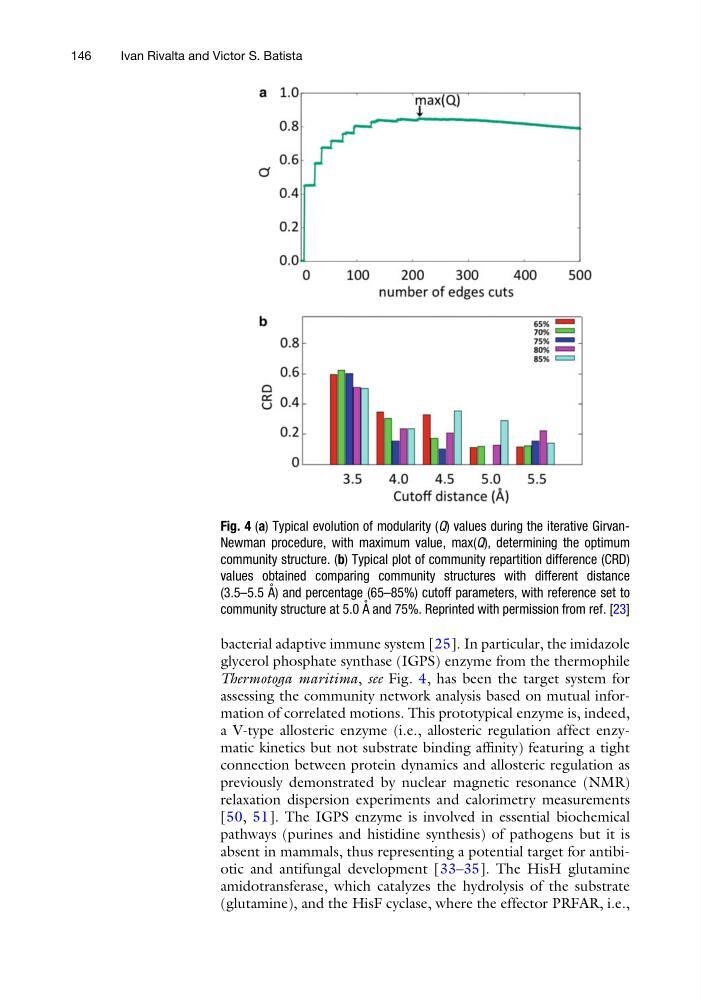
Thermotoga maritima, see Fig. 4, has been the target system for
assessing the community network analysis based on mutual information of correlated motions. This prototypical enzyme is, indeed,
a V-type allosteric enzyme (i.e., allosteric regulation affect enzymatic kinetics but not substrate binding affinity) featuring a tight
connection between protein dynamics and allosteric regulation as
previously demonstrated by nuclear magnetic resonance (NMR)
relaxation dispersion experiments and calorimetry measurements
[50, 51]. The IGPS enzyme is involved in essential biochemical
pathways (purines and histidine synthesis) of pathogens but it is
absent in mammals, thus representing a potential target for antibiotic and antifungal development [33–35]. The HisH glutamine
amidotransferase, which catalyzes the hydrolysis of the substrate
(glutamine), and the HisF cyclase, where the effector PRFAR, i.e.,
Fig. 4 (a) Typical evolution of modularity (Q) values during the iterative GirvanNewman procedure, with maximum value, max(Q), determining the optimum
community structure. (b) Typical plot of community repartition difference (CRD)
values obtained comparing community structures with different distance
(3.5–5.5 A ˚ ) and percentage (65–85%) cutoff parameters, with reference set to
community structure at 5.0 A ˚ and 75%. Reprinted with permission from ref. [23]
146
Ivan Rivalta and Victor S. Batista
glycerol phosphate synthase (IGPS) enzyme from the thermophile
Thermotoga maritima, see Fig. 4, has been the target system for
assessing the community network analysis based on mutual information of correlated motions. This prototypical enzyme is, indeed,
a V-type allosteric enzyme (i.e., allosteric regulation affect enzymatic kinetics but not substrate binding affinity) featuring a tight
connection between protein dynamics and allosteric regulation as
previously demonstrated by nuclear magnetic resonance (NMR)
relaxation dispersion experiments and calorimetry measurements
[50, 51]. The IGPS enzyme is involved in essential biochemical
pathways (purines and histidine synthesis) of pathogens but it is
absent in mammals, thus representing a potential target for antibiotic and antifungal development [33–35]. The HisH glutamine
amidotransferase, which catalyzes the hydrolysis of the substrate
(glutamine), and the HisF cyclase, where the effector PRFAR, i.e.,
Fig. 4 (a) Typical evolution of modularity (Q) values during the iterative GirvanNewman procedure, with maximum value, max(Q), determining the optimum
community structure. (b) Typical plot of community repartition difference (CRD)
values obtained comparing community structures with different distance
(3.5–5.5 A ˚ ) and percentage (65–85%) cutoff parameters, with reference set to
community structure at 5.0 A ˚ and 75%. Reprinted with permission from ref. [23]
146
Ivan Rivalta and Victor S. Batista