

parameters. To this aim, the community repartition difference
(CRD) [27] between two different community structures (e.g., c 1
and c 2 ) can be computed as
CRD c 1 ,c 2
ð
Þ ¼ 1 À
P
n i ,n j
z n i , n j , c 1
À
Á
z n i , n j , c 2
À
Á
P
n i ,n j
z n i , n j , c 1
À
Á
ð5Þ
where z(n i , n j , c i ) is 1 if nodes n i and n j belong to the same
community in a given community structure (c i ) and 0 otherwise.
Thus, CRD represents a normalized count of node pairs that are
grouped together in both community structures (c 1 and c 2 ), going
to 0 if the two community structures are identical or to 1 if they are
totally different. The CRD is then a good estimate of the similarities
between two optimum community structures obtained with different values of the distance and/or percentage cutoff parameters (see
Fig. 5).
4 Applications
The CNA method (see Note 4) described in the above section has
been applied to various proteic systems featuring allosteric regulation, including allosteric enzyme [23], nuclear receptor [24], and
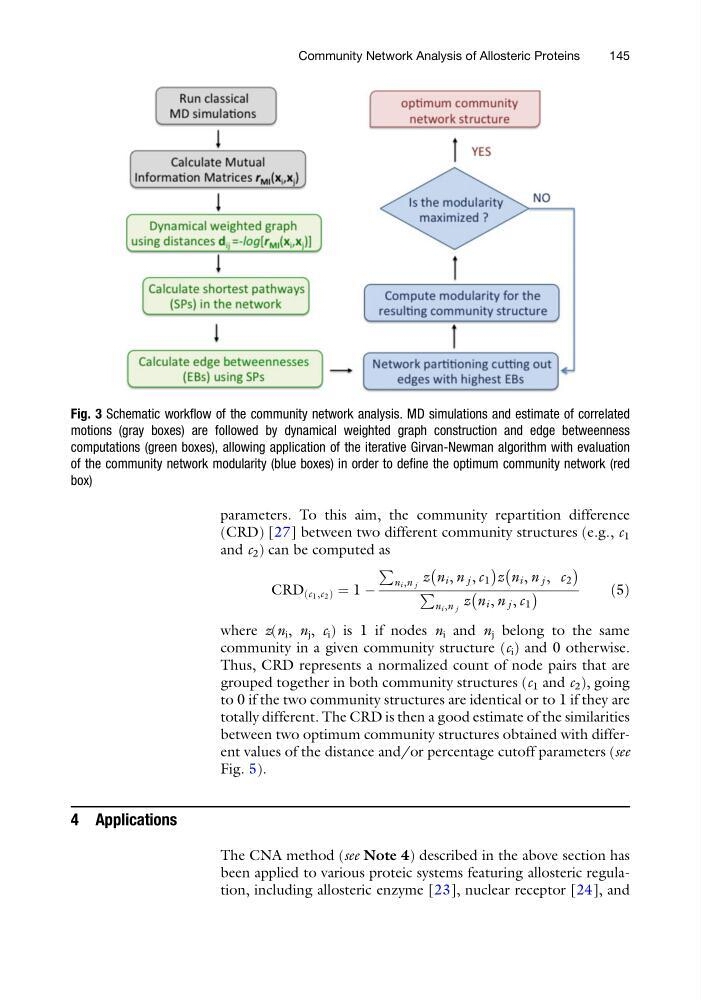
Fig. 3 Schematic workflow of the community network analysis. MD simulations and estimate of correlated
motions (gray boxes) are followed by dynamical weighted graph construction and edge betweenness
computations (green boxes), allowing application of the iterative Girvan-Newman algorithm with evaluation
of the community network modularity (blue boxes) in order to define the optimum community network (red
box)
Community Network Analysis of Allosteric Proteins
145
(CRD) [27] between two different community structures (e.g., c 1
and c 2 ) can be computed as
CRD c 1 ,c 2
ð
Þ ¼ 1 À
P
n i ,n j
z n i , n j , c 1
À
Á
z n i , n j , c 2
À
Á
P
n i ,n j
z n i , n j , c 1
À
Á
ð5Þ
where z(n i , n j , c i ) is 1 if nodes n i and n j belong to the same
community in a given community structure (c i ) and 0 otherwise.
Thus, CRD represents a normalized count of node pairs that are
grouped together in both community structures (c 1 and c 2 ), going
to 0 if the two community structures are identical or to 1 if they are
totally different. The CRD is then a good estimate of the similarities
between two optimum community structures obtained with different values of the distance and/or percentage cutoff parameters (see
Fig. 5).
4 Applications
The CNA method (see Note 4) described in the above section has
been applied to various proteic systems featuring allosteric regulation, including allosteric enzyme [23], nuclear receptor [24], and
Fig. 3 Schematic workflow of the community network analysis. MD simulations and estimate of correlated
motions (gray boxes) are followed by dynamical weighted graph construction and edge betweenness
computations (green boxes), allowing application of the iterative Girvan-Newman algorithm with evaluation
of the community network modularity (blue boxes) in order to define the optimum community network (red
box)
Community Network Analysis of Allosteric Proteins
145