

We just conclude by a statistical argument that 568/715 ¼ 79% of
the data set has a single connected component for IHSN, and this
property implies that proteins prefer to adopt a single CC in order
to control the spatial position of the interfaces.
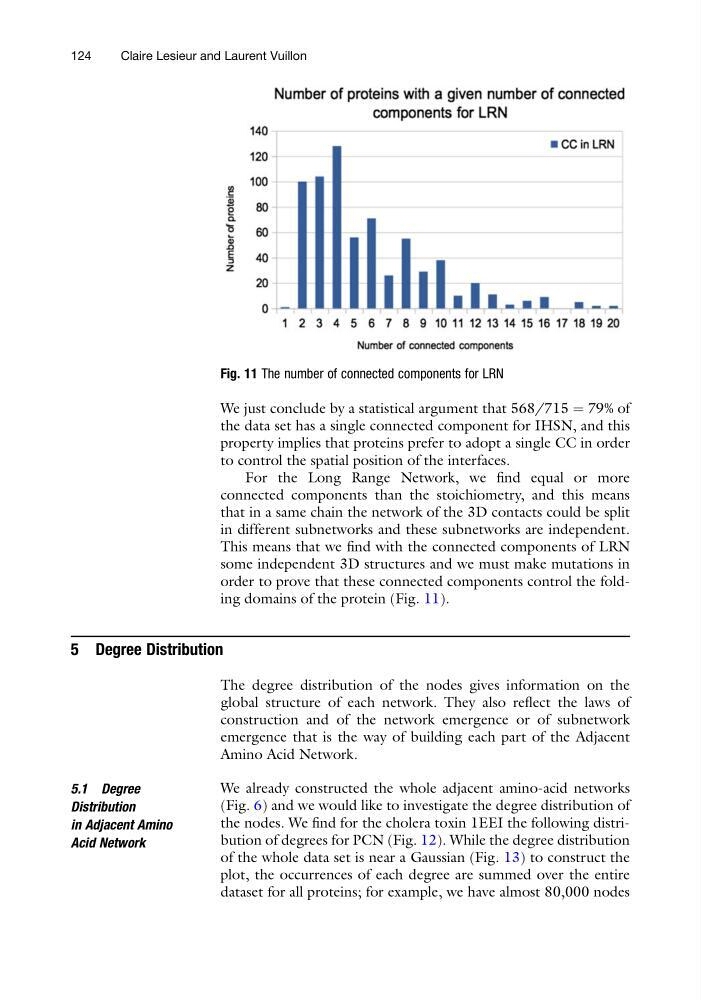
For the Long Range Network, we find equal or more
connected components than the stoichiometry, and this means
that in a same chain the network of the 3D contacts could be split
in different subnetworks and these subnetworks are independent.
This means that we find with the connected components of LRN
some independent 3D structures and we must make mutations in
order to prove that these connected components control the folding domains of the protein (Fig. 11).
5 Degree Distribution
The degree distribution of the nodes gives information on the
global structure of each network. They also reflect the laws of
construction and of the network emergence or of subnetwork
emergence that is the way of building each part of the Adjacent
Amino Acid Network.
5.1 Degree
Distribution
in Adjacent Amino
Acid Network
We already constructed the whole adjacent amino-acid networks
(Fig. 6) and we would like to investigate the degree distribution of
the nodes. We find for the cholera toxin 1EEI the following distribution of degrees for PCN (Fig. 12). While the degree distribution
of the whole data set is near a Gaussian (Fig. 13) to construct the
plot, the occurrences of each degree are summed over the entire
dataset for all proteins; for example, we have almost 80,000 nodes
Fig. 11 The number of connected components for LRN
124
Claire Lesieur and Laurent Vuillon
the data set has a single connected component for IHSN, and this
property implies that proteins prefer to adopt a single CC in order
to control the spatial position of the interfaces.
For the Long Range Network, we find equal or more
connected components than the stoichiometry, and this means
that in a same chain the network of the 3D contacts could be split
in different subnetworks and these subnetworks are independent.
This means that we find with the connected components of LRN
some independent 3D structures and we must make mutations in
order to prove that these connected components control the folding domains of the protein (Fig. 11).
5 Degree Distribution
The degree distribution of the nodes gives information on the
global structure of each network. They also reflect the laws of
construction and of the network emergence or of subnetwork
emergence that is the way of building each part of the Adjacent
Amino Acid Network.
5.1 Degree
Distribution
in Adjacent Amino
Acid Network
We already constructed the whole adjacent amino-acid networks
(Fig. 6) and we would like to investigate the degree distribution of
the nodes. We find for the cholera toxin 1EEI the following distribution of degrees for PCN (Fig. 12). While the degree distribution
of the whole data set is near a Gaussian (Fig. 13) to construct the
plot, the occurrences of each degree are summed over the entire
dataset for all proteins; for example, we have almost 80,000 nodes
Fig. 11 The number of connected components for LRN
124
Claire Lesieur and Laurent Vuillon