

give no insight on the topology of the connected components of
the Hot Spot Network and for example the single connected component could be as a ring or not.
Thus we find a nice power law for the number of connected
components for HSN (by computing directly on the graphic we fit
the function f(x) ¼ 388x
À1.56 with R
2
¼ 0.963).
We notice that proteins (1EEI, 1LTR, 1EFI, the latter with
unknown assembly mechanism) which share similar structures but
have different assembly mechanisms (see [18]) nevertheless have the
same number of CC in the four networks: 1 connected component
for PCN, HSN, IHSN and 10 connected components for LRN.
This means that the number of connected components is a rather
global measurement, which does not account for the way the
protein is built. Globally the interfaces between chains of the
three “versions” of the cholera toxin are linked together to form a
whole global interface network. On the other hand, the three
toxins 1EEI, 1LTR, and 1EFI, all AB 5 toxins, have their 3D structures organized in two domains, indicated by the ten CC.
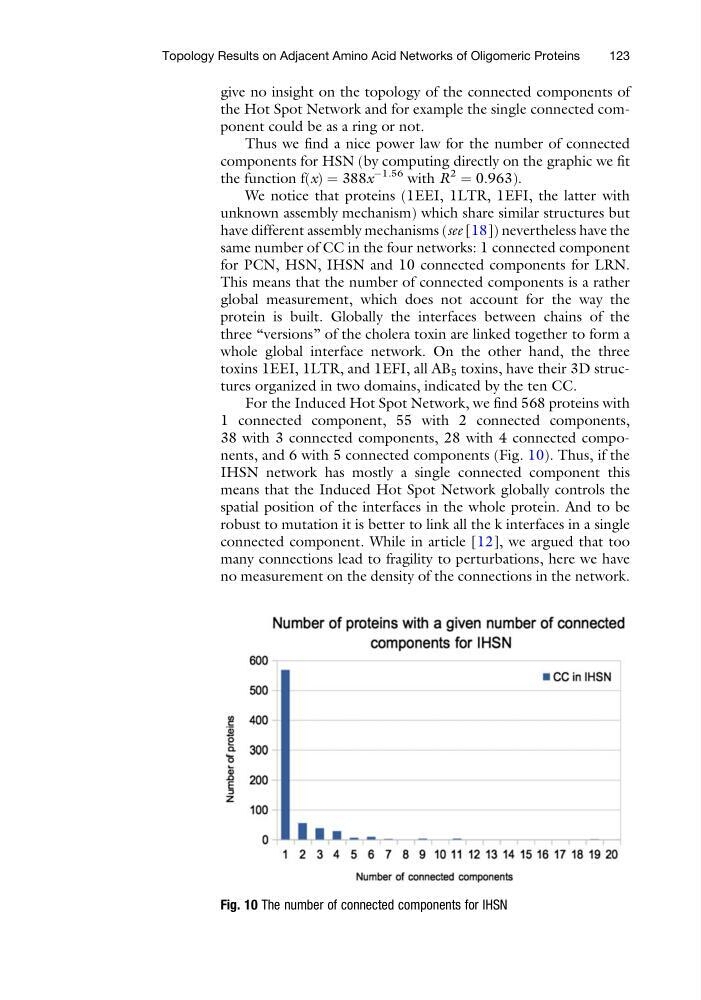
For the Induced Hot Spot Network, we find 568 proteins with
1 connected component, 55 with 2 connected components,
38 with 3 connected components, 28 with 4 connected components, and 6 with 5 connected components (Fig. 10). Thus, if the
IHSN network has mostly a single connected component this
means that the Induced Hot Spot Network globally controls the
spatial position of the interfaces in the whole protein. And to be
robust to mutation it is better to link all the k interfaces in a single
connected component. While in article [12], we argued that too
many connections lead to fragility to perturbations, here we have
no measurement on the density of the connections in the network.
Fig. 10 The number of connected components for IHSN
Topology Results on Adjacent Amino Acid Networks of Oligomeric Proteins
123
the Hot Spot Network and for example the single connected component could be as a ring or not.
Thus we find a nice power law for the number of connected
components for HSN (by computing directly on the graphic we fit
the function f(x) ¼ 388x
À1.56 with R
2
¼ 0.963).
We notice that proteins (1EEI, 1LTR, 1EFI, the latter with
unknown assembly mechanism) which share similar structures but
have different assembly mechanisms (see [18]) nevertheless have the
same number of CC in the four networks: 1 connected component
for PCN, HSN, IHSN and 10 connected components for LRN.
This means that the number of connected components is a rather
global measurement, which does not account for the way the
protein is built. Globally the interfaces between chains of the
three “versions” of the cholera toxin are linked together to form a
whole global interface network. On the other hand, the three
toxins 1EEI, 1LTR, and 1EFI, all AB 5 toxins, have their 3D structures organized in two domains, indicated by the ten CC.
For the Induced Hot Spot Network, we find 568 proteins with
1 connected component, 55 with 2 connected components,
38 with 3 connected components, 28 with 4 connected components, and 6 with 5 connected components (Fig. 10). Thus, if the
IHSN network has mostly a single connected component this
means that the Induced Hot Spot Network globally controls the
spatial position of the interfaces in the whole protein. And to be
robust to mutation it is better to link all the k interfaces in a single
connected component. While in article [12], we argued that too
many connections lead to fragility to perturbations, here we have
no measurement on the density of the connections in the network.
Fig. 10 The number of connected components for IHSN
Topology Results on Adjacent Amino Acid Networks of Oligomeric Proteins
123