

4 Recent Developments in PSNs
Early representations of protein structures as networks are usually
binary. (Edges in binary networks are either 0 or 1, treating all
edges as similar.) Though these representations capture a wealth of
information, more realistic interpretations can be made by weighing the interactions between residues in terms of their strength or
energy. This is realized by implementing weighted network
approach for studying protein structures. The construction of
weighted PSNs and its advantages are presented in detail in Subheading 4.1.
Subtle variations in pair-wise side-chain interactions will not
only lead to local changes but can also permeate to global level. In
fact, biological functions such as allosteric communication are
known to take place at distances away from perturbation sites.
Graph theoretical treatment of networks through eigen spectra is
ideally suited to capture such global changes. One of the parameters
which can get affected by subtle changes in interactions is the
grouping of residues also known as clustering of nodes. Recent
developments involve comparison of weighted PSNs and capturing
changes in residue clustering using graph spectral methods. A brief
overview of the graph spectral methods to study residue clustering
in proteins is given in Subheading 4.2.
4.1 Weighted PSNs
The weighted PSN is generated by transforming the uniquely
folded geometry of the proteins at the side-chain level to a
two-dimensional weighted matrix. The edges between two residues
in a protein can be weighed in various ways, say, interaction energy
obtained by atomistic simulations, surface complementarity, or
knowledge-based potentials, to name a few. A consolidated list of
the variety of definitions used to create weighted PSNs is outlined
in [10]. The simplest way of constructing weighted PSNs is based
on interaction energy using geometric coordinates as described in
Subheading 3. In the case study presented in Subheading 5 of this
chapter, a variation of this method in calculating interaction energy
has been used, which is shown below:
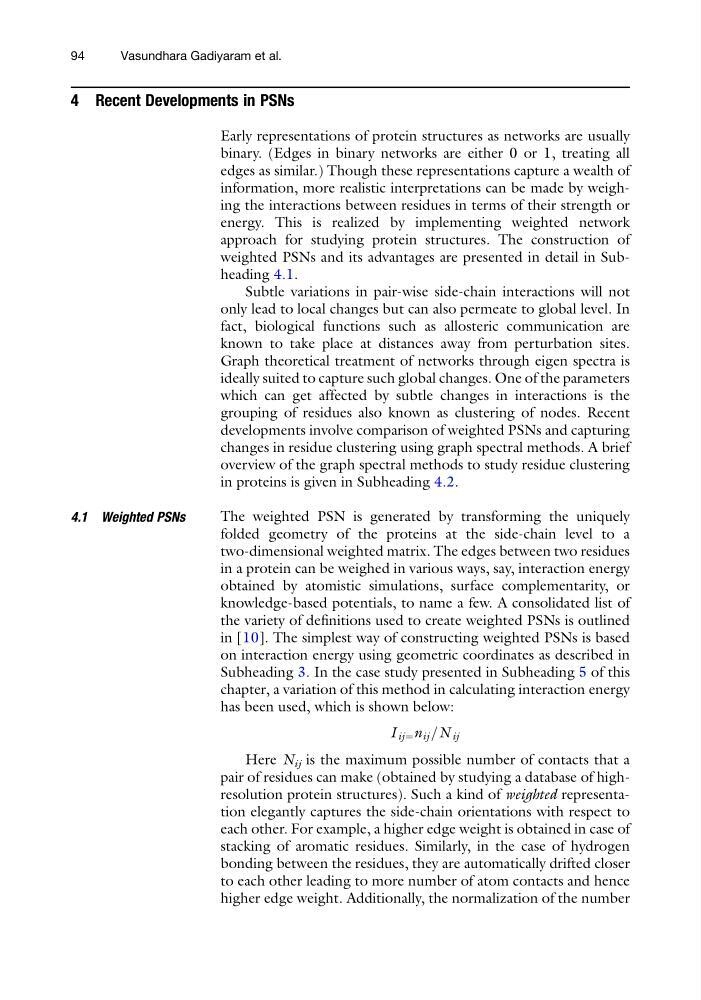
I ij ¼ n ij =N ij
Here N ij is the maximum possible number of contacts that a
pair of residues can make (obtained by studying a database of highresolution protein structures). Such a kind of weighted representation elegantly captures the side-chain orientations with respect to
each other. For example, a higher edge weight is obtained in case of
stacking of aromatic residues. Similarly, in the case of hydrogen
bonding between the residues, they are automatically drifted closer
to each other leading to more number of atom contacts and hence
higher edge weight. Additionally, the normalization of the number
94
Vasundhara Gadiyaram et al.
Early representations of protein structures as networks are usually
binary. (Edges in binary networks are either 0 or 1, treating all
edges as similar.) Though these representations capture a wealth of
information, more realistic interpretations can be made by weighing the interactions between residues in terms of their strength or
energy. This is realized by implementing weighted network
approach for studying protein structures. The construction of
weighted PSNs and its advantages are presented in detail in Subheading 4.1.
Subtle variations in pair-wise side-chain interactions will not
only lead to local changes but can also permeate to global level. In
fact, biological functions such as allosteric communication are
known to take place at distances away from perturbation sites.
Graph theoretical treatment of networks through eigen spectra is
ideally suited to capture such global changes. One of the parameters
which can get affected by subtle changes in interactions is the
grouping of residues also known as clustering of nodes. Recent
developments involve comparison of weighted PSNs and capturing
changes in residue clustering using graph spectral methods. A brief
overview of the graph spectral methods to study residue clustering
in proteins is given in Subheading 4.2.
4.1 Weighted PSNs
The weighted PSN is generated by transforming the uniquely
folded geometry of the proteins at the side-chain level to a
two-dimensional weighted matrix. The edges between two residues
in a protein can be weighed in various ways, say, interaction energy
obtained by atomistic simulations, surface complementarity, or
knowledge-based potentials, to name a few. A consolidated list of
the variety of definitions used to create weighted PSNs is outlined
in [10]. The simplest way of constructing weighted PSNs is based
on interaction energy using geometric coordinates as described in
Subheading 3. In the case study presented in Subheading 5 of this
chapter, a variation of this method in calculating interaction energy
has been used, which is shown below:
I ij ¼ n ij =N ij
Here N ij is the maximum possible number of contacts that a
pair of residues can make (obtained by studying a database of highresolution protein structures). Such a kind of weighted representation elegantly captures the side-chain orientations with respect to
each other. For example, a higher edge weight is obtained in case of
stacking of aromatic residues. Similarly, in the case of hydrogen
bonding between the residues, they are automatically drifted closer
to each other leading to more number of atom contacts and hence
higher edge weight. Additionally, the normalization of the number
94
Vasundhara Gadiyaram et al.