

or ligands [22]. Different ways of constructing PSNs are described
in detail in [10–12]. Here, a brief account of the construction of
backbone and side-chain networks is provided.
For a backbone network, C
α atom of each amino acid is considered as a node and edges are defined based on a cut-off criterion
between C
α atom distances. Two nodes are connected by an edge, if
their C
α atoms are within the distance less than the cut-off. Increase
in this cut-off value leads to more number of edges for a given node
in the network. Various cut-off values are in usage, but the most
common one is 6.5 A ˚ . The radial distribution of non-covalently
interacting C
α atom distances is maximum around this cut-off
value, representing the first shell of interaction [23, 24].
The simplest way to create an unweighted side-chain network is
to draw an edge between any two residues i and j in which at least
one pair of atoms is within 4.5 A ˚ . Several studies have adopted this
procedure. Further, binary networks can also be created, depending on a cut-off value of the interaction strength (I min ) between the
residues. If the interaction strength between two nodes is equal to
or greater than the cut-off value, an edge is placed between the
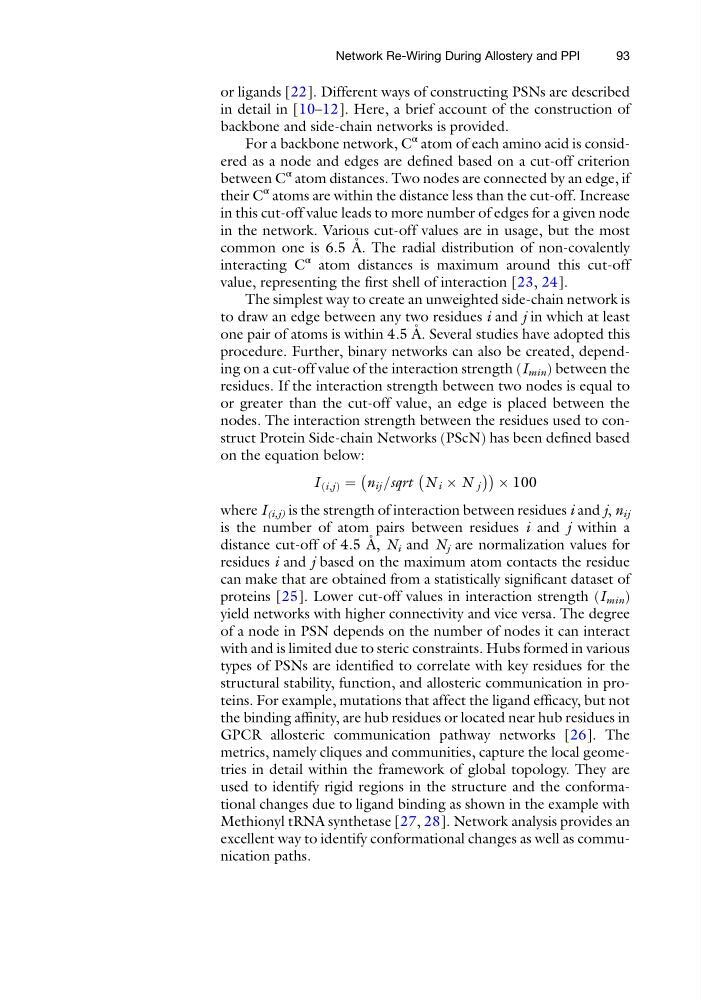
nodes. The interaction strength between the residues used to construct Protein Side-chain Networks (PScN) has been defined based
on the equation below:
I i,j
ð Þ ¼ n ij =sqrt N i  N j
À
Á
À
Á Â 100
where I (i,j) is the strength of interaction between residues i and j, n ij
is the number of atom pairs between residues i and j within a
distance cut-off of 4.5 A ˚ , N i and N j are normalization values for
residues i and j based on the maximum atom contacts the residue
can make that are obtained from a statistically significant dataset of
proteins [25]. Lower cut-off values in interaction strength (I min )
yield networks with higher connectivity and vice versa. The degree
of a node in PSN depends on the number of nodes it can interact
with and is limited due to steric constraints. Hubs formed in various
types of PSNs are identified to correlate with key residues for the
structural stability, function, and allosteric communication in proteins. For example, mutations that affect the ligand efficacy, but not
the binding affinity, are hub residues or located near hub residues in
GPCR allosteric communication pathway networks [26]. The
metrics, namely cliques and communities, capture the local geometries in detail within the framework of global topology. They are
used to identify rigid regions in the structure and the conformational changes due to ligand binding as shown in the example with
Methionyl tRNA synthetase [27, 28]. Network analysis provides an
excellent way to identify conformational changes as well as communication paths.
Network Re-Wiring During Allostery and PPI
93
in detail in [10–12]. Here, a brief account of the construction of
backbone and side-chain networks is provided.
For a backbone network, C
α atom of each amino acid is considered as a node and edges are defined based on a cut-off criterion
between C
α atom distances. Two nodes are connected by an edge, if
their C
α atoms are within the distance less than the cut-off. Increase
in this cut-off value leads to more number of edges for a given node
in the network. Various cut-off values are in usage, but the most
common one is 6.5 A ˚ . The radial distribution of non-covalently
interacting C
α atom distances is maximum around this cut-off
value, representing the first shell of interaction [23, 24].
The simplest way to create an unweighted side-chain network is
to draw an edge between any two residues i and j in which at least
one pair of atoms is within 4.5 A ˚ . Several studies have adopted this
procedure. Further, binary networks can also be created, depending on a cut-off value of the interaction strength (I min ) between the
residues. If the interaction strength between two nodes is equal to
or greater than the cut-off value, an edge is placed between the
nodes. The interaction strength between the residues used to construct Protein Side-chain Networks (PScN) has been defined based
on the equation below:
I i,j
ð Þ ¼ n ij =sqrt N i  N j
À
Á
À
Á Â 100
where I (i,j) is the strength of interaction between residues i and j, n ij
is the number of atom pairs between residues i and j within a
distance cut-off of 4.5 A ˚ , N i and N j are normalization values for
residues i and j based on the maximum atom contacts the residue
can make that are obtained from a statistically significant dataset of
proteins [25]. Lower cut-off values in interaction strength (I min )
yield networks with higher connectivity and vice versa. The degree
of a node in PSN depends on the number of nodes it can interact
with and is limited due to steric constraints. Hubs formed in various
types of PSNs are identified to correlate with key residues for the
structural stability, function, and allosteric communication in proteins. For example, mutations that affect the ligand efficacy, but not
the binding affinity, are hub residues or located near hub residues in
GPCR allosteric communication pathway networks [26]. The
metrics, namely cliques and communities, capture the local geometries in detail within the framework of global topology. They are
used to identify rigid regions in the structure and the conformational changes due to ligand binding as shown in the example with
Methionyl tRNA synthetase [27, 28]. Network analysis provides an
excellent way to identify conformational changes as well as communication paths.
Network Re-Wiring During Allostery and PPI
93