

225
9
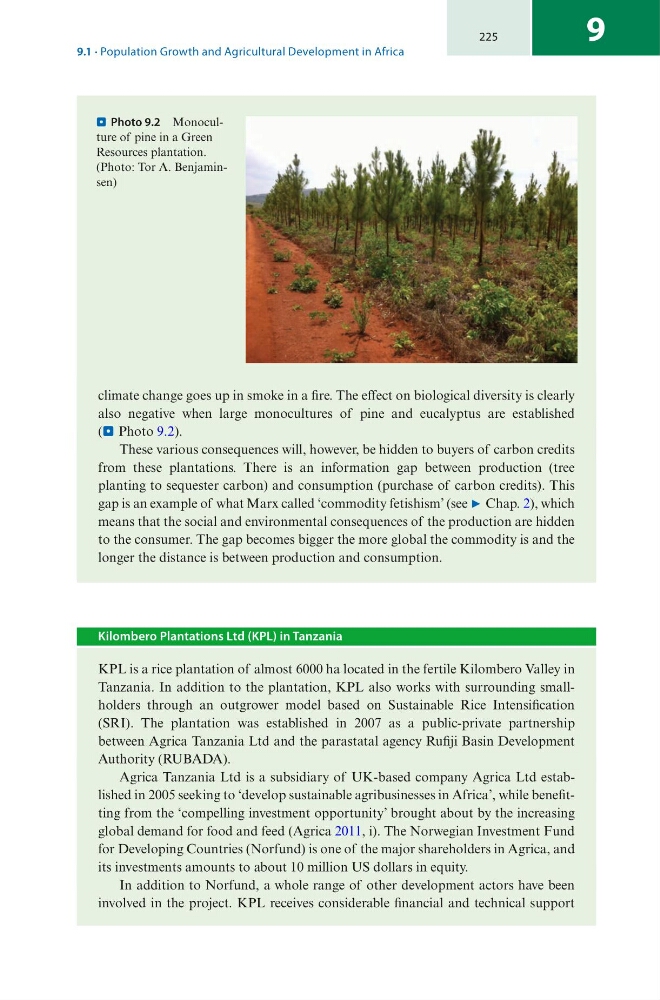
climate change goes up in smoke in a fire. The effect on biological diversity is clearly
also negative when large monocultures of pine and eucalyptus are established
(. Photo 9.2).
These various consequences will, however, be hidden to buyers of carbon credits
from these plantations. There is an information gap between production (tree
planting to sequester carbon) and consumption (purchase of carbon credits). This
gap is an example of what Marx called ‘commodity fetishism’ (see 7 Chap. 2), which
means that the social and environmental consequences of the production are hidden
to the consumer. The gap becomes bigger the more global the commodity is and the
longer the distance is between production and consumption.
. Photo 9.2 Monoculture of pine in a Green
Resources plantation.
(Photo: Tor A. Benjaminsen)
Kilombero Plantations Ltd (KPL) in Tanzania
KPL is a rice plantation of almost 6000 ha located in the fertile Kilombero Valley in
Tanzania. In addition to the plantation, KPL also works with surrounding smallholders through an outgrower model based on Sustainable Rice Intensification
(SRI). The plantation was established in 2007 as a public-private partnership
between Agrica Tanzania Ltd and the parastatal agency Rufiji Basin Development
Authority (RUBADA).
Agrica Tanzania Ltd is a subsidiary of UK-based company Agrica Ltd established in 2005 seeking to ‘develop sustainable agribusinesses in Africa’, while benefitting from the ‘compelling investment opportunity’ brought about by the increasing
global demand for food and feed (Agrica 2011, i). The Norwegian Investment Fund
for Developing Countries (Norfund) is one of the major shareholders in Agrica, and
its investments amounts to about 10 million US dollars in equity.
In addition to Norfund, a whole range of other development actors have been
involved in the project. KPL receives considerable financial and technical support
9.1 · Population Growth and Agricultural Development in Africa
9
climate change goes up in smoke in a fire. The effect on biological diversity is clearly
also negative when large monocultures of pine and eucalyptus are established
(. Photo 9.2).
These various consequences will, however, be hidden to buyers of carbon credits
from these plantations. There is an information gap between production (tree
planting to sequester carbon) and consumption (purchase of carbon credits). This
gap is an example of what Marx called ‘commodity fetishism’ (see 7 Chap. 2), which
means that the social and environmental consequences of the production are hidden
to the consumer. The gap becomes bigger the more global the commodity is and the
longer the distance is between production and consumption.
. Photo 9.2 Monoculture of pine in a Green
Resources plantation.
(Photo: Tor A. Benjaminsen)
Kilombero Plantations Ltd (KPL) in Tanzania
KPL is a rice plantation of almost 6000 ha located in the fertile Kilombero Valley in
Tanzania. In addition to the plantation, KPL also works with surrounding smallholders through an outgrower model based on Sustainable Rice Intensification
(SRI). The plantation was established in 2007 as a public-private partnership
between Agrica Tanzania Ltd and the parastatal agency Rufiji Basin Development
Authority (RUBADA).
Agrica Tanzania Ltd is a subsidiary of UK-based company Agrica Ltd established in 2005 seeking to ‘develop sustainable agribusinesses in Africa’, while benefitting from the ‘compelling investment opportunity’ brought about by the increasing
global demand for food and feed (Agrica 2011, i). The Norwegian Investment Fund
for Developing Countries (Norfund) is one of the major shareholders in Agrica, and
its investments amounts to about 10 million US dollars in equity.
In addition to Norfund, a whole range of other development actors have been
involved in the project. KPL receives considerable financial and technical support
9.1 · Population Growth and Agricultural Development in Africa