

193
8
other hand, were defined as unused land with no recognized use rights (Benjaminsen
and Berge 2004).
For administrative and environmental reasons, the French colonial power drew
lines within districts, so that each pastoral group and village was given its own territory where it was required to stay. The French drew up territorial boundaries so that
pastoralists were excluded from key resources, with the main goal being to weaken
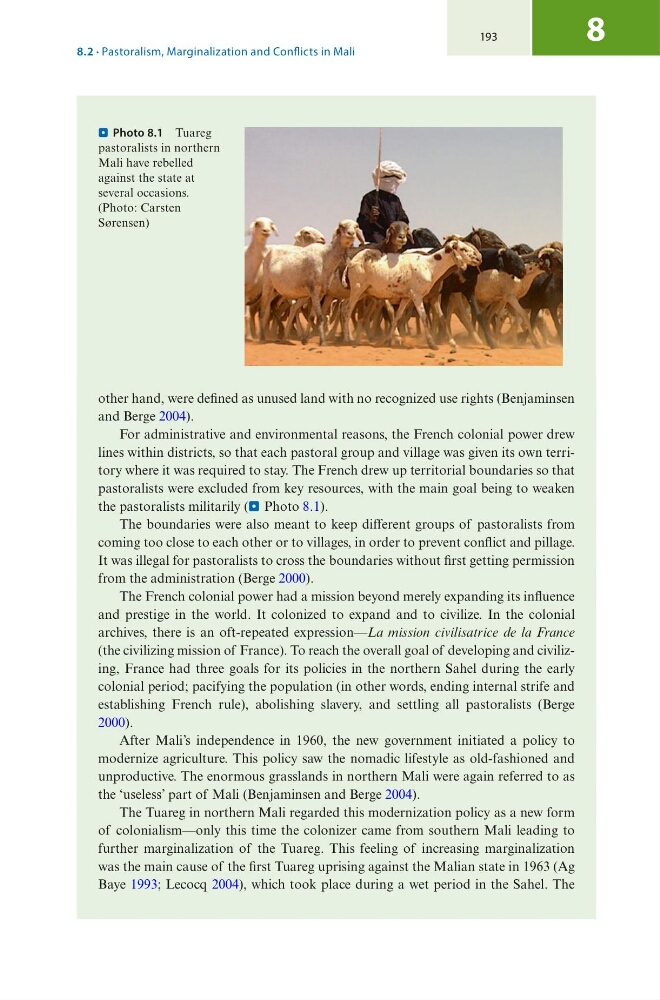
the pastoralists militarily (. Photo 8.1).
The boundaries were also meant to keep different groups of pastoralists from
coming too close to each other or to villages, in order to prevent conflict and pillage.
It was illegal for pastoralists to cross the boundaries without first getting permission
from the administration (Berge 2000).
The French colonial power had a mission beyond merely expanding its influence
and prestige in the world. It colonized to expand and to civilize. In the colonial
archives, there is an oft-repeated expression—La mission civilisatrice de la France
(the civilizing mission of France). To reach the overall goal of developing and civilizing, France had three goals for its policies in the northern Sahel during the early
colonial period; pacifying the population (in other words, ending internal strife and
establishing French rule), abolishing slavery, and settling all pastoralists (Berge
2000).
After Mali’s independence in 1960, the new government initiated a policy to
modernize agriculture. This policy saw the nomadic lifestyle as old-fashioned and
unproductive. The enormous grasslands in northern Mali were again referred to as
the ‘useless’ part of Mali (Benjaminsen and Berge 2004).
The Tuareg in northern Mali regarded this modernization policy as a new form
of colonialism—only this time the colonizer came from southern Mali leading to
further marginalization of the Tuareg. This feeling of increasing marginalization
was the main cause of the first Tuareg uprising against the Malian state in 1963 (Ag
Baye 1993; Lecocq 2004), which took place during a wet period in the Sahel. The
. Photo 8.1 Tuareg
pastoralists in northern
Mali have rebelled
against the state at
several occasions.
(Photo: Carsten
Sørensen)
8.2 · Pastoralism, Marginalization and Conflicts in Mali
8
other hand, were defined as unused land with no recognized use rights (Benjaminsen
and Berge 2004).
For administrative and environmental reasons, the French colonial power drew
lines within districts, so that each pastoral group and village was given its own territory where it was required to stay. The French drew up territorial boundaries so that
pastoralists were excluded from key resources, with the main goal being to weaken
the pastoralists militarily (. Photo 8.1).
The boundaries were also meant to keep different groups of pastoralists from
coming too close to each other or to villages, in order to prevent conflict and pillage.
It was illegal for pastoralists to cross the boundaries without first getting permission
from the administration (Berge 2000).
The French colonial power had a mission beyond merely expanding its influence
and prestige in the world. It colonized to expand and to civilize. In the colonial
archives, there is an oft-repeated expression—La mission civilisatrice de la France
(the civilizing mission of France). To reach the overall goal of developing and civilizing, France had three goals for its policies in the northern Sahel during the early
colonial period; pacifying the population (in other words, ending internal strife and
establishing French rule), abolishing slavery, and settling all pastoralists (Berge
2000).
After Mali’s independence in 1960, the new government initiated a policy to
modernize agriculture. This policy saw the nomadic lifestyle as old-fashioned and
unproductive. The enormous grasslands in northern Mali were again referred to as
the ‘useless’ part of Mali (Benjaminsen and Berge 2004).
The Tuareg in northern Mali regarded this modernization policy as a new form
of colonialism—only this time the colonizer came from southern Mali leading to
further marginalization of the Tuareg. This feeling of increasing marginalization
was the main cause of the first Tuareg uprising against the Malian state in 1963 (Ag
Baye 1993; Lecocq 2004), which took place during a wet period in the Sahel. The
. Photo 8.1 Tuareg
pastoralists in northern
Mali have rebelled
against the state at
several occasions.
(Photo: Carsten
Sørensen)
8.2 · Pastoralism, Marginalization and Conflicts in Mali