

192
8
Tuareg Rebellions in Northern Mali
Tuareg in the Sahel first rebelled against the French colonial invasion from the 1880s
until there was a peace treaty in 1916. The French colonial administrator Clauzel,
who worked in northern Mali from 1946 until the time of Mali’s independence in
1960, wrote a book about his experiences as a colonial official (Clauzel 1989). He
argued that the cultural farm heritage of the French resulted in a view of the settled
farmer as more productive and connected to the French cause than migrating pastoralists. The French felt that it was especially important to settle pastoralists, not only
for purposes of control or ecological considerations, but more generally to promote
development.
This imperative was clearly expressed in the Forest Act of 1935. The law introduced two separate types of land: ‘land where value has been added’ and ‘empty’ or
‘unused’ land. Cultivated land was included in the first category, and farmers were
given rights to use cultivated land and fallow land that had been used less than
5 years previously. Areas with rich agricultural production in southern Mali were
described as ‘the useful districts’ by the French. Grazing land and forests, on the
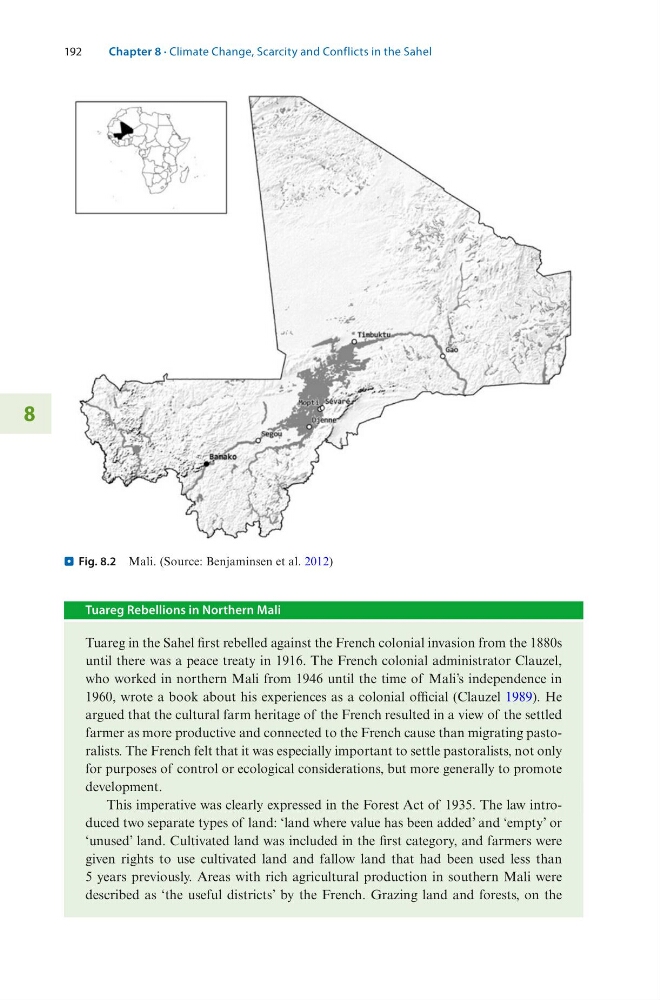
. Fig. 8.2 Mali. (Source: Benjaminsen et al. 2012)
Chapter 8 · Climate Change, Scarcity and Conflicts in the Sahel
8
Tuareg Rebellions in Northern Mali
Tuareg in the Sahel first rebelled against the French colonial invasion from the 1880s
until there was a peace treaty in 1916. The French colonial administrator Clauzel,
who worked in northern Mali from 1946 until the time of Mali’s independence in
1960, wrote a book about his experiences as a colonial official (Clauzel 1989). He
argued that the cultural farm heritage of the French resulted in a view of the settled
farmer as more productive and connected to the French cause than migrating pastoralists. The French felt that it was especially important to settle pastoralists, not only
for purposes of control or ecological considerations, but more generally to promote
development.
This imperative was clearly expressed in the Forest Act of 1935. The law introduced two separate types of land: ‘land where value has been added’ and ‘empty’ or
‘unused’ land. Cultivated land was included in the first category, and farmers were
given rights to use cultivated land and fallow land that had been used less than
5 years previously. Areas with rich agricultural production in southern Mali were
described as ‘the useful districts’ by the French. Grazing land and forests, on the
. Fig. 8.2 Mali. (Source: Benjaminsen et al. 2012)
Chapter 8 · Climate Change, Scarcity and Conflicts in the Sahel