

49
leveraged to capture changes in plant “greenness” based on the ratio of red absorption in leaves (signal of pigmentation levels and change) to near-infrared reflectance
(tied to internal cellular structure and water content) to monitor changes in plant
vigor and change (e.g., Tucker et al. 2001; Zhou et al. 2001; Goetz et al. 2005;
Goetz et al. 2006). With the advent of focused Earth-observing (EO) sensors, such
as the Landsat constellation, the science and use of optical RS observations for
monitoring plant properties and functioning increased substantially (e.g., Chen and
Cihlar 1996; Turner et al. 1999; Townsend 2002; Jones et al. 2007; Sonnentag et al.
2007; Drolet et al. 2008; Foster et al. 2008; Peckham et al. 2008; Yilmaz et al. 2008).
Since the earliest uses, optical RS observations from the leaf to suborbital to satellite EO platforms have been heavily leveraged in the plant sciences, RS, and biodiversity communities (e.g., Jacquemoud et al. 1995; Roberts et al. 2004; Ustin et al.
2004; Gitelson et al. 2006; Hilker et al. 2008; Pettorelli et al. 2016; Cavender-Bares
et al. 2017).
Fig. 3.2 The internal structure and biochemistry of leaves within a canopy control the optical
signatures observed by remote sensing instrumentation. The amount of incident radiation that is
reflected by, transmitted through, or absorbed by leaves within a canopy is regulated by these
structural and biochemical properties of leaves. For example, leaf properties such as a thick cuticle
layer, high wax, and/or a large amount of leaf hairs can significantly influence the amount of firstsurface reflectance (that is the reflected light directly off the outer leaf layer that does not interact
with the leaf interior), causing less solar radiation to penetrate into the leaf. The thickness of the
mesophyll layer associated with other properties, such as thicker leaves, can cause higher degree
of internal leaf scattering, less transmittance through the leaf, and higher absorption in some wavelengths. Importantly, the diffuse reflectance out of the leaf is that modified by internal leaf properties and contains useful for mapping functional traits
3 Scaling Functional Traits from Leaves to Canopies
leveraged to capture changes in plant “greenness” based on the ratio of red absorption in leaves (signal of pigmentation levels and change) to near-infrared reflectance
(tied to internal cellular structure and water content) to monitor changes in plant
vigor and change (e.g., Tucker et al. 2001; Zhou et al. 2001; Goetz et al. 2005;
Goetz et al. 2006). With the advent of focused Earth-observing (EO) sensors, such
as the Landsat constellation, the science and use of optical RS observations for
monitoring plant properties and functioning increased substantially (e.g., Chen and
Cihlar 1996; Turner et al. 1999; Townsend 2002; Jones et al. 2007; Sonnentag et al.
2007; Drolet et al. 2008; Foster et al. 2008; Peckham et al. 2008; Yilmaz et al. 2008).
Since the earliest uses, optical RS observations from the leaf to suborbital to satellite EO platforms have been heavily leveraged in the plant sciences, RS, and biodiversity communities (e.g., Jacquemoud et al. 1995; Roberts et al. 2004; Ustin et al.
2004; Gitelson et al. 2006; Hilker et al. 2008; Pettorelli et al. 2016; Cavender-Bares
et al. 2017).
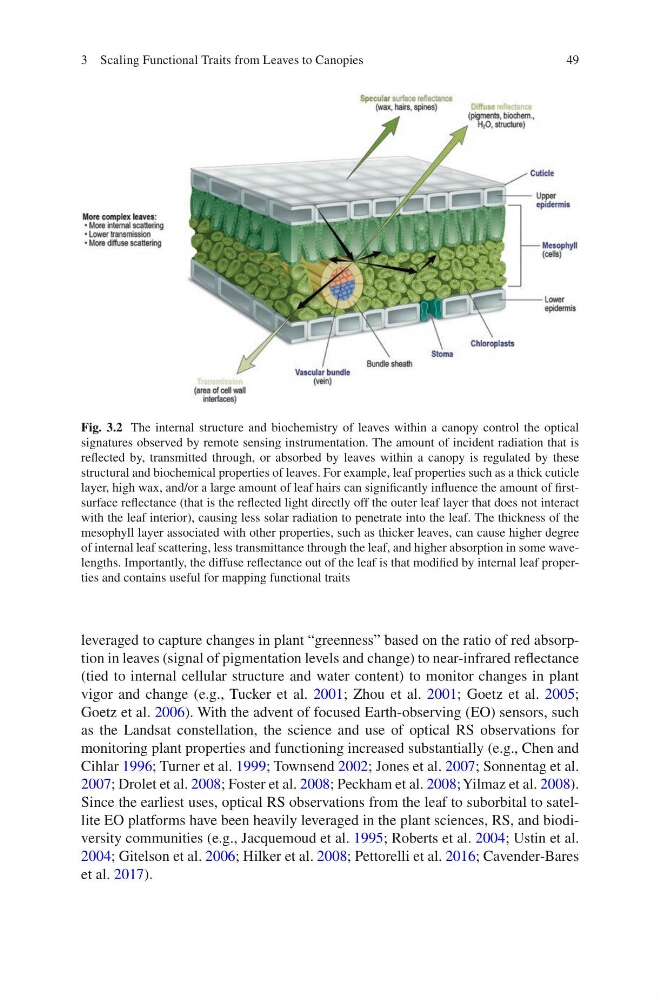
Fig. 3.2 The internal structure and biochemistry of leaves within a canopy control the optical
signatures observed by remote sensing instrumentation. The amount of incident radiation that is
reflected by, transmitted through, or absorbed by leaves within a canopy is regulated by these
structural and biochemical properties of leaves. For example, leaf properties such as a thick cuticle
layer, high wax, and/or a large amount of leaf hairs can significantly influence the amount of firstsurface reflectance (that is the reflected light directly off the outer leaf layer that does not interact
with the leaf interior), causing less solar radiation to penetrate into the leaf. The thickness of the
mesophyll layer associated with other properties, such as thicker leaves, can cause higher degree
of internal leaf scattering, less transmittance through the leaf, and higher absorption in some wavelengths. Importantly, the diffuse reflectance out of the leaf is that modified by internal leaf properties and contains useful for mapping functional traits
3 Scaling Functional Traits from Leaves to Canopies