

50
3.1.3 Remote Sensing as a Tool for Scaling and Mapping
Plant Traits
The use of leaf-level spectroscopy to understand plant functioning via biochemistry
dates to the early twentieth century with papers describing light absorption and
reflectance (Shull 1929; McNicholas 1931; Rabideau et al. 1946; Clark 1946;
Krinov 1953). Billings and Morris (1951) made a direct linkage to differing ecological
strategies of plants, in particular demonstrating that visible and near-infrared reflectance of species growing in different environments is directly linked to strategies
associated with thermoregulation. Similarly, Gates et al. (1965) connected the interaction of light with leaves to internal leaf pigments and leaf structure (Fig. 3.2.) and
how this relates to larger ecological processes.
By the 1970s, work with spectrophotometers at the US Department of Agriculture
(USDA) led to the use of spectral methods for constituent characterization—nearinfrared spectroscopy (NIRS) to predict moisture, protein, fat, and carbohydrate
content of feed (Norris and Hart 1965; Norris et al. 1976; Shenk et al. 1981; Davies
1998; Workman and Weyer 2012), generally using linear regression on dry samples.
In the 1980s and 1990s, field and laboratory studies used these earlier spectrometer
systems to develop relationships and approaches to link leaf optical properties
and underlying biochemical and structural properties, including variations in leaf
moisture condition (Hunt and Rock 1989). For example, Elvidge (1990) utilized
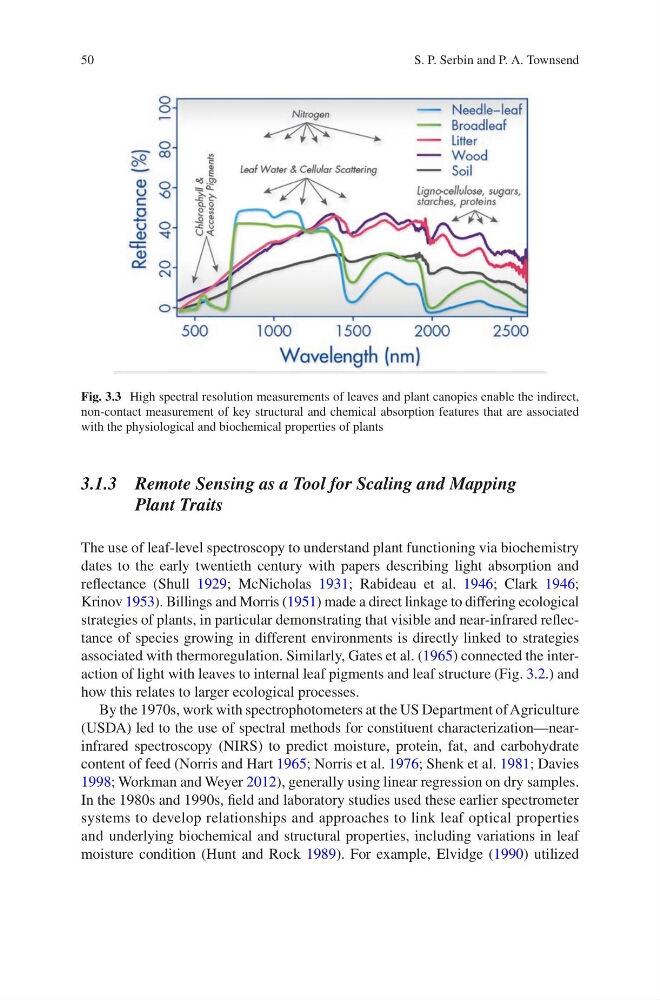
Fig. 3.3 High spectral resolution measurements of leaves and plant canopies enable the indirect,
non-contact measurement of key structural and chemical absorption features that are associated
with the physiological and biochemical properties of plants
S. P. Serbin and P. A. Townsend
3.1.3 Remote Sensing as a Tool for Scaling and Mapping
Plant Traits
The use of leaf-level spectroscopy to understand plant functioning via biochemistry
dates to the early twentieth century with papers describing light absorption and
reflectance (Shull 1929; McNicholas 1931; Rabideau et al. 1946; Clark 1946;
Krinov 1953). Billings and Morris (1951) made a direct linkage to differing ecological
strategies of plants, in particular demonstrating that visible and near-infrared reflectance of species growing in different environments is directly linked to strategies
associated with thermoregulation. Similarly, Gates et al. (1965) connected the interaction of light with leaves to internal leaf pigments and leaf structure (Fig. 3.2.) and
how this relates to larger ecological processes.
By the 1970s, work with spectrophotometers at the US Department of Agriculture
(USDA) led to the use of spectral methods for constituent characterization—nearinfrared spectroscopy (NIRS) to predict moisture, protein, fat, and carbohydrate
content of feed (Norris and Hart 1965; Norris et al. 1976; Shenk et al. 1981; Davies
1998; Workman and Weyer 2012), generally using linear regression on dry samples.
In the 1980s and 1990s, field and laboratory studies used these earlier spectrometer
systems to develop relationships and approaches to link leaf optical properties
and underlying biochemical and structural properties, including variations in leaf
moisture condition (Hunt and Rock 1989). For example, Elvidge (1990) utilized
Fig. 3.3 High spectral resolution measurements of leaves and plant canopies enable the indirect,
non-contact measurement of key structural and chemical absorption features that are associated
with the physiological and biochemical properties of plants
S. P. Serbin and P. A. Townsend