

367
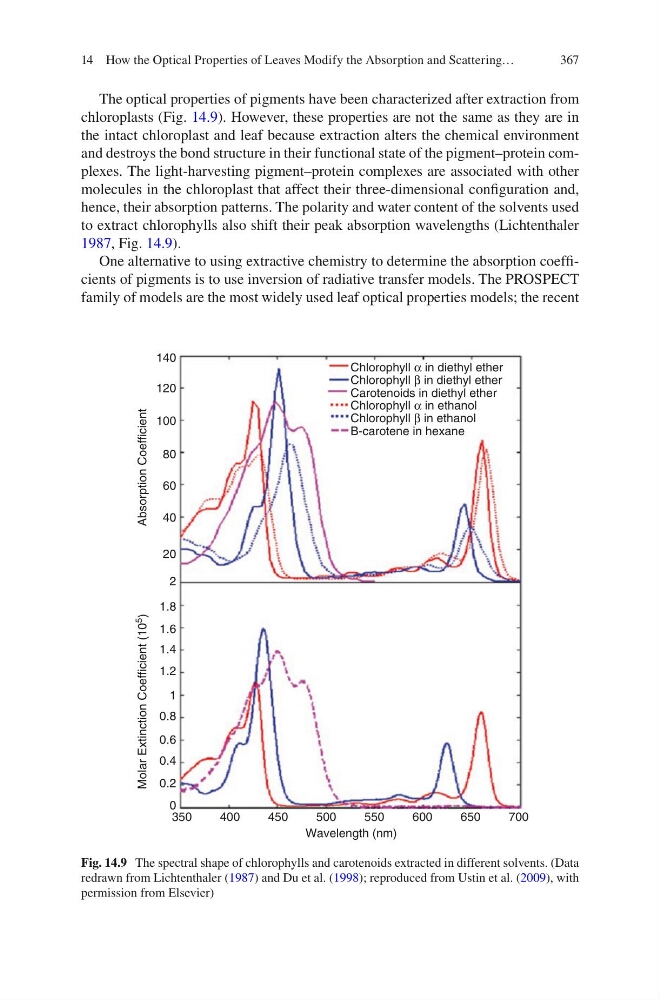
The optical properties of pigments have been characterized after extraction from
chloroplasts (Fig. 14.9). However, these properties are not the same as they are in
the intact chloroplast and leaf because extraction alters the chemical environment
and destroys the bond structure in their functional state of the pigment–protein complexes. The light-harvesting pigment–protein complexes are associated with other
molecules in the chloroplast that affect their three-dimensional configuration and,
hence, their absorption patterns. The polarity and water content of the solvents used
to extract chlorophylls also shift their peak absorption wavelengths (Lichtenthaler
1987, Fig. 14.9).
One alternative to using extractive chemistry to determine the absorption coefficients of pigments is to use inversion of radiative transfer models. The PROSPECT
family of models are the most widely used leaf optical properties models; the recent
0
350
400
450
500
Wavelength (nm)
550
600
650
700
0.2
0.4
0.6
0.8
1
1.2
1.4
1.6
1.8
2
20
40
60
80
Absorption Coefficient
Molar Extinction Coefficient (10
5
)
100
120
140
Chlorophyll α in diethyl ether
Chlorophyll β in diethyl ether
Carotenoids in diethyl ether
Chlorophyll β in ethanol
Chlorophyll α in ethanol
B-carotene in hexane
Fig. 14.9 The spectral shape of chlorophylls and carotenoids extracted in different solvents. (Data
redrawn from Lichtenthaler (1987) and Du et al. (1998); reproduced from Ustin et al. (2009), with
permission from Elsevier)
14 How the Optical Properties of Leaves Modify the Absorption and Scattering…
The optical properties of pigments have been characterized after extraction from
chloroplasts (Fig. 14.9). However, these properties are not the same as they are in
the intact chloroplast and leaf because extraction alters the chemical environment
and destroys the bond structure in their functional state of the pigment–protein complexes. The light-harvesting pigment–protein complexes are associated with other
molecules in the chloroplast that affect their three-dimensional configuration and,
hence, their absorption patterns. The polarity and water content of the solvents used
to extract chlorophylls also shift their peak absorption wavelengths (Lichtenthaler
1987, Fig. 14.9).
One alternative to using extractive chemistry to determine the absorption coefficients of pigments is to use inversion of radiative transfer models. The PROSPECT
family of models are the most widely used leaf optical properties models; the recent
0
350
400
450
500
Wavelength (nm)
550
600
650
700
0.2
0.4
0.6
0.8
1
1.2
1.4
1.6
1.8
2
20
40
60
80
Absorption Coefficient
Molar Extinction Coefficient (10
5
)
100
120
140
Chlorophyll α in diethyl ether
Chlorophyll β in diethyl ether
Carotenoids in diethyl ether
Chlorophyll β in ethanol
Chlorophyll α in ethanol
B-carotene in hexane
Fig. 14.9 The spectral shape of chlorophylls and carotenoids extracted in different solvents. (Data
redrawn from Lichtenthaler (1987) and Du et al. (1998); reproduced from Ustin et al. (2009), with
permission from Elsevier)
14 How the Optical Properties of Leaves Modify the Absorption and Scattering…