

366
to rapidly characterize phenotypic variability in relation to desired crop attributes
like resistance to disease or other stressors while retaining high growth potential
(Bai et al. 2016; Tanger et al. 2017). Such combined methods would provide better
resolution of biodiversity in natural systems than use of a single instrument data type.
14.8.4 Photosynthetic Pigments
Light absorption by pigments in the chloroplast produces a unique absorption pattern in the visible spectrum, with higher absorption in the blue and red wavelengths
than in the green wavelengths. All higher plants have chlorophyll a and b in their
photosynthetic tissues. Absorption features in the visible to NIR part of the spectrum are predominantly caused by excitation of electrons in a process call electronic
transitions, in contrast with bending and stretching of molecules in the infrared bands.
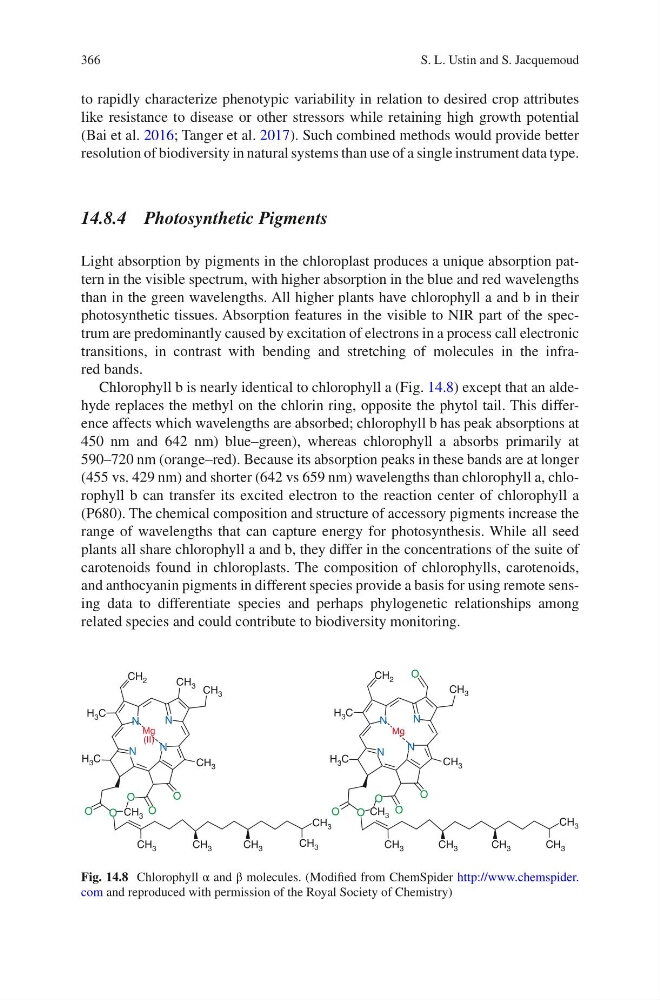
Chlorophyll b is nearly identical to chlorophyll a (Fig. 14.8) except that an aldehyde replaces the methyl on the chlorin ring, opposite the phytol tail. This difference affects which wavelengths are absorbed; chlorophyll b has peak absorptions at
450 nm and 642 nm) blue–green), whereas chlorophyll a absorbs primarily at
590–720 nm (orange–red). Because its absorption peaks in these bands are at longer
(455 vs. 429 nm) and shorter (642 vs 659 nm) wavelengths than chlorophyll a, chlorophyll b can transfer its excited electron to the reaction center of chlorophyll a
(P680). The chemical composition and structure of accessory pigments increase the
range of wavelengths that can capture energy for photosynthesis. While all seed
plants all share chlorophyll a and b, they differ in the concentrations of the suite of
carotenoids found in chloroplasts. The composition of chlorophylls, carotenoids,
and anthocyanin pigments in different species provide a basis for using remote sensing data to differentiate species and perhaps phylogenetic relationships among
related species and could contribute to biodiversity monitoring.
CH 2
CH 3
CH 3
CH 3
CH 3
CH 3
CH 3
CH 3
CH 3
CH 3
CH 3
CH 3
CH 3
CH 3
O
O
O
O
O
O
O
N
N
N
N
N
N
N
N
Mg
(II)
Mg
O
O
O
O
H 3 C
H 3 C
H 3 C
H 3 C
CH 3
CH 2
CH 3
CH 3
CH 3
Fig. 14.8 Chlorophyll α and β molecules. (Modified from ChemSpider http://www.chemspider.
com and reproduced with permission of the Royal Society of Chemistry)
S. L. Ustin and S. Jacquemoud
to rapidly characterize phenotypic variability in relation to desired crop attributes
like resistance to disease or other stressors while retaining high growth potential
(Bai et al. 2016; Tanger et al. 2017). Such combined methods would provide better
resolution of biodiversity in natural systems than use of a single instrument data type.
14.8.4 Photosynthetic Pigments
Light absorption by pigments in the chloroplast produces a unique absorption pattern in the visible spectrum, with higher absorption in the blue and red wavelengths
than in the green wavelengths. All higher plants have chlorophyll a and b in their
photosynthetic tissues. Absorption features in the visible to NIR part of the spectrum are predominantly caused by excitation of electrons in a process call electronic
transitions, in contrast with bending and stretching of molecules in the infrared bands.
Chlorophyll b is nearly identical to chlorophyll a (Fig. 14.8) except that an aldehyde replaces the methyl on the chlorin ring, opposite the phytol tail. This difference affects which wavelengths are absorbed; chlorophyll b has peak absorptions at
450 nm and 642 nm) blue–green), whereas chlorophyll a absorbs primarily at
590–720 nm (orange–red). Because its absorption peaks in these bands are at longer
(455 vs. 429 nm) and shorter (642 vs 659 nm) wavelengths than chlorophyll a, chlorophyll b can transfer its excited electron to the reaction center of chlorophyll a
(P680). The chemical composition and structure of accessory pigments increase the
range of wavelengths that can capture energy for photosynthesis. While all seed
plants all share chlorophyll a and b, they differ in the concentrations of the suite of
carotenoids found in chloroplasts. The composition of chlorophylls, carotenoids,
and anthocyanin pigments in different species provide a basis for using remote sensing data to differentiate species and perhaps phylogenetic relationships among
related species and could contribute to biodiversity monitoring.
CH 2
CH 3
CH 3
CH 3
CH 3
CH 3
CH 3
CH 3
CH 3
CH 3
CH 3
CH 3
CH 3
CH 3
O
O
O
O
O
O
O
N
N
N
N
N
N
N
N
Mg
(II)
Mg
O
O
O
O
H 3 C
H 3 C
H 3 C
H 3 C
CH 3
CH 2
CH 3
CH 3
CH 3
Fig. 14.8 Chlorophyll α and β molecules. (Modified from ChemSpider http://www.chemspider.
com and reproduced with permission of the Royal Society of Chemistry)
S. L. Ustin and S. Jacquemoud